QUESTION IMAGE
Question
as you like it
by william shakespeare
act iii, scene 2
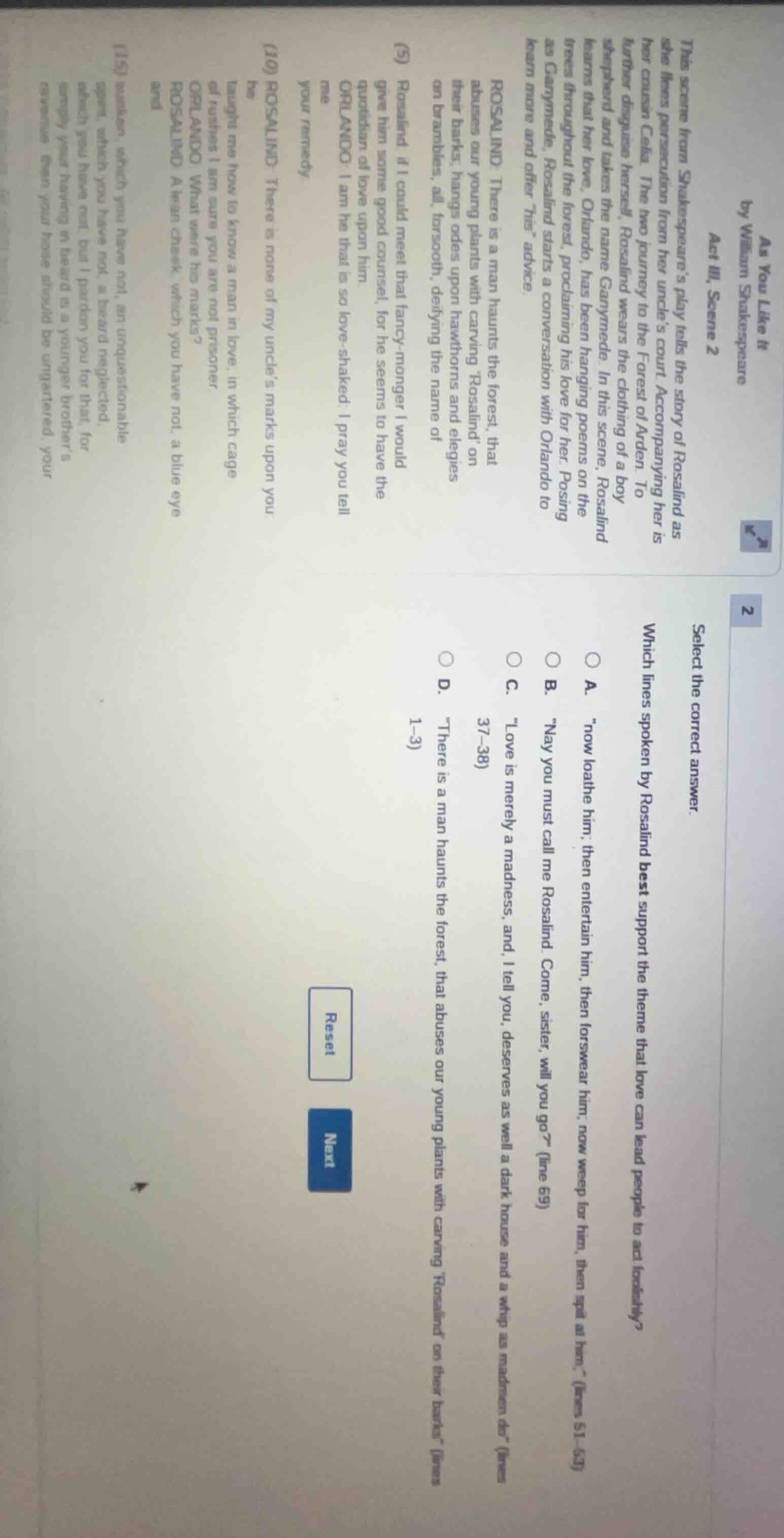
this scene from shakespeare’s play tells the story of rosalind and she flees persecution from her uncle’s court. accompanying her is her cousin celia. the two journey to the forest of arden. to further disguise herself, rosalind wears the clothing of a boy shepherd and takes the name ganymede. in this scene, rosalind learns that her love, orlando, has been hanging poems on the trees throughout the forest, proclaiming his love for her. posing as ganymede, rosalind starts a conversation with orlando to learn more and offer “his” advice.
rosalind. there is a man haunts the forest, that abuses our young plants with carving “rosalind” on their barks; hangs odes upon hawthorns and elegies on brambles, all, forsooth, defying the name of
rosalind. if i could meet that fancy - monger i would give him some good counsel, for he seems to have the quotation of love upon him.
orlando. i am he that is so love - shaked. i pray you tell me your remedy
(10) rosalind. there is none of my uncle’s marks upon you: he taught me how to know a man in love, in which cage of rushes i am sure you are not prisoner.
orlando. what were his marks?
rosalind. a wan cheek, which you have not, a blue eye and
(15) a maiden, which you have not, an unquestionable spirit, which you have not, a beard neglected, which you have not, but i pardon you for simply your having in beard a younger brother’s trespass: then your hose should be unlettered, your
select the correct answer.
which lines spoken by rosalind best support the theme that love can lead people to act foolishly?
a. “now loathe him; then entertain him, then forswear him, now weep for him, then spit at him.” (lines 51 - 53)
b. “nay you must call me rosalind. come, sister, will you go?” (line 69)
c. “love is merely a madness, and, i tell you, deserves as well a dark house and a whip as madness do.” (lines 37 - 38)
d. “there is a man haunts the forest, that abuses our young plants with carving “rosalind” on their barks” (lines 1 - 3)
To determine which lines support the theme that love can lead to foolishness, we analyze each option:
- Option A: The line describes changing emotions (loathe, entertain, forswear, weep, spit) towards someone, showing irrational and foolish behavior driven by love's fluctuations.
- Option B: This is a request to be called by a name and an invitation, not related to love - induced foolishness.
- Option C: Compares love to madness but focuses on punishment for madness, not the foolish acts love causes.
- Option D: Describes a man carving a name on plants, which is more about obsession or romantic gesture rather than foolishness from love.
So Option A best supports the theme.

Snap & solve any problem in the app
Get step-by-step solutions on Sovi AI
Photo-based solutions with guided steps
Explore more problems and detailed explanations
A. "now loathe him; then entertain him, then forswear him, now weep for him, then spit at him." (lines 51 - 53)