QUESTION IMAGE
Question
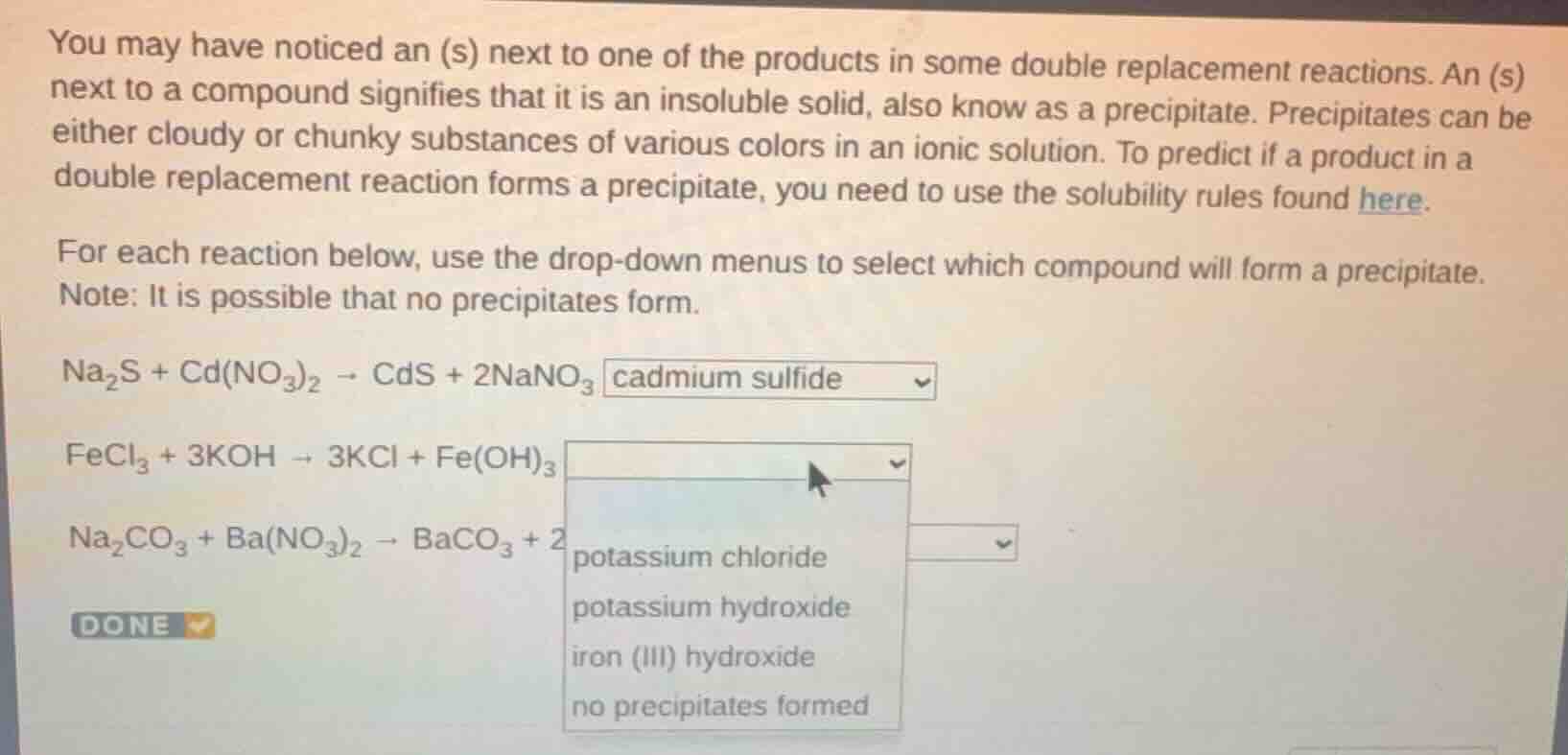
you may have noticed an (s) next to one of the products in some double replacement reactions. an (s) next to a compound signifies that it is an insoluble solid, also know as a precipitate. precipitates can be either cloudy or chunky substances of various colors in an ionic solution. to predict if a product in a double replacement reaction forms a precipitate, you need to use the solubility rules found here. for each reaction below, use the drop - down menus to select which compound will form a precipitate. note: it is possible that no precipitates form. na₂s + cd(no₃)₂ → cds + 2nano₃ cadmium sulfide fecl₃ + 3koh → 3kcl + fe(oh)₃ potassium chloride potassium hydroxide iron (iii) hydroxide no precipitates formed na₂co₃ + ba(no₃)₂ → baco₃ + 2
Step1: Recall solubility rules for hydroxides
Hydroxides of most transition metals (like Fe³⁺) are insoluble. Potassium compounds (KCl, KOH) are soluble (group 1 metal salts are soluble).
Step2: Analyze products of \( \text{FeCl}_3 + 3\text{KOH} \)
Products are \( 3\text{KCl} \) (soluble, group 1 + chloride) and \( \text{Fe(OH)}_3 \). Since Fe(OH)₃ is a hydroxide of a transition metal (Fe³⁺), it is insoluble (precipitate), while KCl is soluble.

Snap & solve any problem in the app
Get step-by-step solutions on Sovi AI
Photo-based solutions with guided steps
Explore more problems and detailed explanations
iron (III) hydroxide