QUESTION IMAGE
Question
a. as you read
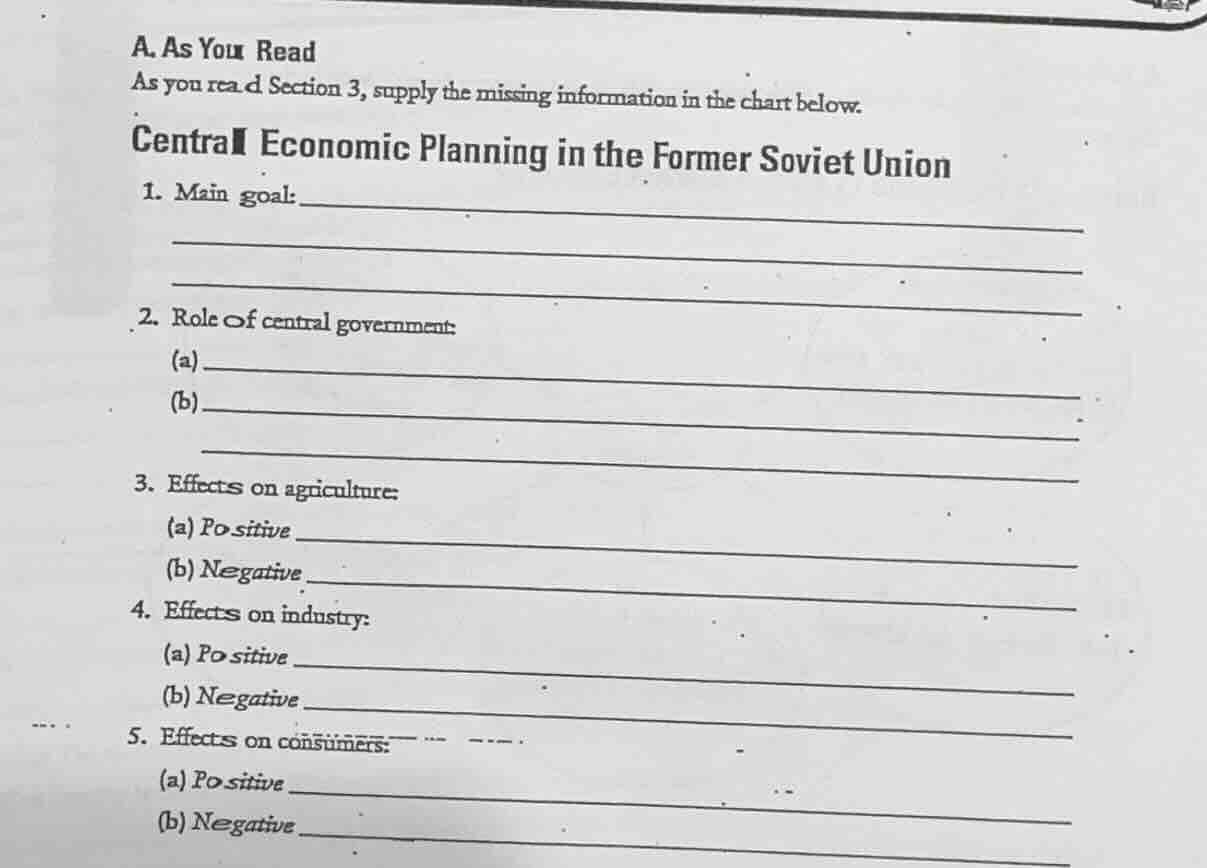
as you read section 3, supply the missing information in the chart below.
central economic planning in the former soviet union
- main goal:
- role of central government:
(a)
(b)
- effects on agriculture:
(a) positive
(b) negative
- effects on industry:
(a) positive
(b) negative
- effects on consumers:
(a) positive
(b) negative
To answer this, we refer to knowledge about the Soviet Union's central economic planning:
1. Main goal:
To rapidly industrialize the country, eliminate economic inequality, and achieve self - sufficiency, while also promoting the goals of socialism (like equitable distribution of resources).
2. Role of central government:
(a) Created five - year plans that outlined production targets for different sectors (such as setting how much steel to produce, how many tractors for agriculture).
(b) Allocated resources (like raw materials, labor) to different industries and sectors according to the plans, and also set prices for goods and services.
3. Effects on agriculture:
(a) Positive: The government invested in large - scale collective farms (kolkhozes and sovkhozes), which led to the mechanization of agriculture (more tractors, combines were used). Also, there were some increases in certain crop productions in the early years as a result of planned resource allocation.
(b) Negative: Collective farming often led to a lack of incentive for farmers (since they didn't own the land or the produce in the same way as private farmers), which resulted in low productivity. Also, the government's focus on industrialization meant that agriculture was often underfunded compared to industry, leading to food shortages in some periods.
4. Effects on industry:
(a) Positive: There was rapid industrial growth, especially in heavy industries like steel, coal, and machinery. The Soviet Union was able to transform from a mostly agrarian society to an industrial power, with large - scale factories and infrastructure built.
(b) Negative: The focus on quantity (meeting production targets) over quality meant that many industrial products were of low quality. Also, there was a lack of innovation as factories were focused on meeting set targets rather than developing new technologies. Consumer goods industries were often neglected as the government prioritized heavy industry.
5. Effects on consumers:
(a) Positive: There was some access to basic goods and services that were provided by the state, and there was a certain level of job security as employment was planned by the government.
(b) Negative: There were chronic shortages of consumer goods (like clothing, electronics) because the government prioritized industrial and military production. Also, the quality of consumer goods was often poor, and there was little variety in the products available.
These answers are based on historical and economic knowledge of the Soviet Union's central planning system. If this is a textbook - based question, you should also cross - check with the specific content of Section 3 mentioned in the prompt.

Snap & solve any problem in the app
Get step-by-step solutions on Sovi AI
Photo-based solutions with guided steps
Explore more problems and detailed explanations
To answer this, we refer to knowledge about the Soviet Union's central economic planning:
1. Main goal:
To rapidly industrialize the country, eliminate economic inequality, and achieve self - sufficiency, while also promoting the goals of socialism (like equitable distribution of resources).
2. Role of central government:
(a) Created five - year plans that outlined production targets for different sectors (such as setting how much steel to produce, how many tractors for agriculture).
(b) Allocated resources (like raw materials, labor) to different industries and sectors according to the plans, and also set prices for goods and services.
3. Effects on agriculture:
(a) Positive: The government invested in large - scale collective farms (kolkhozes and sovkhozes), which led to the mechanization of agriculture (more tractors, combines were used). Also, there were some increases in certain crop productions in the early years as a result of planned resource allocation.
(b) Negative: Collective farming often led to a lack of incentive for farmers (since they didn't own the land or the produce in the same way as private farmers), which resulted in low productivity. Also, the government's focus on industrialization meant that agriculture was often underfunded compared to industry, leading to food shortages in some periods.
4. Effects on industry:
(a) Positive: There was rapid industrial growth, especially in heavy industries like steel, coal, and machinery. The Soviet Union was able to transform from a mostly agrarian society to an industrial power, with large - scale factories and infrastructure built.
(b) Negative: The focus on quantity (meeting production targets) over quality meant that many industrial products were of low quality. Also, there was a lack of innovation as factories were focused on meeting set targets rather than developing new technologies. Consumer goods industries were often neglected as the government prioritized heavy industry.
5. Effects on consumers:
(a) Positive: There was some access to basic goods and services that were provided by the state, and there was a certain level of job security as employment was planned by the government.
(b) Negative: There were chronic shortages of consumer goods (like clothing, electronics) because the government prioritized industrial and military production. Also, the quality of consumer goods was often poor, and there was little variety in the products available.
These answers are based on historical and economic knowledge of the Soviet Union's central planning system. If this is a textbook - based question, you should also cross - check with the specific content of Section 3 mentioned in the prompt.