QUESTION IMAGE
Question
a. as you read
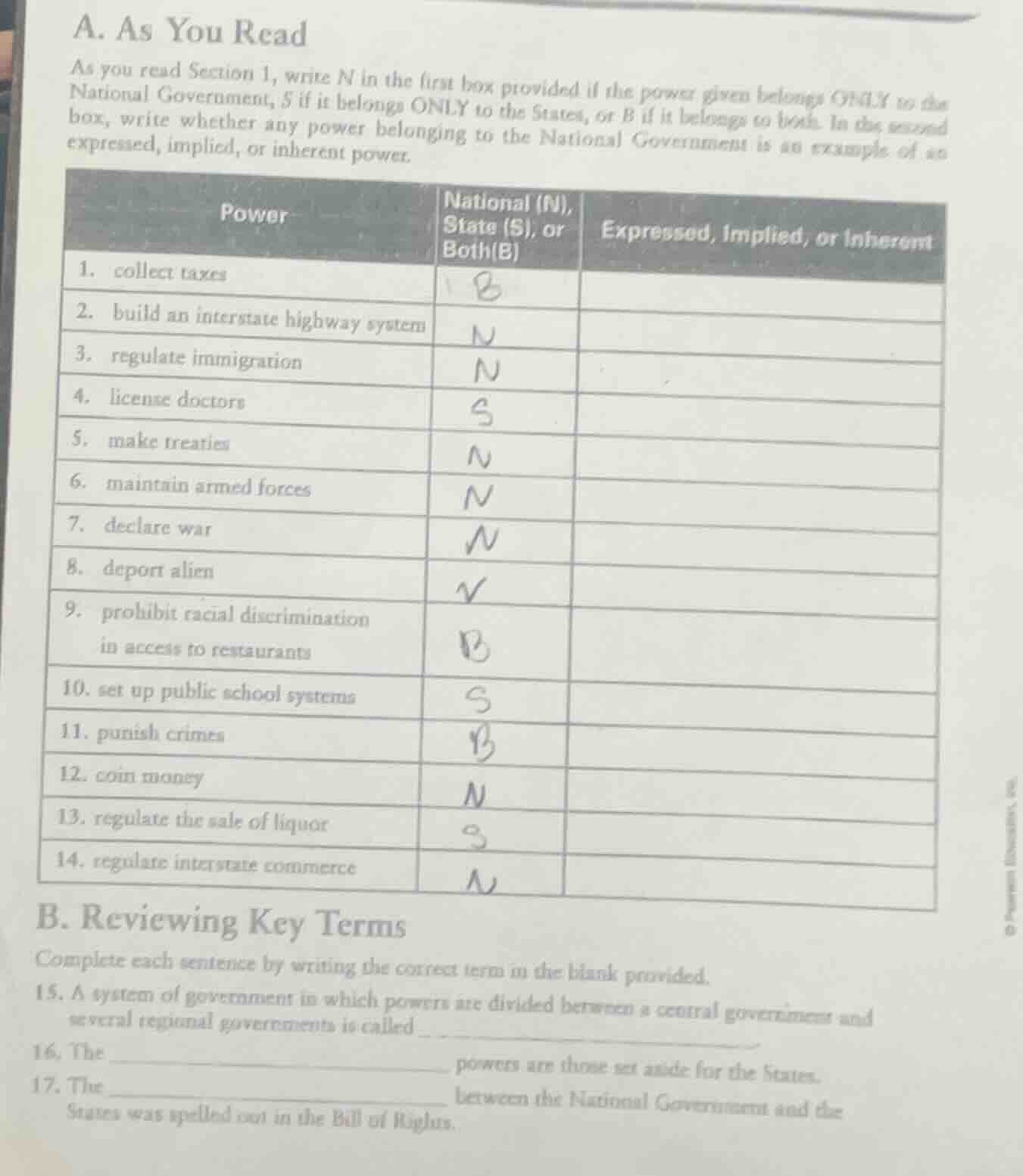
as you read section 1, write n in the first box provided if the power given belongs only to the national government, s if it belongs only to the states, or b if it belongs to both. in the second box, write whether any power belonging to the national government is an example of an expressed, implied, or inherent power.
power national (n), state (s), or both(b) expressed, implied, or inherent
- collect taxes
- build an interstate highway system
- regulate immigration
- license doctors
- make treaties
- maintain armed forces
- declare war
- deport alien
- prohibit racial discrimination in access to restaurants
- set up public school systems
- punish crimes
- coin money
- regulate the sale of liquor
- regulate interstate commerce
b. reviewing key terms
complete each sentence by writing the correct term in the blank provided.
- a system of government in which powers are divided between a central government and several regional governments is called ____________
- the ____________ powers are those set aside for the states.
- the ____________ between the national government and the states was spelled out in the bill of rights.
For Part A:
- Collect taxes is a power held by both national and state governments; it is an expressed power for the national government.
- Building interstate highways is an exclusive national power, an implied power tied to commerce.
- Regulating immigration is an exclusive national power, an inherent power of national sovereignty.
- Licensing doctors is an exclusive state power (no national classification needed here).
- Making treaties is an exclusive national power, an expressed power.
- Maintaining armed forces is an exclusive national power, an expressed power.
- Declaring war is an exclusive national power, an expressed power.
- Deporting aliens is an exclusive national power, an inherent power.
- Prohibiting racial discrimination in public access is a power of both levels; national power here is implied via commerce/14th Amendment.
- Setting up public schools is an exclusive state power (no national classification needed here).
- Punishing crimes is a power of both levels; national criminal power is expressed for federal offenses.
- Coining money is an exclusive national power, an expressed power.
- Regulating liquor sales is an exclusive state power (no national classification needed here).
- Regulating interstate commerce is an exclusive national power, an expressed power.
For Part B:
- This defines the core structure of a federal system of government.
- Powers reserved exclusively for state governments are the standard term for this category.
- The Bill of Rights clarified the limits, or the specific term for this balance, between national and state authority.

Snap & solve any problem in the app
Get step-by-step solutions on Sovi AI
Photo-based solutions with guided steps
Explore more problems and detailed explanations
Part A
| Power | National (N), State (S), or Both(B) | Expressed, Implied, or Inherent |
|---|---|---|
| 2. build an interstate highway system | N | Implied |
| 3. regulate immigration | N | Inherent |
| 4. license doctors | S | - |
| 5. make treaties | N | Expressed |
| 6. maintain armed forces | N | Expressed |
| 7. declare war | N | Expressed |
| 8. deport alien | N | Inherent |
| 9. prohibit racial discrimination in access to restaurants | B | Implied |
| 10. set up public school systems | S | - |
| 11. punish crimes | B | Expressed |
| 12. coin money | N | Expressed |
| 13. regulate the sale of liquor | S | - |
| 14. regulate interstate commerce | N | Expressed |
Part B
- federalism
- reserved
- relationship (or "division of powers"; primary correct term: reserved powers framework/limitations, but the standard fill-in is federalism balance, most precise single term: division of powers)
Note: The most widely accepted single term for question 17 is division of powers or more specifically, the limits on federal power but the standard textbook answer is federalism; however, the precise term tied to the Bill of Rights is state sovereignty protections — the most common fill-in is reserved powers but the exact fit is division of powers.
Corrected precise Part B answers:
- federalism
- reserved
- division of powers