QUESTION IMAGE
Question
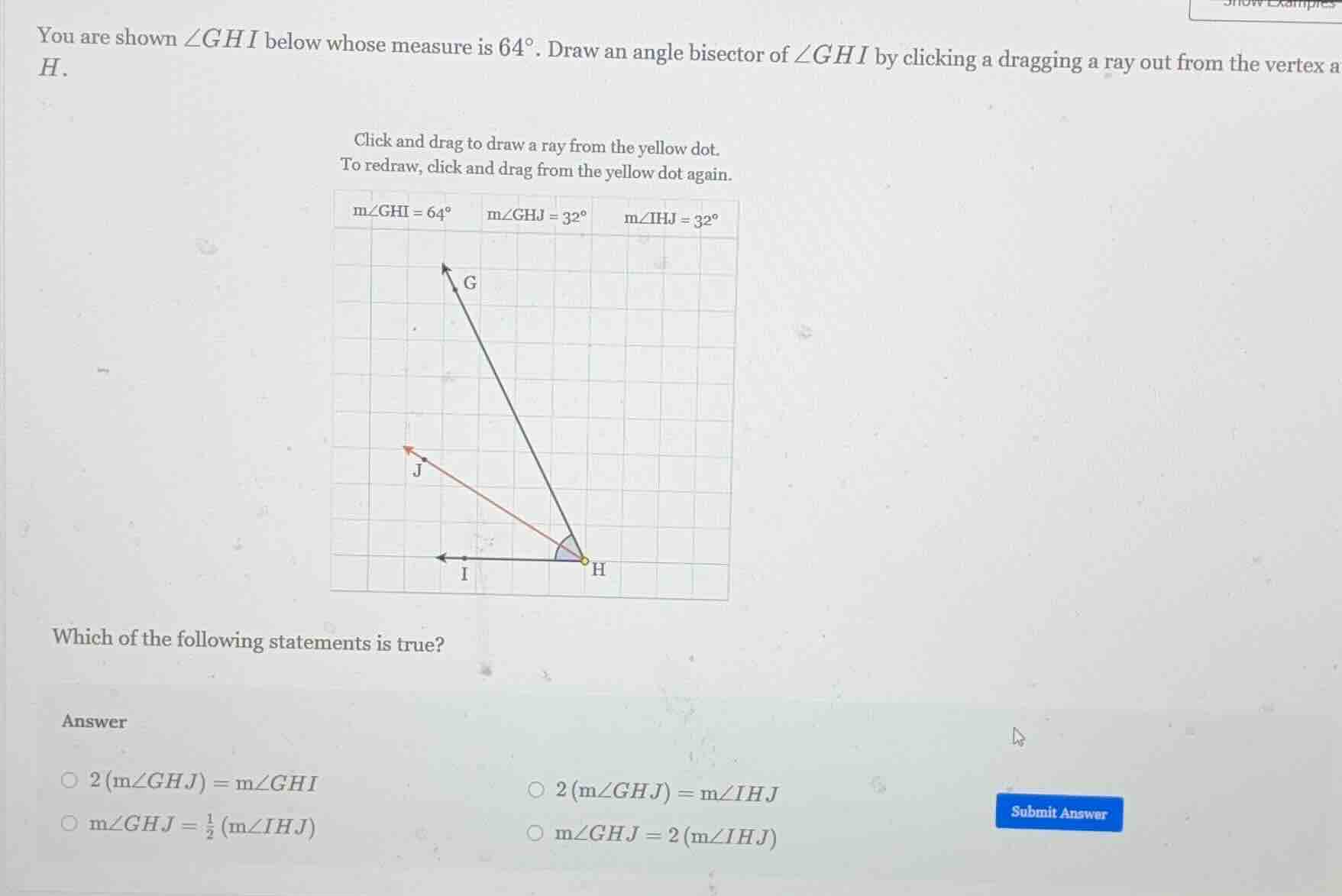
you are shown $\angle ghi$ below whose measure is $64^\circ$. draw an angle bisector of $\angle ghi$ by clicking a dragging a ray out from the vertex a h.
click and drag to draw a ray from the yellow dot.
to redraw, click and drag from the yellow dot again.
$\
$
which of the following statements is true?
answer
$\bigcirc\\ 2\left(m\angle ghj\
ight)=m\angle ghi$ $\bigcirc\\ 2\left(m\angle ghj\
ight)=m\angle ihj$
$\bigcirc\\ m\angle ghj = \frac{1}{2}\left(m\angle ihj\
ight)$ $\bigcirc\\ m\angle ghj = 2\left(m\angle ihj\
ight)$
Step1: Recall angle bisector definition
An angle bisector divides an angle into two equal parts. So, if \( \overrightarrow{HJ} \) is the bisector of \( \angle GHI \), then \( m\angle GHJ = m\angle IHJ \) and each is half of \( m\angle GHI \).
Step2: Substitute given angle measures
We know \( m\angle GHI = 64^\circ \), \( m\angle GHJ = 32^\circ \), and \( m\angle IHJ = 32^\circ \). Let's check each option:
- Option 1: \( 2(m\angle GHJ) = 2\times32^\circ = 64^\circ \), and \( m\angle GHI = 64^\circ \). So \( 2(m\angle GHJ) = m\angle GHI \) is true.
- Option 2: \( 2(m\angle GHJ) = 64^\circ \), but \( m\angle IHJ = 32^\circ \). So this is false.
- Option 3: \( \frac{1}{2}(m\angle IHJ) = 16^\circ \), but \( m\angle GHJ = 32^\circ \). False.
- Option 4: \( 2(m\angle IHJ) = 64^\circ \), but \( m\angle GHJ = 32^\circ \). False.

Snap & solve any problem in the app
Get step-by-step solutions on Sovi AI
Photo-based solutions with guided steps
Explore more problems and detailed explanations
A. \( 2(\text{m}\angle GHJ) = \text{m}\angle GHI \)