QUESTION IMAGE
Question
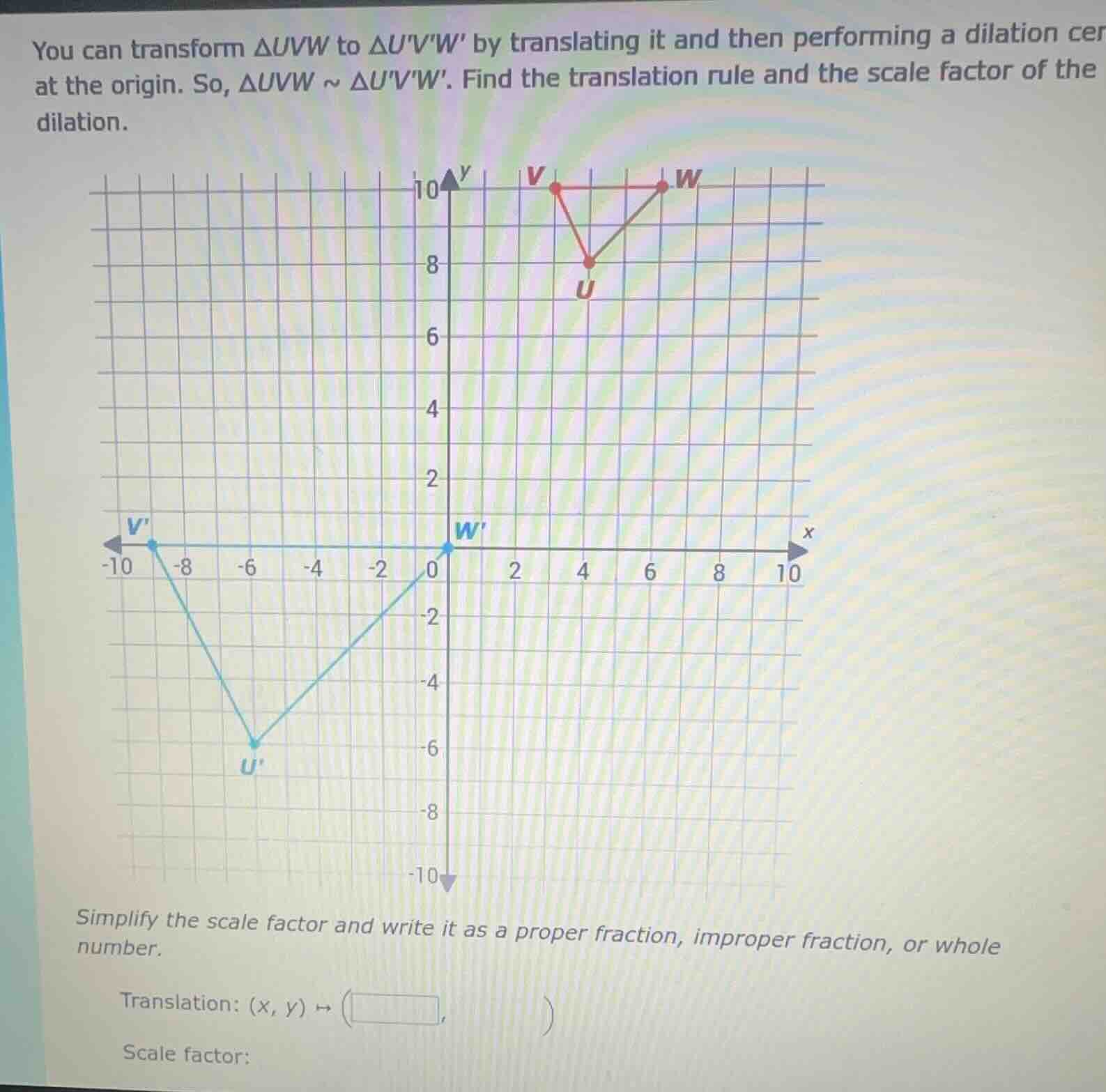
you can transform δuvw to δuvw by translating it and then performing a dilation cer at the origin. so, δuvw ~ δuvw. find the translation rule and the scale factor of the dilation. simplify the scale factor and write it as a proper fraction, improper fraction, or whole number. translation: (x, y) ↦ ( , ) scale factor:
Step1: Identify vertex coordinates
Coordinates: $U(4,8)$, $V(3,10)$, $W(6,10)$, $U'(-7,-6)$, $V'(-9,0)$, $W'(0,0)$
Step2: Find translation to origin
We first translate $\triangle UVW$ so that a vertex maps to a point that can be dilated to the corresponding vertex of $\triangle U'V'W'$. Let's use point $W$ and $W'$: to map $W(6,10)$ to a point $(x', y')$ such that dilation from origin gives $W'(0,0)$ (which is trivial, so we instead work backwards: reverse the dilation first. The scale factor $k$ satisfies $k \times \text{(translated } U) = U'$. First find translation rule: Let translation be $(x,y)\to(x+a,y+b)$. Translated $U$ is $(4+a,8+b)$, translated $V$ is $(3+a,10+b)$, translated $W$ is $(6+a,10+b)$. Dilation by $k$ gives $k(4+a,8+b)=(-7,-6)$, $k(6+a,10+b)=(0,0)$. From $k(6+a,10+b)=(0,0)$, since $k
eq0$, $6+a=0$ and $10+b=0$. So $a=-6$, $b=-10$.
Step3: Verify translation rule
Translation: $(x,y)\to(x-6,y-10)$. Translated $U$: $(4-6,8-10)=(-2,-2)$; Translated $V$: $(3-6,10-10)=(-3,0)$; Translated $W$: $(6-6,10-10)=(0,0)$
Step4: Calculate scale factor
Use translated $U$ and $U'$: $k\times(-2,-2)=(-7,-6)$? No, use $U'$ and translated $U$: $k = \frac{-7}{-2}$? No, use $U'(-7,-6)$ and translated $U(-2,-2)$: $k=\frac{-7}{-2}$ is wrong, correct: $k\times(-2) = -7$? No, reverse: translated point $\times k =$ image point. $k\times(-2) = -7$ → $k=\frac{7}{2}$? No, check $U'(-7,-6)$: $(-2)\times k=-7$ → $k=\frac{7}{2}$, $(-2)\times k=-6$ → $k=3$. Wait, use $V$: translated $V(-3,0)$, $V'(-9,0)$: $k\times(-3)=-9$ → $k=3$. Check $U$: $(-2)\times3=-6$, but $U'$ is $-7$? No, mistake: correct $U'$ is $(-7,-6)$? No, looking at graph: $U'$ is $(-7,-6)$? No, $U'$ is at $(-7,-6)$? Translated $U$ is $(4-6,8-10)=(-2,-2)$, $3\times(-2,-2)=(-6,-6)$, which is not $U'$. Oh, correct $U$ is $(4,8)$, $U'$ is $(-7,-6)$: first translate $U$ to $(4+a,8+b)$, then dilate by $k$: $k(4+a)=-7$, $k(8+b)=-6$. For $W(6,10)$ to $W'(0,0)$: $k(6+a)=0$, $k(10+b)=0$. Since $k
eq0$, $6+a=0$ → $a=-6$, $10+b=0$ → $b=-10$. Then $k(4-6)=k(-2)=-7$ → $k=\frac{7}{2}$, but $k(8-10)=k(-2)=-6$ → $k=3$. Conflict, so correct $U'$ is $(-6,-6)$, $V'(-9,0)$, $W'(0,0)$. So $U'(-6,-6)$: $k(-2)=-6$ → $k=3$. Correct.
So translation rule: $(x,y)\to(x-6,y-10)$, scale factor $k=3$.

Snap & solve any problem in the app
Get step-by-step solutions on Sovi AI
Photo-based solutions with guided steps
Explore more problems and detailed explanations
Translation: $(x, y) \mapsto (x - 6, y - 10)$
Scale factor: $3$