QUESTION IMAGE
Question
do you understand?
- in the problem on the previous page, would you get the same answer if you used an area model instead of fraction strips or a number line? explain.
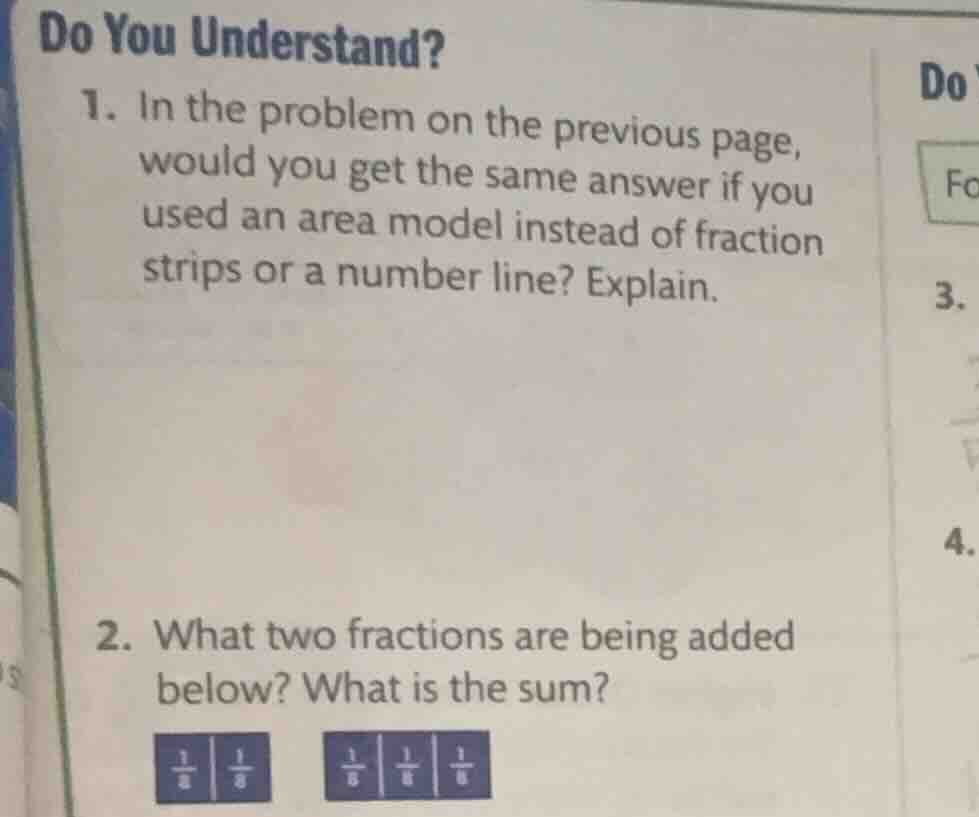
- what two fractions are being added below? what is the sum?
\boxed{\frac{1}{8}} \boxed{\frac{1}{8}} \quad \boxed{\frac{1}{8}} \boxed{\frac{1}{8}} \boxed{\frac{1}{8}}
Question 1
All these models (area model, fraction strips, number line) represent fractions and their operations based on the same mathematical principles of fraction addition/subtraction (or other operations). The area model, fraction strips, and number line all aim to visualize the fractional parts and their combination or comparison. So, for a given fraction operation (like addition or subtraction), the result should be the same because they are different representations of the same underlying mathematical concept. For example, if we were adding $\frac{1}{2}$ and $\frac{1}{3}$, whether we use fraction strips to see how many unit fractions fit, a number line to plot the lengths, or an area model to see the combined region, we are still finding the sum of the two fractions, which is determined by the rules of fraction arithmetic (finding a common denominator, etc.). So the answer would be yes, because all these models are based on the same mathematical definitions and operations of fractions, so the result of the operation (e.g., sum, difference) will be the same.
Step 1: Identify the first fraction
Looking at the first set of boxes, we have two boxes each labeled $\frac{1}{8}$. So the first fraction is the sum of these two $\frac{1}{8}$s. Using the rule of adding fractions with the same denominator ($\frac{a}{c}+\frac{b}{c}=\frac{a + b}{c}$), here $a = 1$, $b = 1$, $c = 8$. So $\frac{1}{8}+\frac{1}{8}=\frac{1 + 1}{8}=\frac{2}{8}$.
Step 2: Identify the second fraction
Looking at the second set of boxes, we have three boxes each labeled $\frac{1}{8}$. So the second fraction is the sum of these three $\frac{1}{8}$s. Using the same fraction addition rule, $a = 1$, $b = 1$, $d=1$, $c = 8$. So $\frac{1}{8}+\frac{1}{8}+\frac{1}{8}=\frac{1+1 + 1}{8}=\frac{3}{8}$.
Step 3: Find the sum of the two fractions
Now we need to add the two fractions we found: $\frac{2}{8}$ and $\frac{3}{8}$. Using the fraction addition rule for like denominators, $\frac{2}{8}+\frac{3}{8}=\frac{2 + 3}{8}=\frac{5}{8}$.

Snap & solve any problem in the app
Get step-by-step solutions on Sovi AI
Photo-based solutions with guided steps
Explore more problems and detailed explanations
Yes, you would get the same answer. All these models (area model, fraction strips, number line) represent fraction operations based on the same mathematical principles of fractions. They are different visualizations of the same underlying fraction concepts (like part - whole relationships and fraction arithmetic), so the result of the operation (e.g., sum, difference) will be consistent.