QUESTION IMAGE
Question
zimmerman telegram (1917)
directions: as you read the text, highlight the problem faced by the united states. then answer the following questions.
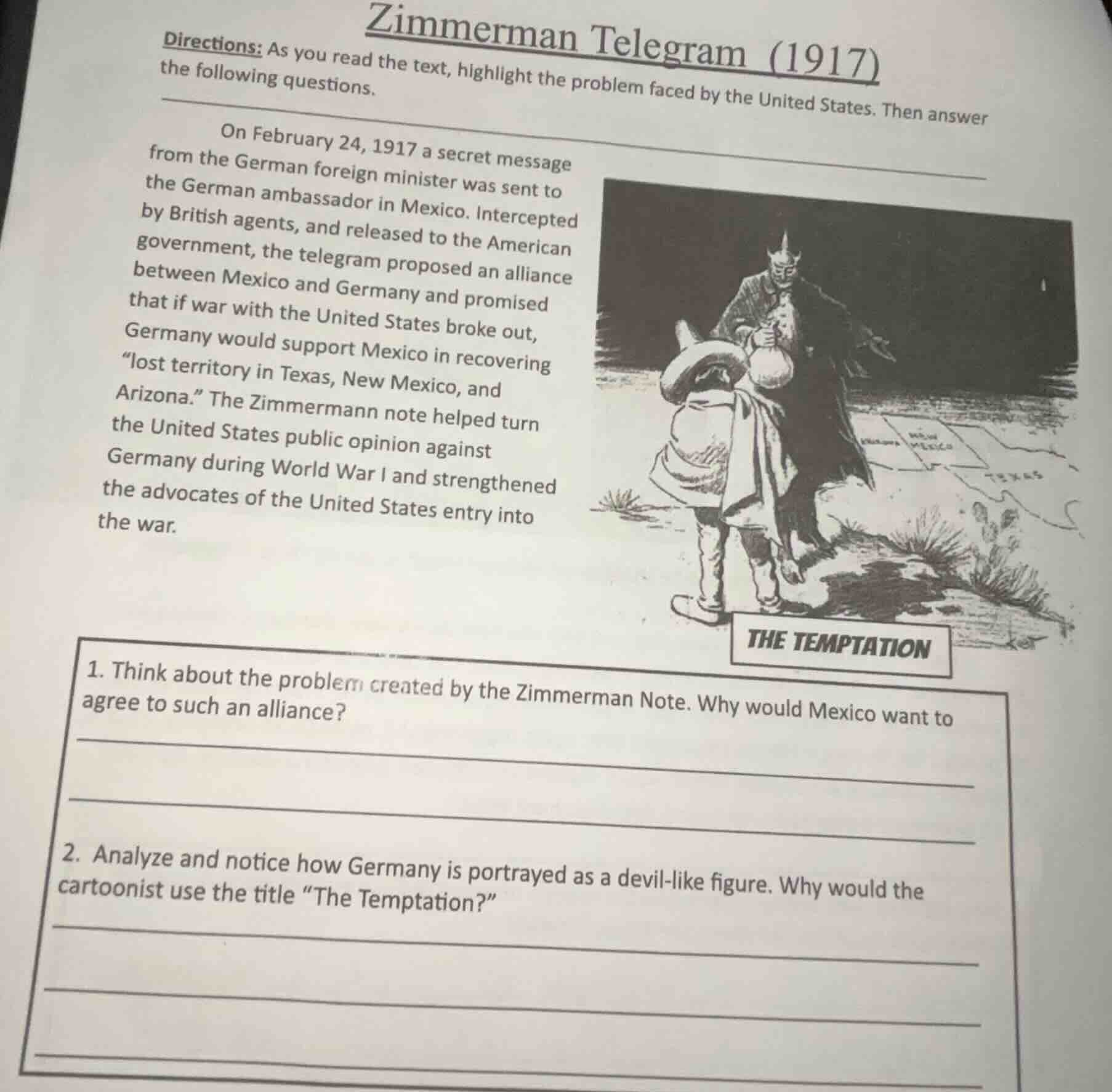
on february 24, 1917 a secret message from the german foreign minister was sent to the german ambassador in mexico. intercepted by british agents, and released to the american government, the telegram proposed an alliance between mexico and germany and promised that if war with the united states broke out, germany would support mexico in recovering \lost territory in texas, new mexico, and arizona.\ the zimmermann note helped turn the united states public opinion against germany during world war i and strengthened the advocates of the united states entry into the war.
- think about the problem created by the zimmerman note. why would mexico want to agree to such an alliance?
- analyze and notice how germany is portrayed as a devil - like figure. why would the cartoonist use the title \the temptation?\
- Mexico would have incentive to agree to the alliance because Germany promised to help it recover large, valuable territories (Texas, New Mexico, Arizona) that it had lost to the United States in the Mexican-American War. This offered a chance to regain land, resources, and national prestige.
- The title "The Temptation" works with the devil-like portrayal of Germany because:
- The devil is a common symbol of temptation to do something morally questionable or risky.
- Germany is depicted as offering Mexico an enticing but dangerous deal: regaining territory, but at the cost of going to war with the far more powerful United States.
- The framing positions the alliance as a corrupting, risky offer, mirroring the idea of succumbing to a devil's temptation.

Snap & solve any problem in the app
Get step-by-step solutions on Sovi AI
Photo-based solutions with guided steps
Explore more problems and detailed explanations
- Mexico would want to agree to the alliance because Germany promised to help it recover the lost territories of Texas, New Mexico, and Arizona, which Mexico had lost to the U.S. in the Mexican-American War, allowing it to regain land, resources, and national standing.
- The cartoonist uses the title "The Temptation" because the devil-like figure representing Germany is offering Mexico an enticing but risky deal (regaining lost territory) that would require allying against the powerful U.S. This mirrors the idea of a devil tempting someone with something desirable that carries severe moral or practical risks.