QUESTION IMAGE
Question
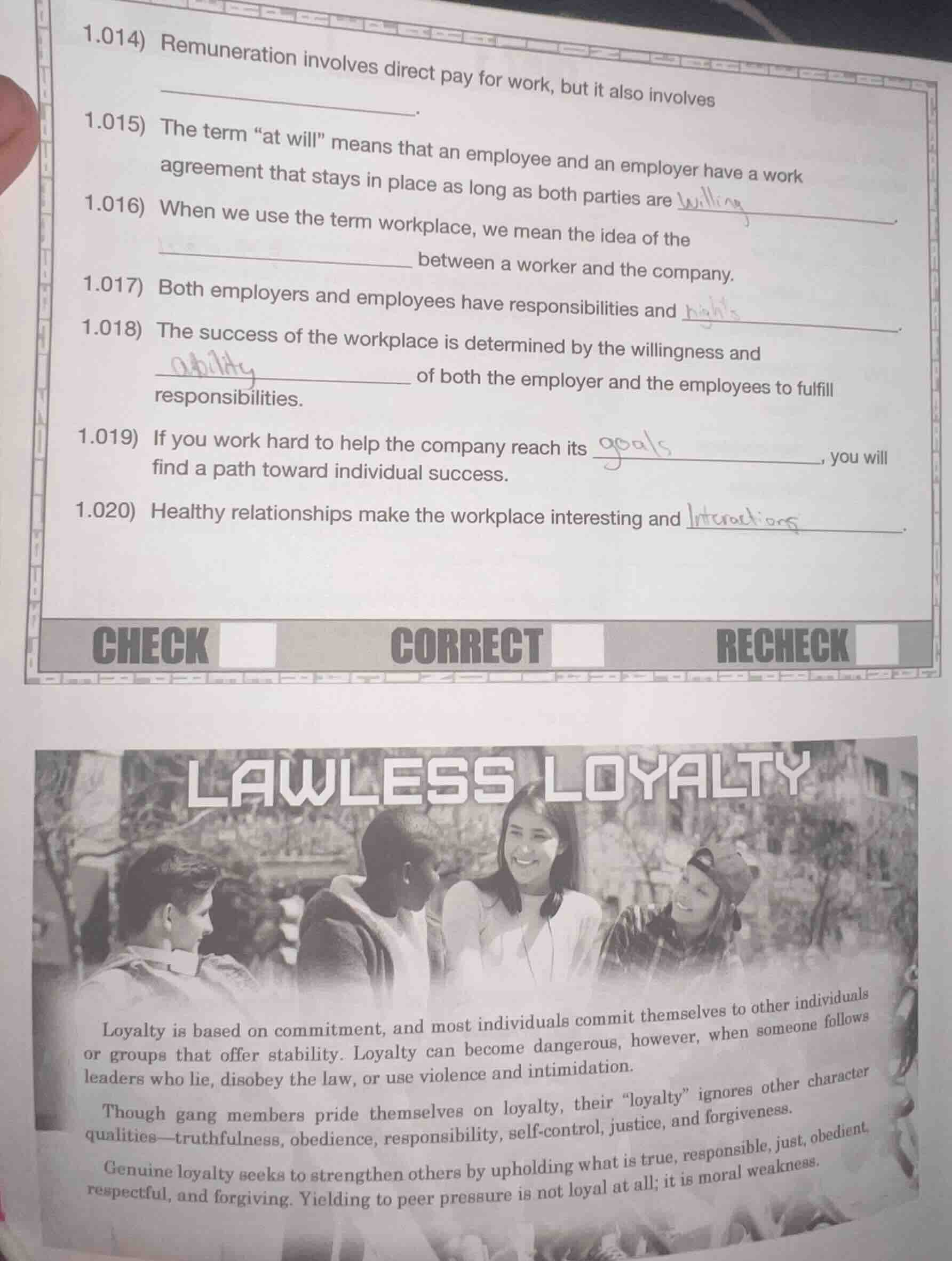
1.014) remuneration involves direct pay for work, but it also involves ____.1.015) the term \at will\ means that an employee and an employer have a work agreement that stays in place as long as both parties are __.1.016) when we use the term workplace, we mean the idea of the __ between a worker and the company.1.017) both employers and employees have responsibilities and __.1.018) the success of the workplace is determined by the willingness and __ of both the employer and the employees to fulfill responsibilities.1.019) if you work hard to help the company reach its __, you will find a path toward individual success.1.020) healthy relationships make the workplace interesting and ____.check correct rechecklawless loyaltyloyalty is based on commitment, and most individuals commit themselves to other individuals or groups that offer stability. loyalty can become dangerous, however, when someone follows leaders who lie, disobey the law, or use violence and intimidation.though gang members pride themselves on loyalty, their \loyalty\ ignores other character qualities—truthfulness, obedience, responsibility, self - control, justice, and forgiveness.genuine loyalty seeks to strengthen others by upholding what is true, responsible, just, obedient, respectful, and forgiving. yielding to peer pressure is not loyal at all; it is moral weakness.
To answer these fill - in - the - blank questions, we analyze each one based on workplace and employment - related knowledge:
Question 1.014
Remuneration (compensation for work) not only includes direct pay for work but also benefits (such as health insurance, retirement plans, paid time off, etc.). So the answer is "benefits".
Question 1.015
The "at - will" employment concept means that the employment agreement remains valid as long as both the employee and the employer are willing to continue the employment relationship. So the answer is "willing to continue the employment relationship".
Question 1.016
When we talk about the "workplace" in terms of the relationship between a worker and the company, we are referring to the "relationship" (the overall connection including professional, social, and contractual aspects) between them. So the answer is "relationship".
Question 1.017
In the employer - employee relationship, both parties have responsibilities and "rights" (for example, employees have the right to a safe workplace, and employers have the right to expect good performance from employees). So the answer is "rights".
Question 1.018
The success of the workplace depends on the willingness and "ability" (the capacity to actually carry out the responsibilities, like having the necessary skills and knowledge) of both employers and employees to fulfill their responsibilities. So the answer is "ability".
Question 1.019
If an employee works hard to help the company reach its "goals" (the company's objectives, such as profit targets, growth targets, or project completion goals), they are more likely to find individual success. So the answer is "goals".
Question 1.020
Healthy relationships in the workplace make it interesting and "productive" (because good relationships can lead to better communication, cooperation, and thus more efficient work). So the answer is "productive".
Final Answers
1.014) benefits
1.015) willing to continue the employment relationship
1.016) relationship
1.017) rights
1.018) ability
1.019) goals
1.020) productive

Snap & solve any problem in the app
Get step-by-step solutions on Sovi AI
Photo-based solutions with guided steps
Explore more problems and detailed explanations
To answer these fill - in - the - blank questions, we analyze each one based on workplace and employment - related knowledge:
Question 1.014
Remuneration (compensation for work) not only includes direct pay for work but also benefits (such as health insurance, retirement plans, paid time off, etc.). So the answer is "benefits".
Question 1.015
The "at - will" employment concept means that the employment agreement remains valid as long as both the employee and the employer are willing to continue the employment relationship. So the answer is "willing to continue the employment relationship".
Question 1.016
When we talk about the "workplace" in terms of the relationship between a worker and the company, we are referring to the "relationship" (the overall connection including professional, social, and contractual aspects) between them. So the answer is "relationship".
Question 1.017
In the employer - employee relationship, both parties have responsibilities and "rights" (for example, employees have the right to a safe workplace, and employers have the right to expect good performance from employees). So the answer is "rights".
Question 1.018
The success of the workplace depends on the willingness and "ability" (the capacity to actually carry out the responsibilities, like having the necessary skills and knowledge) of both employers and employees to fulfill their responsibilities. So the answer is "ability".
Question 1.019
If an employee works hard to help the company reach its "goals" (the company's objectives, such as profit targets, growth targets, or project completion goals), they are more likely to find individual success. So the answer is "goals".
Question 1.020
Healthy relationships in the workplace make it interesting and "productive" (because good relationships can lead to better communication, cooperation, and thus more efficient work). So the answer is "productive".
Final Answers
1.014) benefits
1.015) willing to continue the employment relationship
1.016) relationship
1.017) rights
1.018) ability
1.019) goals
1.020) productive