QUESTION IMAGE
Question
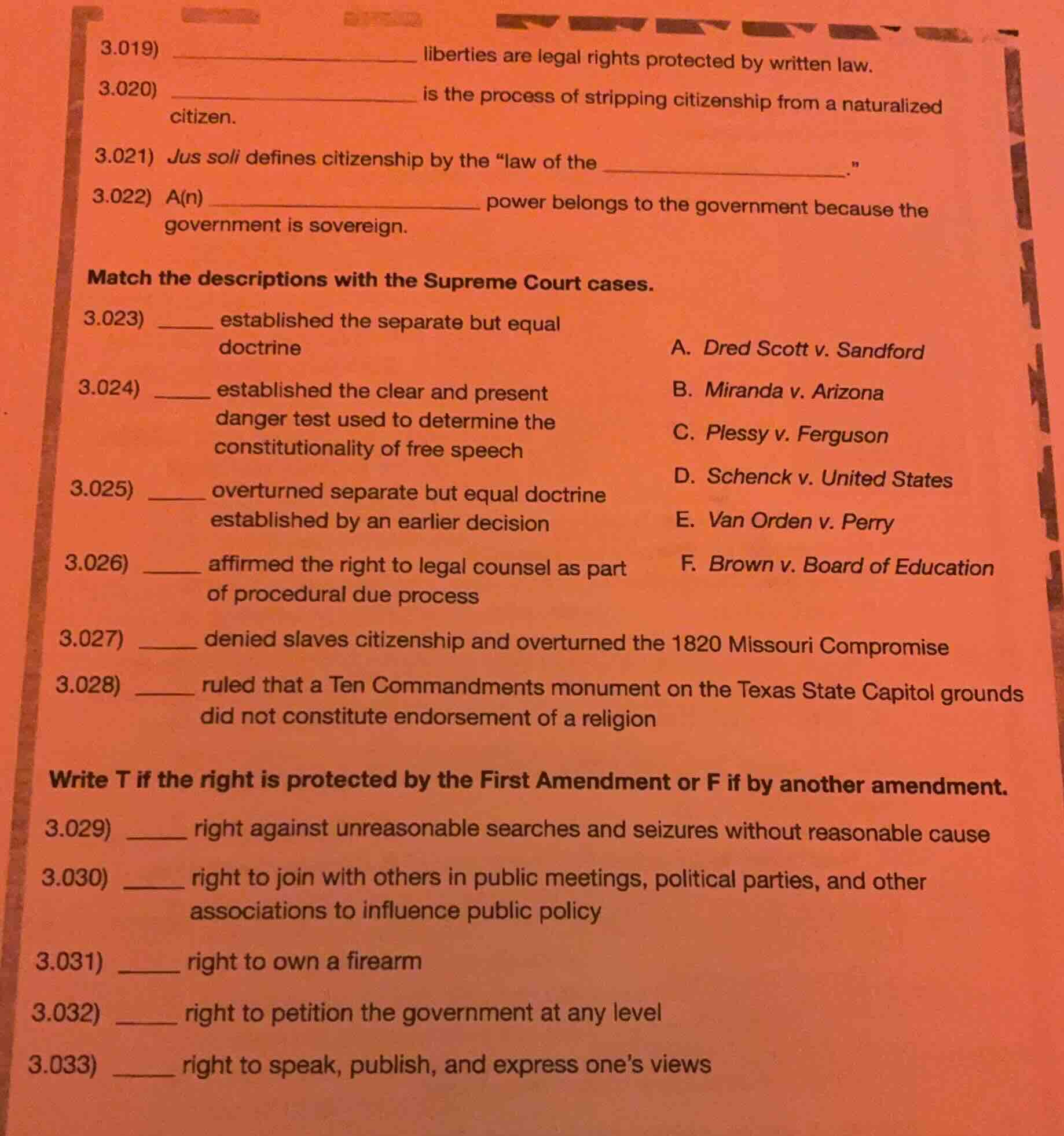
3.019) ________________ liberties are legal rights protected by written law.
3.020) ________________ is the process of stripping citizenship from a naturalized citizen.
3.021) jus soli defines citizenship by the “law of the ________________.”
3.022) a(n) ________________ power belongs to the government because the government is sovereign.
match the descriptions with the supreme court cases.
3.023) ____ established the separate but equal doctrine a. dred scott v. sandford
3.024) ____ established the clear and present danger test used to determine the constitutionality of free speech b. miranda v. arizona
3.025) ____ overturned separate but equal doctrine established by an earlier decision c. plessy v. ferguson
3.026) ____ affirmed the right to legal counsel as part of procedural due process d. schenck v. united states
3.027) ____ denied slaves citizenship and overturned the 1820 missouri compromise e. van orden v. perry
3.028) ____ ruled that a ten commandments monument on the texas state capitol grounds did not constitute endorsement of a religion f. brown v. board of education
write t if the right is protected by the first amendment or f if by another amendment.
3.029) ____ right against unreasonable searches and seizures without reasonable cause
3.030) ____ right to join with others in public meetings, political parties, and other associations to influence public policy
3.031) ____ right to own a firearm
3.032) ____ right to petition the government at any level
3.033) ____ right to speak, publish, and express one’s views
Fill-in-the-Blank Section
- 3.019: These are legal rights codified in written law, distinct from unwritten natural rights.
- 3.020: This term refers to the formal revocation of citizenship for a naturalized person.
- 3.021: Jus soli is a citizenship principle tied to place of birth.
- 3.022: This type of power stems from a government's sovereign status, not explicit legal grant.
Supreme Court Case Matching
- 3.023: This 1896 case created the "separate but equal" doctrine for racial segregation.
- 3.024: This 1919 case established the free speech test related to wartime dangers.
- 3.025: This 1954 case overturned the "separate but equal" doctrine in public education.
- 3.026: This 1966 case established the requirement to inform suspects of their right to an attorney.
- 3.027: This 1857 case denied citizenship to enslaved people and invalidated a key compromise.
- 3.028: This 2005 case ruled a religious monument on public property did not violate the Establishment Clause.
First Amendment True/False Section
- 3.029: This right is protected by the 4th Amendment, not the 1st.
- 3.030: This right (freedom of assembly) is a core part of the 1st Amendment.
- 3.031: This right is protected by the 2nd Amendment, not the 1st.
- 3.032: This right is explicitly listed in the 1st Amendment.
- 3.033: This right (freedom of speech/press) is a core part of the 1st Amendment.

Snap & solve any problem in the app
Get step-by-step solutions on Sovi AI
Photo-based solutions with guided steps
Explore more problems and detailed explanations
Fill-in-the-Blank
3.019) Civil
3.020) Denaturalization
3.021) soil
3.022) inherent
Supreme Court Case Matching
3.023) C. Plessy v. Ferguson
3.024) D. Schenck v. United States
3.025) F. Brown v. Board of Education
3.026) B. Miranda v. Arizona
3.027) A. Dred Scott v. Sandford
3.028) E. Van Orden v. Perry
First Amendment T/F
3.029) F
3.030) T
3.031) F
3.032) T
3.033) T