QUESTION IMAGE
Question
- (02.01 mc)
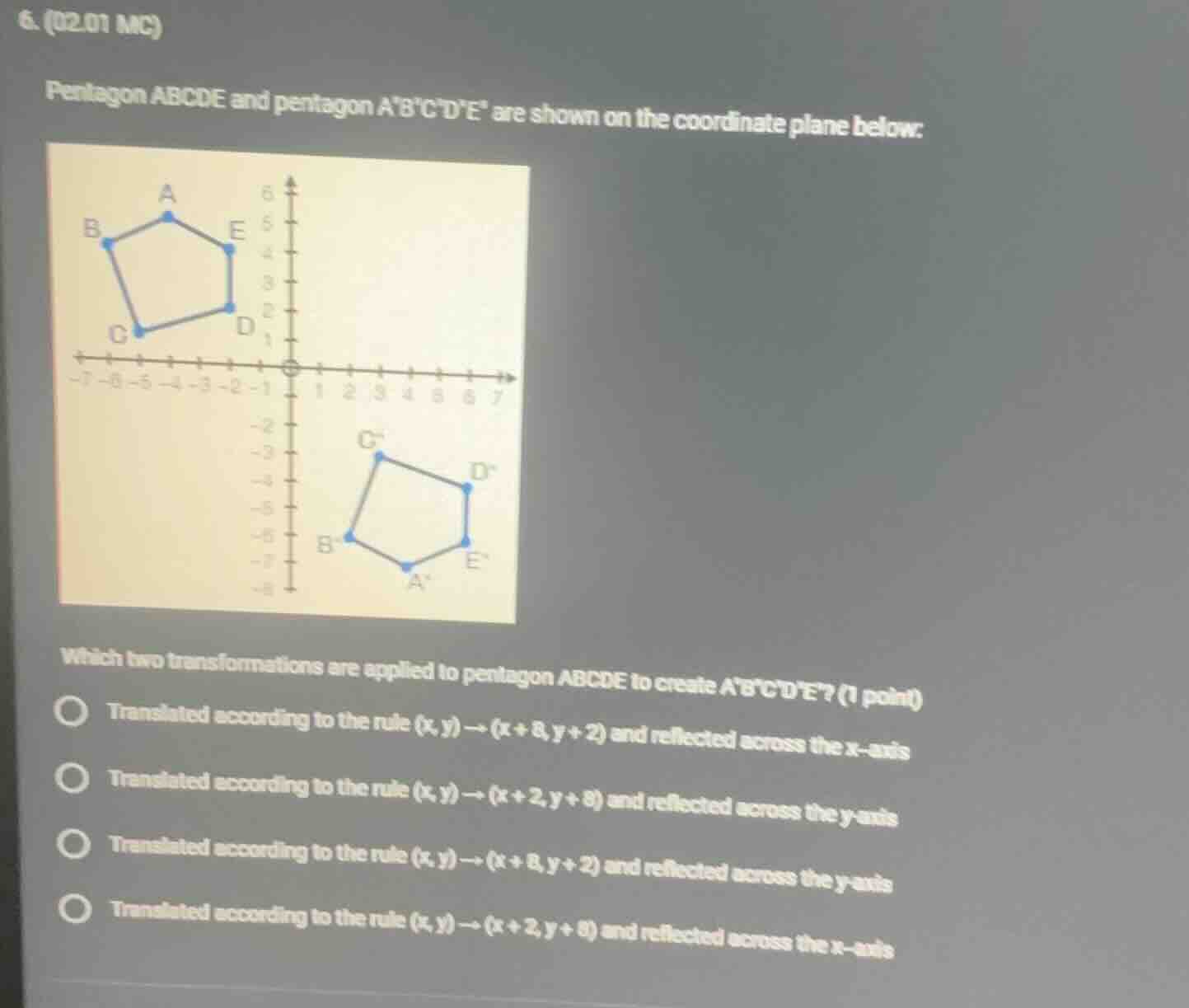
pentagon abcde and pentagon abcde are shown on the coordinate plane below:
which two transformations are applied to pentagon abcde to create abcde? (1 point)
- translated according to the rule ((x, y) \to (x + 8, y + 2)) and reflected across the x - axis
- translated according to the rule ((x, y) \to (x + 2, y + 8)) and reflected across the y - axis
- translated according to the rule ((x, y) \to (x + 8, y + 2)) and reflected across the y - axis
- translated according to the rule ((x, y) \to (x + 2, y + 8)) and reflected across the x - axis
Brief Explanations
- First, identify a point on pentagon ABCDE, e.g., point A at (-4, 5).
- Test the reflection first: the image A' is in the fourth quadrant, so reflecting across the x-axis flips the y-coordinate sign: $(-4, 5) \to (-4, -5)$.
- Now apply translation to match A' at (4, -7): calculate the horizontal shift: $4 - (-4) = 8$, vertical shift: $-7 - (-5) = -2$? No, reverse: start with original point, apply translation then reflection. Let's use the rule: if we translate first $(x,y)\to(x+8,y+2)$, point A $(-4,5)$ becomes $(-4+8,5+2)=(4,7)$. Then reflect across x-axis: $(4, 7)\to(4, -7)$, which matches point A'.
- Verify reflection type: reflecting across x-axis changes $(x,y)\to(x,-y)$, which turns the upper-left pentagon to the lower-right one after translation. The other options fail coordinate checks: e.g., y-axis reflection would flip x-sign, which doesn't match; wrong translation values don't align points.

Snap & solve any problem in the app
Get step-by-step solutions on Sovi AI
Photo-based solutions with guided steps
Explore more problems and detailed explanations
Translated according to the rule $(x, y) \to (x + 8, y + 2)$ and reflected across the x-axis