QUESTION IMAGE
Question
(02.01 mc)
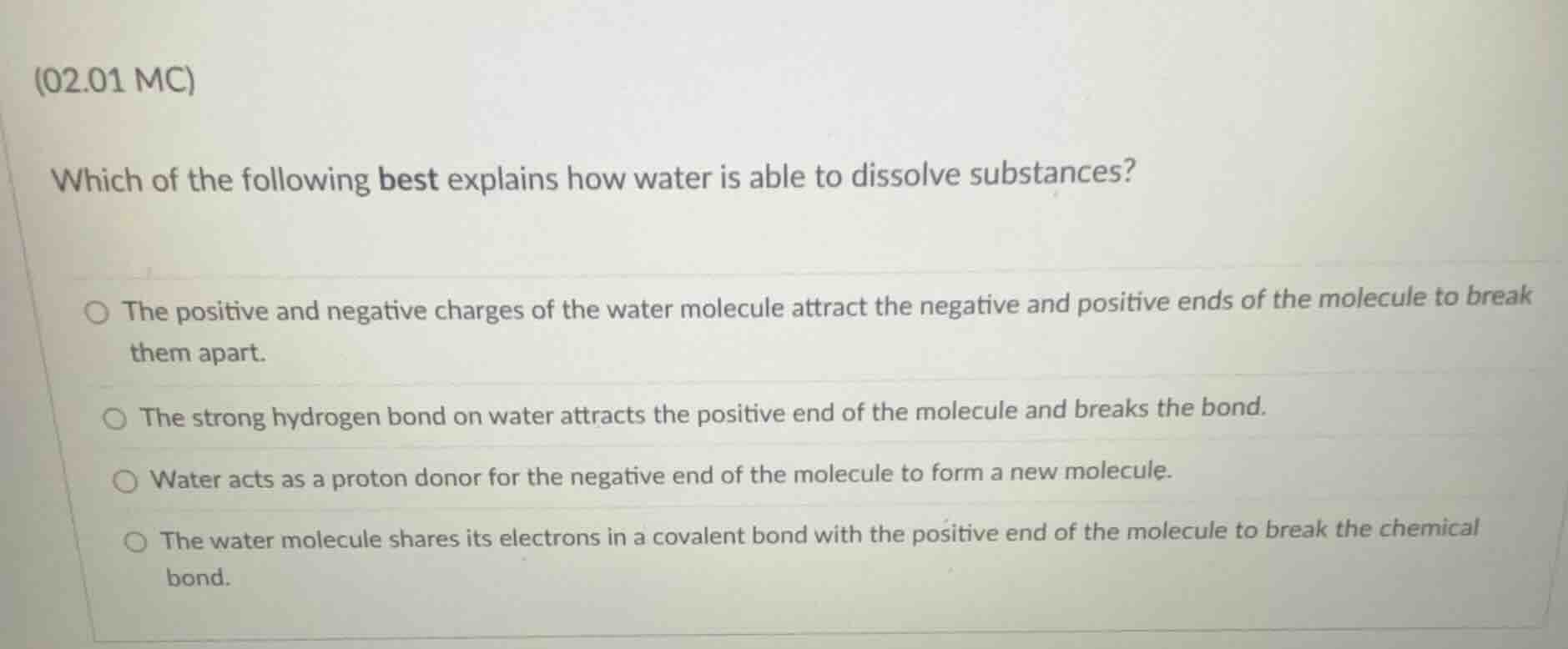
which of the following best explains how water is able to dissolve substances?
the positive and negative charges of the water molecule attract the negative and positive ends of the molecule to break them apart.
the strong hydrogen bond on water attracts the positive end of the molecule and breaks the bond.
water acts as a proton donor for the negative end of the molecule to form a new molecule.
the water molecule shares its electrons in a covalent bond with the positive end of the molecule to break the chemical bond.
To determine the correct answer, we analyze each option:
- Option 1: Water is a polar molecule with a positive (hydrogen) and negative (oxygen) end. These charges attract the opposite charges of solute molecules, breaking them apart for dissolution. This matches the principle of polarity in water's dissolving ability.
- Option 2: Hydrogen bonds in water are between water molecules, not directly attracting solute positive ends to break bonds. This is incorrect.
- Option 3: Water acting as a proton donor (like in acid - base reactions) is not the main mechanism for general dissolution. Dissolution of ionic or polar substances is about charge attraction, not proton donation to form new molecules. So this is wrong.
- Option 4: Water doesn't share electrons in a covalent bond with solute molecules to break chemical bonds during dissolution. Dissolution of ionic compounds, for example, is about ion - dipole interactions, not covalent bonding. So this is incorrect.

Snap & solve any problem in the app
Get step-by-step solutions on Sovi AI
Photo-based solutions with guided steps
Explore more problems and detailed explanations
The positive and negative charges of the water molecule attract the negative and positive ends of the molecule to break them apart.