QUESTION IMAGE
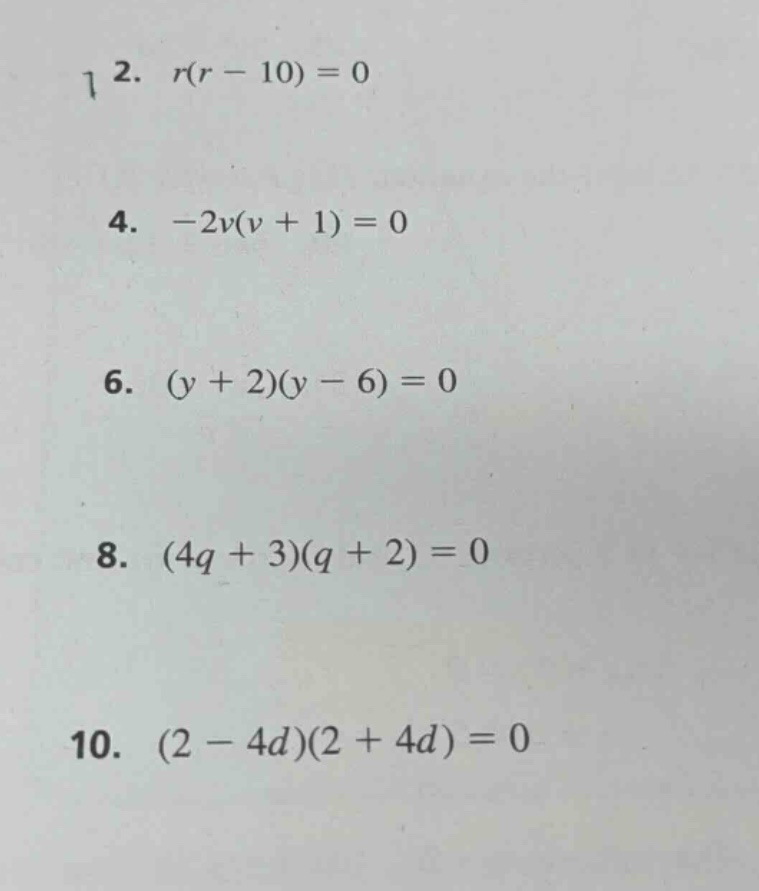
Question
- ( r(r - 10) = 0 )
- ( -2v(v + 1) = 0 )
- ( (y + 2)(y - 6) = 0 )
- ( (4q + 3)(q + 2) = 0 )
- ( (2 - 4d)(2 + 4d) = 0 )
Problem 2: \( r(r - 10) = 0 \)
Step 1: Apply zero - product property
If \( ab = 0 \), then either \( a = 0 \) or \( b = 0 \). For the equation \( r(r - 10)=0 \), we set each factor equal to zero.
So we have two cases:
Case 1: \( r = 0 \)
Case 2: \( r-10 = 0 \)
Step 2: Solve for \( r \) in the second case
For \( r - 10=0 \), we add 10 to both sides of the equation.
\( r-10 + 10=0 + 10 \), which gives \( r = 10 \)
Step 1: Apply zero - product property
Since \( ab = 0\) implies \( a = 0\) or \( b = 0\), for \( - 2v(v + 1)=0\), we consider two cases:
Case 1: \( -2v=0 \)
Case 2: \( v + 1=0 \)
Step 2: Solve for \( v \) in each case
For \( -2v = 0\), divide both sides by - 2: \( v=\frac{0}{-2}=0 \)
For \( v + 1=0\), subtract 1 from both sides: \( v=-1 \)
Step 1: Apply zero - product property
Using the zero - product property \( ab = 0\Rightarrow a = 0\) or \( b = 0\), we have two cases:
Case 1: \( y + 2=0 \)
Case 2: \( y - 6=0 \)
Step 2: Solve for \( y \) in each case
For \( y + 2=0\), subtract 2 from both sides: \( y=-2 \)
For \( y - 6=0\), add 6 to both sides: \( y = 6 \)

Snap & solve any problem in the app
Get step-by-step solutions on Sovi AI
Photo-based solutions with guided steps
Explore more problems and detailed explanations
\( r = 0 \) or \( r = 10 \)