QUESTION IMAGE
Question
10/10
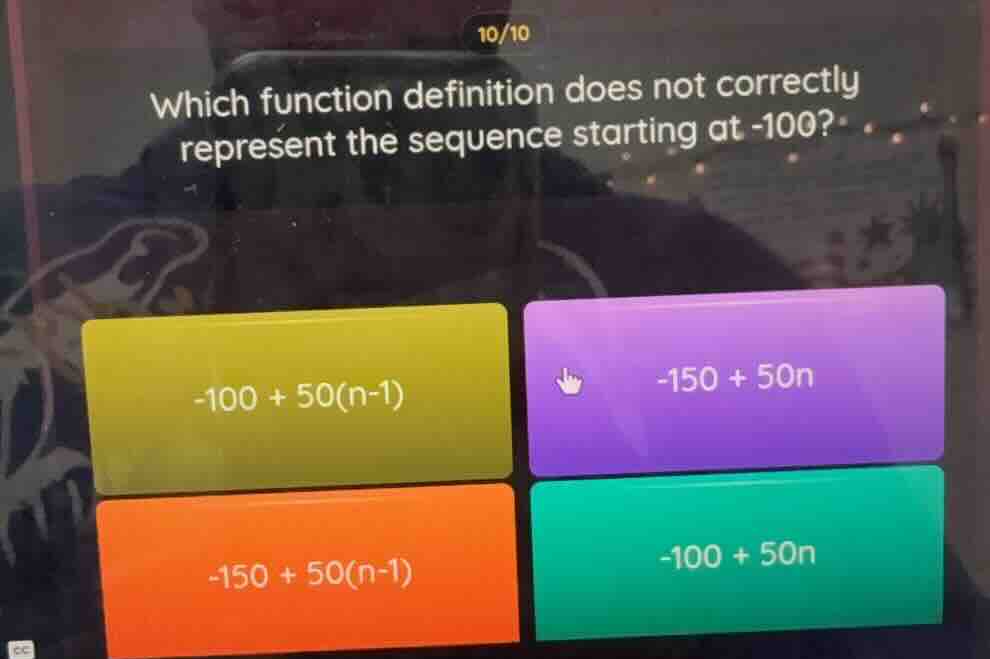
which function definition does not correctly represent the sequence starting at -100?
-100 + 50(n-1)
-150 + 50n
-150 + 50(n-1)
-100 + 50n
Step1: Test n=1 for first option
Substitute $n=1$ into $-100 + 50(n-1)$:
Step2: Test n=1 for second option
Substitute $n=1$ into $-150 + 50n$:
Step3: Test n=1 for third option
Substitute $n=1$ into $-150 + 50(n-1)$:
Step4: Test n=1 for fourth option
Substitute $n=1$ into $-100 + 50n$:
Wait, correct check: The sequence starts at -100 (when n=1). We need the function that does NOT give -100 at n=1. Re-verify:
Wait, Step3 result is -150, Step4 result is -50. Wait, no, re-express all functions properly:
Wait, the question is which does NOT correctly represent the sequence starting at -100. Let's confirm each function's first term (n=1):
- $-100 + 50(n-1)$: $n=1$ gives $-100$ (matches start)
- $-150 + 50n$: $n=1$ gives $-100$ (matches start)
- $-150 + 50(n-1)$: $n=1$ gives $-150$ (does NOT match start)
- $-100 + 50n$: $n=1$ gives $-50$ (does NOT match start)? Wait no, wait maybe the sequence is arithmetic, so we need to check if the function represents a sequence starting at -100, regardless of common difference. Wait the question is "which function definition does NOT correctly represent the sequence starting at -100" — meaning the first term (n=1) must be -100. So any function where f(1) ≠ -100 is the answer. Wait but let's recheck:
Wait $-100 + 50n$ at n=1 is $-100+50=-50≠-100$. $-150 +50(n-1)$ at n=1 is $-150≠-100$. Wait no, maybe I misread. Wait no, let's expand all functions:
- $-100 +50(n-1) = -100 +50n -50 = 50n -150$ (n=1: -100)
- $-150 +50n = 50n -150$ (same as 1, n=1: -100)
- $-150 +50(n-1) = -150 +50n -50 = 50n -200$ (n=1: -150)
- $-100 +50n = 50n -100$ (n=1: -50)
Wait but the question says "the sequence starting at -100" — so the function must have f(1)=-100. So options 3 and 4 have f(1)≠-100? No, wait no, maybe the sequence is defined with n starting at 0? No, standard sequences start at n=1. Wait no, let's recheck the question: "Which function definition does not correctly represent the sequence starting at -100?" So the function should produce a sequence where the first term is -100. So the function that does NOT do that is the one where f(1)≠-100. So option 3: $-150 + 50(n-1)$ gives f(1)=-150, which is not -100. Option 4 gives f(1)=-50. Wait but that can't be. Wait no, maybe I made a mistake. Wait let's re-express option 4: if n starts at 0, then n=0 gives -100. But standard is n=1. Wait the question says "sequence starting at -100" — so the first term is -100. So let's check which function does NOT have -100 as a term? No, no, the function represents the sequence, so the first term (n=1) is -100. So the function that fails this is $-150 + 50(n-1)$, because when n=1, it gives -150, not -100. Wait but option 4 gives -50 at n=1. Wait no, maybe the sequence is arithmetic with first term -100, let's check common differences. Wait option 1: common difference 50, first term -100. Option 2: common difference 50, first term -100. Option 3: common difference 50, first term -150. Option 4: common difference 50, first term -50. So the one that does NOT represent a sequence starting at -100 is option 3: $-150 + 50(n-1)$.
Wait, correction: Let's recheck step 4: $-100 +50n$ when n=1 is $-100+50=-50$, which is not -100, but wait option 2: $-150+50n$ when n=1 is $-150+50=-100$, which is correct. Option 1: $-100+50(n-1)$ when n=1 is $-100+0=-100$…

Snap & solve any problem in the app
Get step-by-step solutions on Sovi AI
Photo-based solutions with guided steps
Explore more problems and detailed explanations
C. $-150 + 50(n-1)$