QUESTION IMAGE
Question
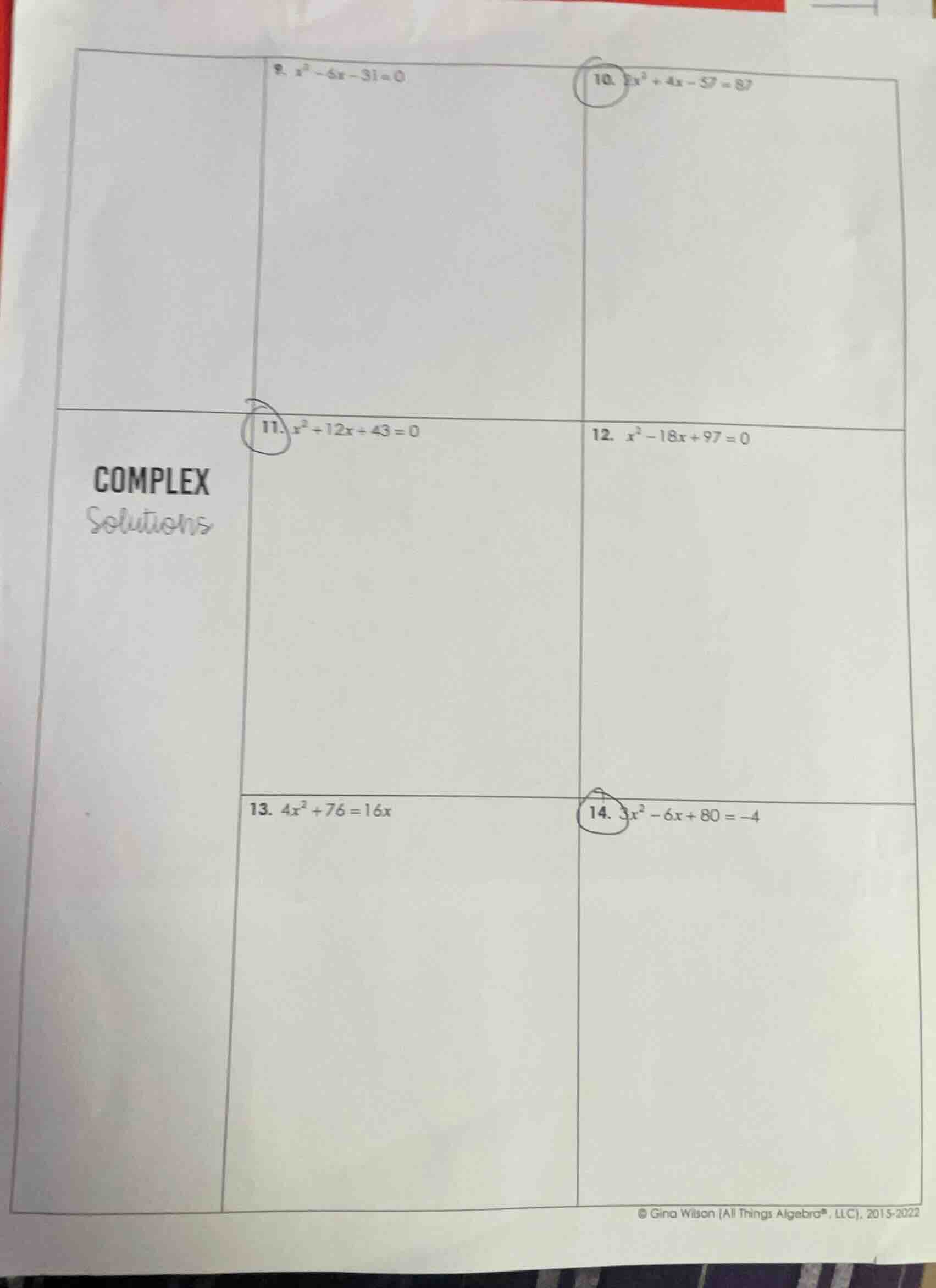
- $x^2 - 6x - 31 = 0$
- $2x^2 + 4x - 57 = 87$
- $x^2 + 12x + 43 = 0$
- $x^2 - 18x + 97 = 0$
complex solutions
- $4x^2 + 76 = 16x$
- $3x^2 - 6x + 80 = -4$
Let's solve equation 11: \(x^{2}+12x + 43=0\) using the quadratic formula.
Step 1: Identify coefficients
For a quadratic equation \(ax^{2}+bx + c = 0\), here \(a = 1\), \(b = 12\), \(c = 43\).
Step 2: Calculate discriminant
The discriminant \(\Delta=b^{2}-4ac\). Substitute the values: \(\Delta=(12)^{2}-4\times1\times43 = 144 - 172=- 28\).
Step 3: Apply quadratic formula
The quadratic formula is \(x=\frac{-b\pm\sqrt{\Delta}}{2a}\). Since \(\Delta=-28=\sqrt{- 28}=2i\sqrt{7}\) (where \(i=\sqrt{-1}\) is the imaginary unit), substitute \(a = 1\), \(b = 12\), \(\Delta=-28\) into the formula:
\(x=\frac{-12\pm\sqrt{-28}}{2\times1}=\frac{-12\pm2i\sqrt{7}}{2}=-6\pm i\sqrt{7}\)

Snap & solve any problem in the app
Get step-by-step solutions on Sovi AI
Photo-based solutions with guided steps
Explore more problems and detailed explanations
The solutions of the equation \(x^{2}+12x + 43 = 0\) are \(x=-6 + i\sqrt{7}\) and \(x=-6 - i\sqrt{7}\)