QUESTION IMAGE
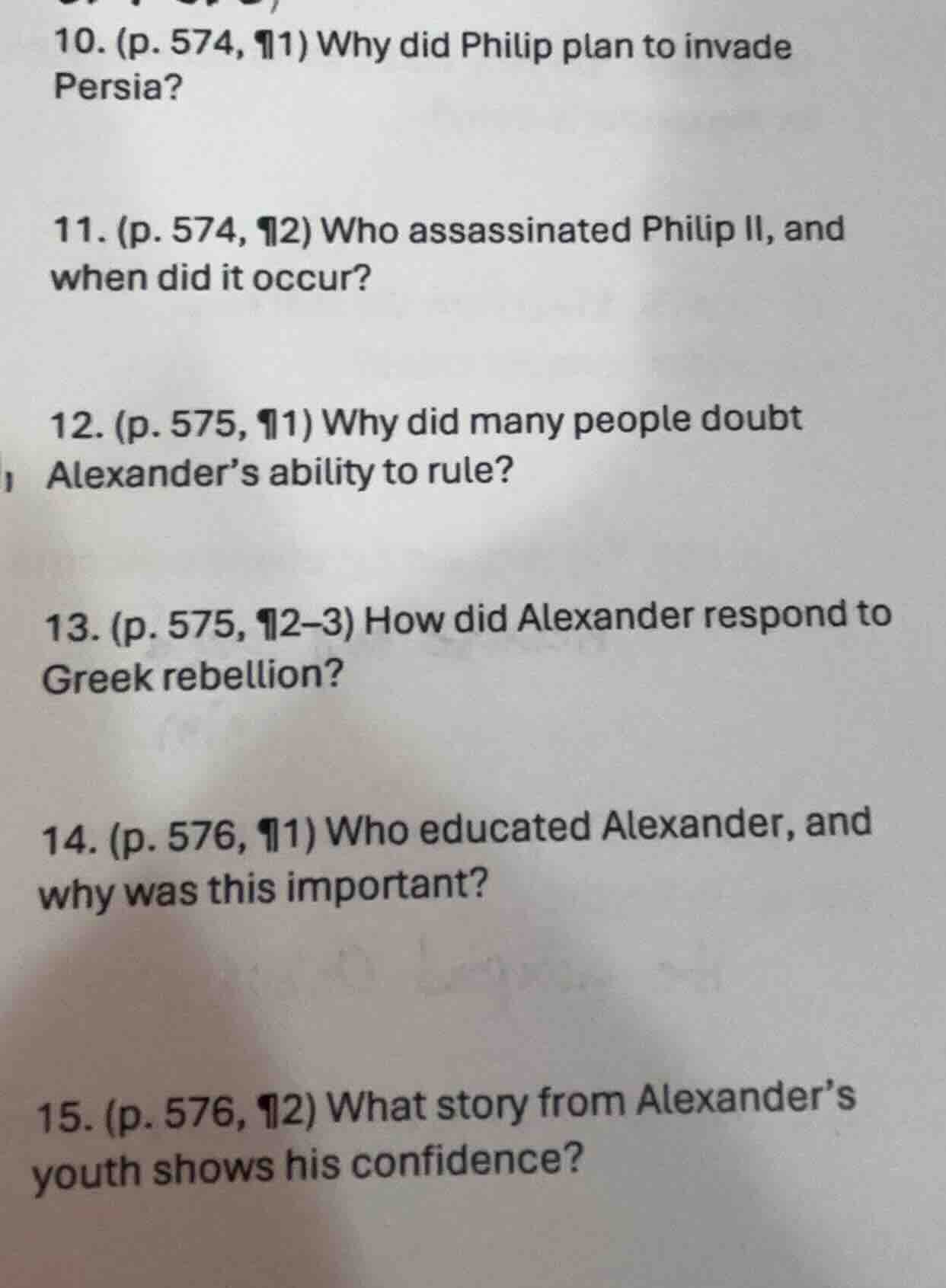
Question
- (p. 574, ¶1) why did philip plan to invade persia?
- (p. 574, ¶2) who assassinated philip ii, and when did it occur?
- (p. 575, ¶1) why did many people doubt alexanders ability to rule?
- (p. 575, ¶2-3) how did alexander respond to greek rebellion?
- (p. 576, ¶1) who educated alexander, and why was this important?
- (p. 576, ¶2) what story from alexanders youth shows his confidence?
Brief Explanations
- Philip of Macedon planned to invade Persia to fulfill a Greek pan-Hellenic goal of avenging the Persian invasions of Greece, gain control of Persia's vast wealth and territories, and unify the Greek city-states under his leadership through a common military campaign.
- Philip II was assassinated in 336 BCE by Pausanias, a young Macedonian noble with a personal grudge against the king.
- Many doubted Alexander's ability to rule because he was only 20 when he took power, had little prior experience leading on a large scale, and some Greek city-states and Macedonian nobles saw him as untested and too impulsive.
- Alexander responded to the Greek rebellion (led by Thebes) by quickly marching his army to the city, sacking and destroying Thebes as a brutal warning to other rebellious Greek states, sparing only temples and the house of the poet Pindar.
- Alexander was educated by the Greek philosopher Aristotle. This was important because Aristotle taught him logic, philosophy, science, and Greek culture, shaping Alexander's intellectual worldview, his appreciation for Greek civilization, and his later goal of spreading Hellenistic culture across his empire.
- The story of Alexander taming the wild horse Bucephalus when he was a youth shows his confidence. While others failed to control the fierce horse, Alexander noticed it was afraid of its own shadow, turned it toward the sun, and rode it, proving his self-assurance and keen observation.

Snap & solve any problem in the app
Get step-by-step solutions on Sovi AI
Photo-based solutions with guided steps
Explore more problems and detailed explanations
- To avenge past Persian invasions of Greece, seize Persia's wealth/territories, and unify Greek states under his leadership.
- Pausanias, a Macedonian noble, assassinated Philip II in 336 BCE.
- He was only 20, untested, and seen as impulsive by many Greeks and Macedonian elites.
- He swiftly sacked and destroyed Thebes to warn other rebellious Greek city-states.
- Aristotle educated him; this shaped his intellectual views and drive to spread Hellenistic culture.
- Taming the unruly horse Bucephalus as a young man.