QUESTION IMAGE
Question
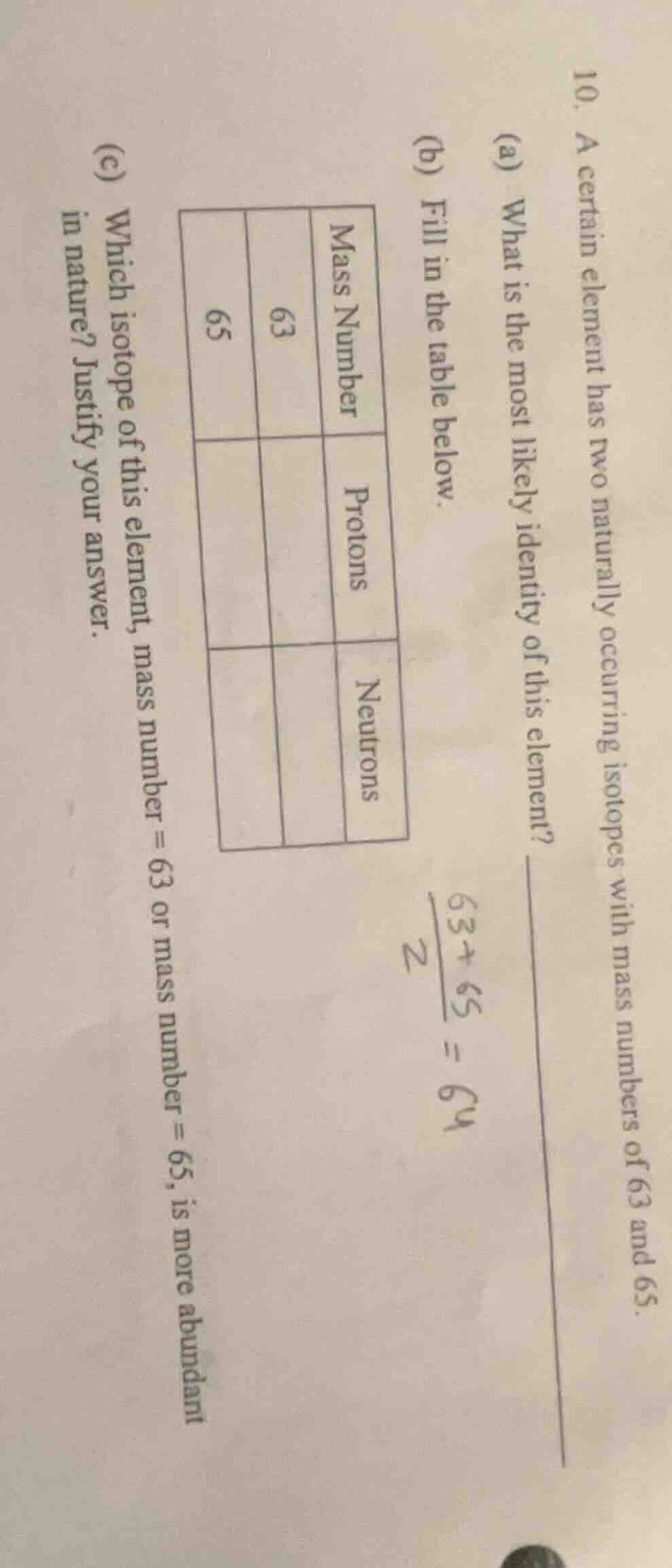
- a certain element has two naturally occurring isotopes with mass numbers of 63 and 65.
(a) what is the most likely identity of this element?
(b) fill in the table below.
| mass number | protons | neutrons |
|---|---|---|
| 65 |
(c) which isotope of this element, mass number = 63 or mass number = 65, is more abundant in nature? justify your answer.
Part (a)
To determine the element, we first recall that the atomic mass of an element is a weighted average of its isotopes' masses. The formula for atomic mass ($A$) is $A = f_1m_1 + f_2m_2$, where $f$ is the fractional abundance and $m$ is the mass number (approximate mass of the isotope). The atomic mass is also close to the mass number of the more abundant isotope. Looking at the calculation hint $\frac{63 + 65}{2}=64$, which is close to the atomic mass of copper (Cu), which has isotopes with mass numbers 63 and 65. So the element is likely Copper (Cu).
Part (b)
For an element, the number of protons is equal to the atomic number. For copper, the atomic number ($Z$) is 29.
- For mass number 63:
- Protons = Atomic number = 29.
- Neutrons = Mass number - Protons = $63 - 29 = 34$.
- For mass number 65:
- Protons = 29 (same atomic number).
- Neutrons = $65 - 29 = 36$.
So the table is filled as:
| Mass Number | Protons | Neutrons |
|---|---|---|
| 65 | 29 | 36 |
Part (c)
The atomic mass of copper is approximately 63.55 amu. The atomic mass is a weighted average of the isotopes' masses. Let the fractional abundance of the 63 isotope be $x$ and of 65 be $1 - x$. Then:
$63x + 65(1 - x)=63.55$
$63x + 65 - 65x = 63.55$
$-2x = 63.55 - 65$
$-2x = -1.45$
$x=\frac{1.45}{2}=0.725$ or 72.5%.
Since the fractional abundance of the mass number 63 isotope is higher (72.5% > 27.5% for 65), the isotope with mass number 63 is more abundant in nature. The atomic mass (63.55) is closer to 63 than to 65, indicating a higher abundance of the 63 isotope.
Final Answers
(a) The element is Copper (Cu).
(b) The table is filled as above.
(c) The isotope with mass number 63 is more abundant because the atomic mass (≈63.55) is closer to 63, indicating a higher fractional abundance of the 63 isotope.

Snap & solve any problem in the app
Get step-by-step solutions on Sovi AI
Photo-based solutions with guided steps
Explore more problems and detailed explanations
Part (a)
To determine the element, we first recall that the atomic mass of an element is a weighted average of its isotopes' masses. The formula for atomic mass ($A$) is $A = f_1m_1 + f_2m_2$, where $f$ is the fractional abundance and $m$ is the mass number (approximate mass of the isotope). The atomic mass is also close to the mass number of the more abundant isotope. Looking at the calculation hint $\frac{63 + 65}{2}=64$, which is close to the atomic mass of copper (Cu), which has isotopes with mass numbers 63 and 65. So the element is likely Copper (Cu).
Part (b)
For an element, the number of protons is equal to the atomic number. For copper, the atomic number ($Z$) is 29.
- For mass number 63:
- Protons = Atomic number = 29.
- Neutrons = Mass number - Protons = $63 - 29 = 34$.
- For mass number 65:
- Protons = 29 (same atomic number).
- Neutrons = $65 - 29 = 36$.
So the table is filled as:
| Mass Number | Protons | Neutrons |
|---|---|---|
| 65 | 29 | 36 |
Part (c)
The atomic mass of copper is approximately 63.55 amu. The atomic mass is a weighted average of the isotopes' masses. Let the fractional abundance of the 63 isotope be $x$ and of 65 be $1 - x$. Then:
$63x + 65(1 - x)=63.55$
$63x + 65 - 65x = 63.55$
$-2x = 63.55 - 65$
$-2x = -1.45$
$x=\frac{1.45}{2}=0.725$ or 72.5%.
Since the fractional abundance of the mass number 63 isotope is higher (72.5% > 27.5% for 65), the isotope with mass number 63 is more abundant in nature. The atomic mass (63.55) is closer to 63 than to 65, indicating a higher abundance of the 63 isotope.
Final Answers
(a) The element is Copper (Cu).
(b) The table is filled as above.
(c) The isotope with mass number 63 is more abundant because the atomic mass (≈63.55) is closer to 63, indicating a higher fractional abundance of the 63 isotope.