QUESTION IMAGE
Question
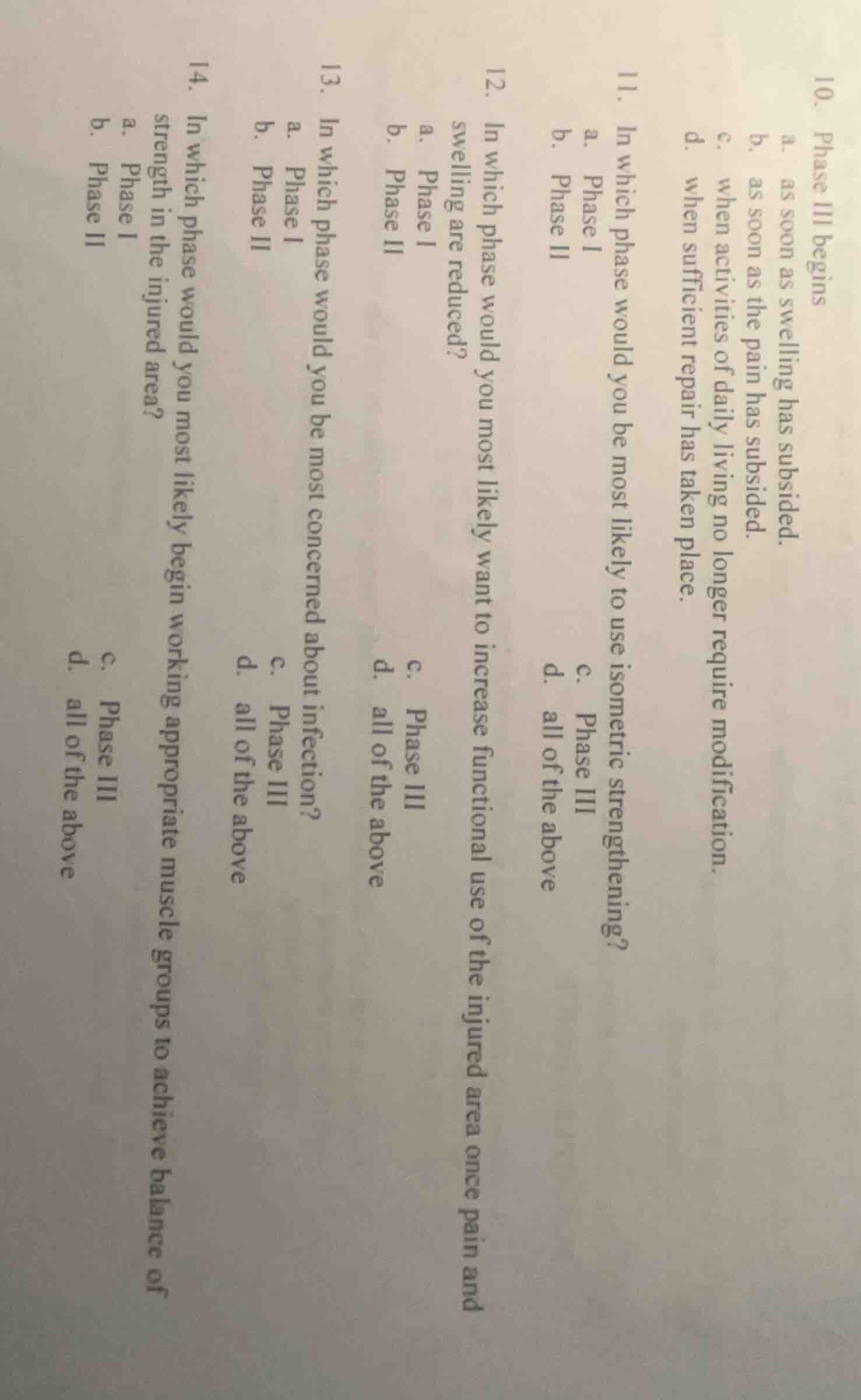
- phase iii begins
a. as soon as swelling has subsided.
b. as soon as the pain has subsided.
c. when activities of daily living no longer require modification.
d. when sufficient repair has taken place.
- in which phase would you be most likely to use isometric strengthening?
a. phase i
b. phase ii
c. phase iii
d. all of the above
- in which phase would you most likely want to increase functional use of the injured area once pain and swelling are reduced?
a. phase i
b. phase ii
c. phase iii
d. all of the above
- in which phase would you be most concerned about infection?
a. phase i
b. phase ii
c. phase iii
d. all of the above
- in which phase would you most likely begin working appropriate muscle groups to achieve balance of strength in the injured area?
a. phase i
b. phase ii
c. phase iii
d. all of the above
Brief Explanations
- Phase III (late rehabilitation) focuses on returning to full function, which starts once repair is sufficient.
- Isometric strengthening is safe to start in Phase I (acute phase) to maintain muscle tone without stressing the injury.
- Phase II (subacute phase) is when pain/swelling reduce, so functional use can increase.
- Phase I (acute phase) is when the injury is fresh, so infection risk is highest.
- Phase III (late rehabilitation) focuses on restoring full strength and muscle balance after initial healing.

Snap & solve any problem in the app
Get step-by-step solutions on Sovi AI
Photo-based solutions with guided steps
Explore more problems and detailed explanations
- d. when sufficient repair has taken place.
- a. Phase I
- b. Phase II
- a. Phase I
- c. Phase III