QUESTION IMAGE
Question
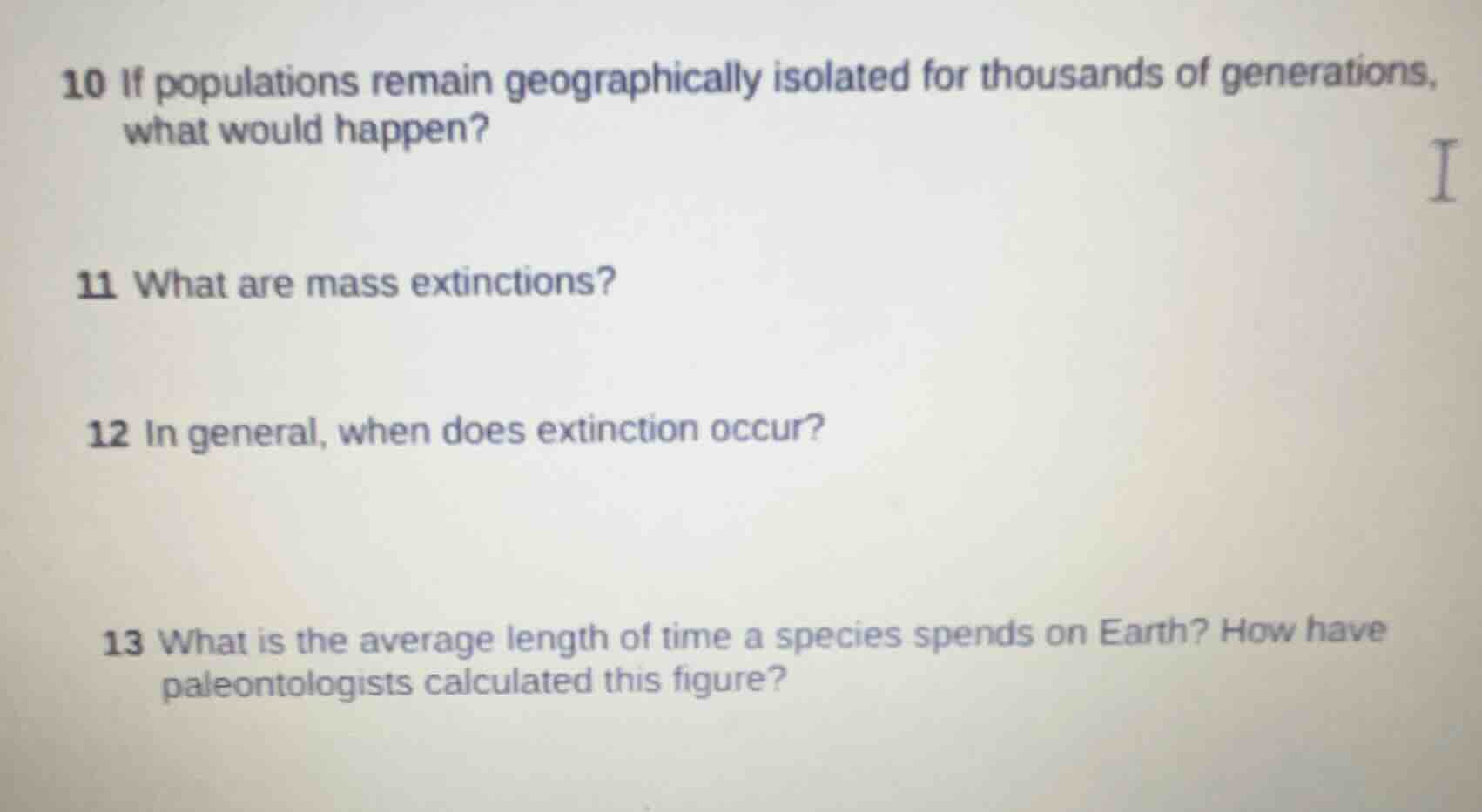
10 if populations remain geographically isolated for thousands of generations, what would happen?
11 what are mass extinctions?
12 in general, when does extinction occur?
13 what is the average length of time a species spends on earth? how have paleontologists calculated this figure?
Brief Explanations
- For question 10: Geographic isolation stops gene flow between populations. Over thousands of generations, genetic differences accumulate due to mutation, genetic drift, and natural selection adapting each group to its local environment. These differences become so great that the populations can no longer interbreed and produce fertile offspring, forming new species.
- For question 11: Mass extinctions are distinct from background extinctions (the steady, low-rate loss of species over time). They involve extreme, rapid environmental disruptions like asteroid impacts, volcanic eruptions, or climate shifts that kill off most life on Earth in a short geological timeframe.
- For question 12: Extinction happens when a species cannot adapt to changing environmental conditions (like habitat loss, competition, or climate change) fast enough to survive and reproduce, leading to the loss of all its individuals.
- For question 13: The average species lifespan is based on fossil record analysis. Paleontologists track the first and last appearance of species in layered rock formations, calculate the time span for each, then average these values across many species.

Snap & solve any problem in the app
Get step-by-step solutions on Sovi AI
Photo-based solutions with guided steps
Explore more problems and detailed explanations
- The populations will likely evolve into separate, reproductively isolated species (speciation will occur) due to accumulated genetic differences from mutation, drift, and local adaptation.
- Mass extinctions are events where a very large percentage (75% or more) of Earth's species go extinct in a relatively short period (geologically speaking, usually less than 2.8 million years), caused by severe global environmental disruptions.
- Extinction occurs when a species is unable to adapt to environmental changes (such as habitat destruction, new predators, climate shift, or resource scarcity) sufficiently to maintain a viable breeding population, leading to the death of all its remaining individuals.
- The average length of time a species spends on Earth is roughly 1-10 million years. Paleontologists calculate this by examining the fossil record: they identify the earliest and latest fossil occurrences of a species in sedimentary rock layers (dating the layers using radiometric dating or relative dating), determine the time interval between these points for each species, then compute the average of these intervals across a large sample of species.