QUESTION IMAGE
Question
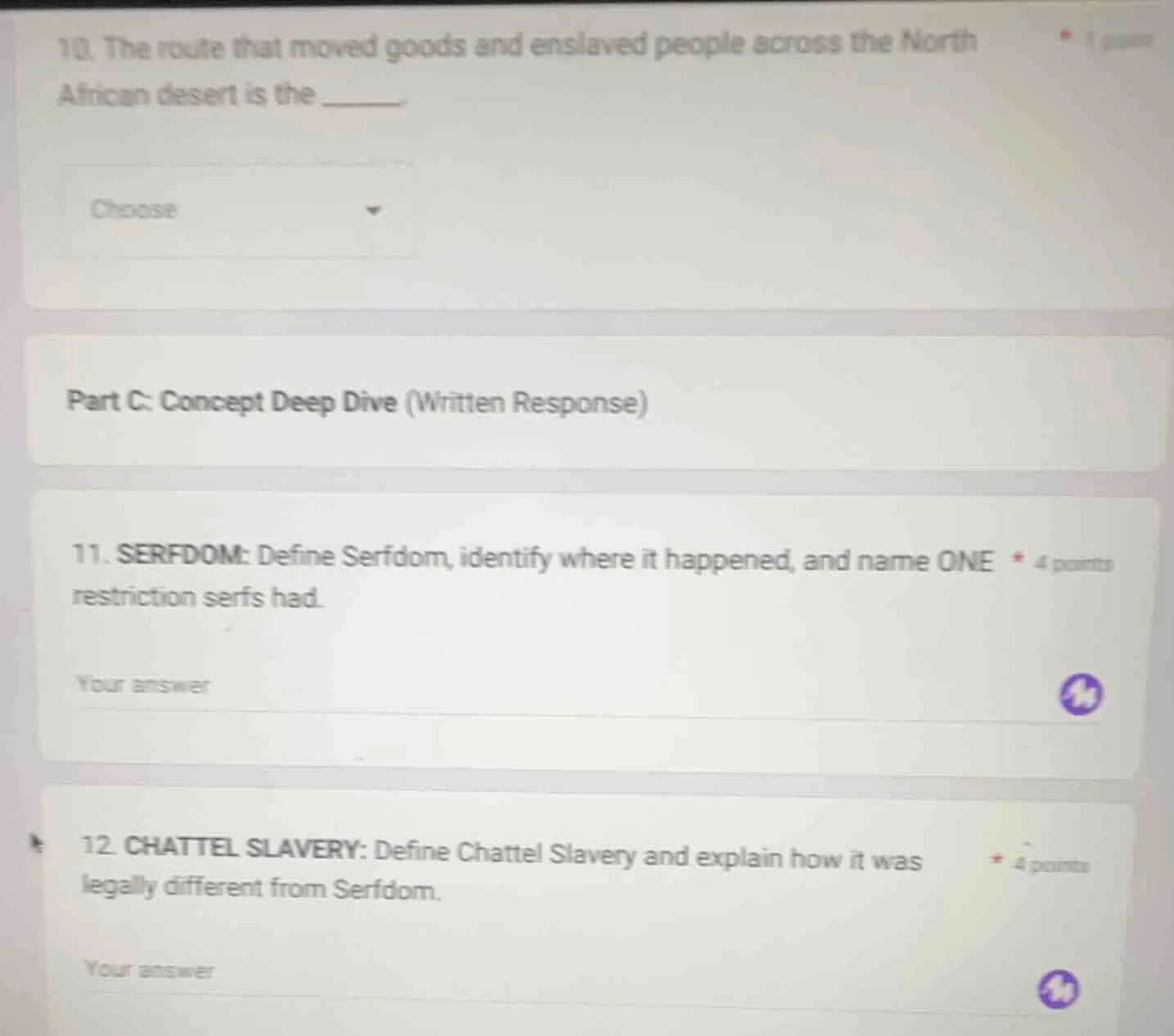
- the route that moved goods and enslaved people across the north african desert is the ______. choose part c: concept deep dive (written response) 11. serfdom: define serfdom, identify where it happened, and name one restriction serfs had. your answer 12. chattel slavery: define chattel slavery and explain how it was legally different from serfdom. your answer
Brief Explanations
For Question 10:
This refers to a historic trade route that traversed the Sahara, moving goods and enslaved people between West Africa, North Africa, and the Mediterranean.
For Question 11:
Serfdom is a feudal labor system. The definition covers the bonded status of serfs, the primary region of occurrence is medieval Europe, and a key restriction limits their movement.
For Question 12:
Chattel slavery treats people as property. The legal difference lies in the permanent, inheritable property status of enslaved people versus serfs' tie to land.

Snap & solve any problem in the app
Get step-by-step solutions on Sovi AI
Photo-based solutions with guided steps
Explore more problems and detailed explanations
- Trans-Saharan Trade Route
- - Definition: Serfdom was a feudal system where serfs were legally bound to work on a lord's land, in exchange for small plots to farm and protection.
- Location: It was most widespread in medieval Europe (across Western, Central, and Eastern European kingdoms).
- Restriction: Serfs could not leave the lord's estate without the lord's permission.
- - Definition: Chattel slavery is a system where enslaved people are treated as fully transferable, inheritable property, with no legal personhood.
- Legal difference: Unlike serfs, who were tied to a specific plot of land (and transferred only if the land was sold), enslaved people under chattel slavery could be bought, sold, or traded independently of land, and their status was passed down to their children automatically.