QUESTION IMAGE
Question
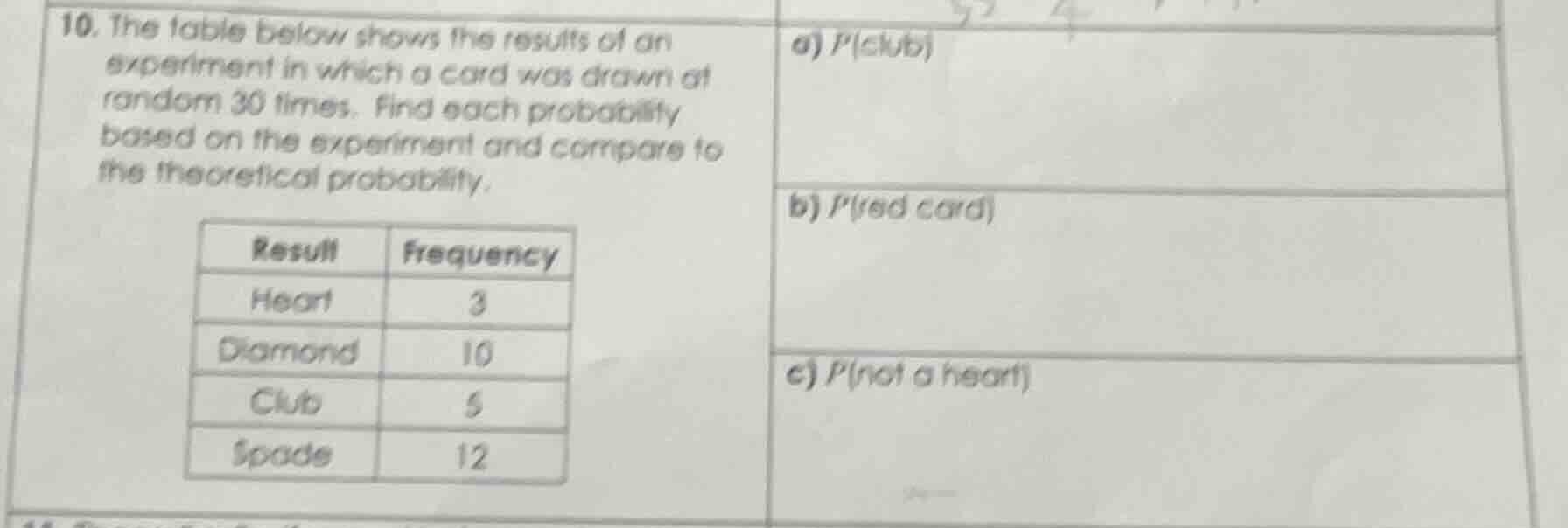
- the table below shows the results of an experiment in which a card was drawn at random 30 times. find each probability based on the experiment and compare to the theoretical probability.
| result | frequency |
|---|---|
| diamond | 10 |
| club | 5 |
| spade | 12 |
a) ( p(\text{club}) )
b) ( p(\text{red card}) )
c) ( p(\text{not a heart}) )
Part (a): \( P(\text{club}) \)
Step 1: Recall the formula for experimental probability
The experimental probability of an event is given by \( P(\text{event}) = \frac{\text{Frequency of the event}}{\text{Total number of trials}} \).
First, we find the total number of trials. The total number of card draws is the sum of the frequencies: \( 3 + 10 + 5 + 12 = 30 \).
Step 2: Calculate \( P(\text{club}) \)
The frequency of drawing a club is 5, and the total number of trials is 30. So, \( P(\text{club}) = \frac{5}{30} = \frac{1}{6} \approx 0.1667 \).
The theoretical probability of drawing a club (in a standard deck of 52 cards) is \( \frac{13}{52} = \frac{1}{4} = 0.25 \). The experimental probability is less than the theoretical probability.
Part (b): \( P(\text{red card}) \)
Step 1: Identify red card results
Red cards are hearts and diamonds. The frequency of hearts is 3, and the frequency of diamonds is 10. So, the total frequency of red cards is \( 3 + 10 = 13 \).
Step 2: Calculate \( P(\text{red card}) \)
Using the experimental probability formula, with total trials 30, we have \( P(\text{red card}) = \frac{13}{30} \approx 0.4333 \).
The theoretical probability of drawing a red card (in a standard deck) is \( \frac{26}{52} = \frac{1}{2} = 0.5 \). The experimental probability is slightly less than the theoretical probability.
Part (c): \( P(\text{not a heart}) \)
Step 1: Find the frequency of not a heart
The frequency of hearts is 3, so the frequency of not a heart is the total number of trials minus the frequency of hearts: \( 30 - 3 = 27 \).
Step 2: Calculate \( P(\text{not a heart}) \)
Using the experimental probability formula, \( P(\text{not a heart}) = \frac{27}{30} = \frac{9}{10} = 0.9 \).
The theoretical probability of not drawing a heart (in a standard deck) is \( 1 - \frac{13}{52} = 1 - \frac{1}{4} = \frac{3}{4} = 0.75 \). The experimental probability is greater than the theoretical probability.
Final Answers:
a) \( P(\text{club}) = \boldsymbol{\frac{1}{6} \approx 0.167} \) (experimental), theoretical \( \frac{1}{4} = 0.25 \)
b) \( P(\text{red card}) = \boldsymbol{\frac{13}{30} \approx 0.433} \) (experimental), theoretical \( \frac{1}{2} = 0.5 \)
c) \( P(\text{not a heart}) = \boldsymbol{\frac{9}{10} = 0.9} \) (experimental), theoretical \( \frac{3}{4} = 0.75 \)

Snap & solve any problem in the app
Get step-by-step solutions on Sovi AI
Photo-based solutions with guided steps
Explore more problems and detailed explanations
Step 1: Find the frequency of not a heart
The frequency of hearts is 3, so the frequency of not a heart is the total number of trials minus the frequency of hearts: \( 30 - 3 = 27 \).
Step 2: Calculate \( P(\text{not a heart}) \)
Using the experimental probability formula, \( P(\text{not a heart}) = \frac{27}{30} = \frac{9}{10} = 0.9 \).
The theoretical probability of not drawing a heart (in a standard deck) is \( 1 - \frac{13}{52} = 1 - \frac{1}{4} = \frac{3}{4} = 0.75 \). The experimental probability is greater than the theoretical probability.
Final Answers:
a) \( P(\text{club}) = \boldsymbol{\frac{1}{6} \approx 0.167} \) (experimental), theoretical \( \frac{1}{4} = 0.25 \)
b) \( P(\text{red card}) = \boldsymbol{\frac{13}{30} \approx 0.433} \) (experimental), theoretical \( \frac{1}{2} = 0.5 \)
c) \( P(\text{not a heart}) = \boldsymbol{\frac{9}{10} = 0.9} \) (experimental), theoretical \( \frac{3}{4} = 0.75 \)