QUESTION IMAGE
Question
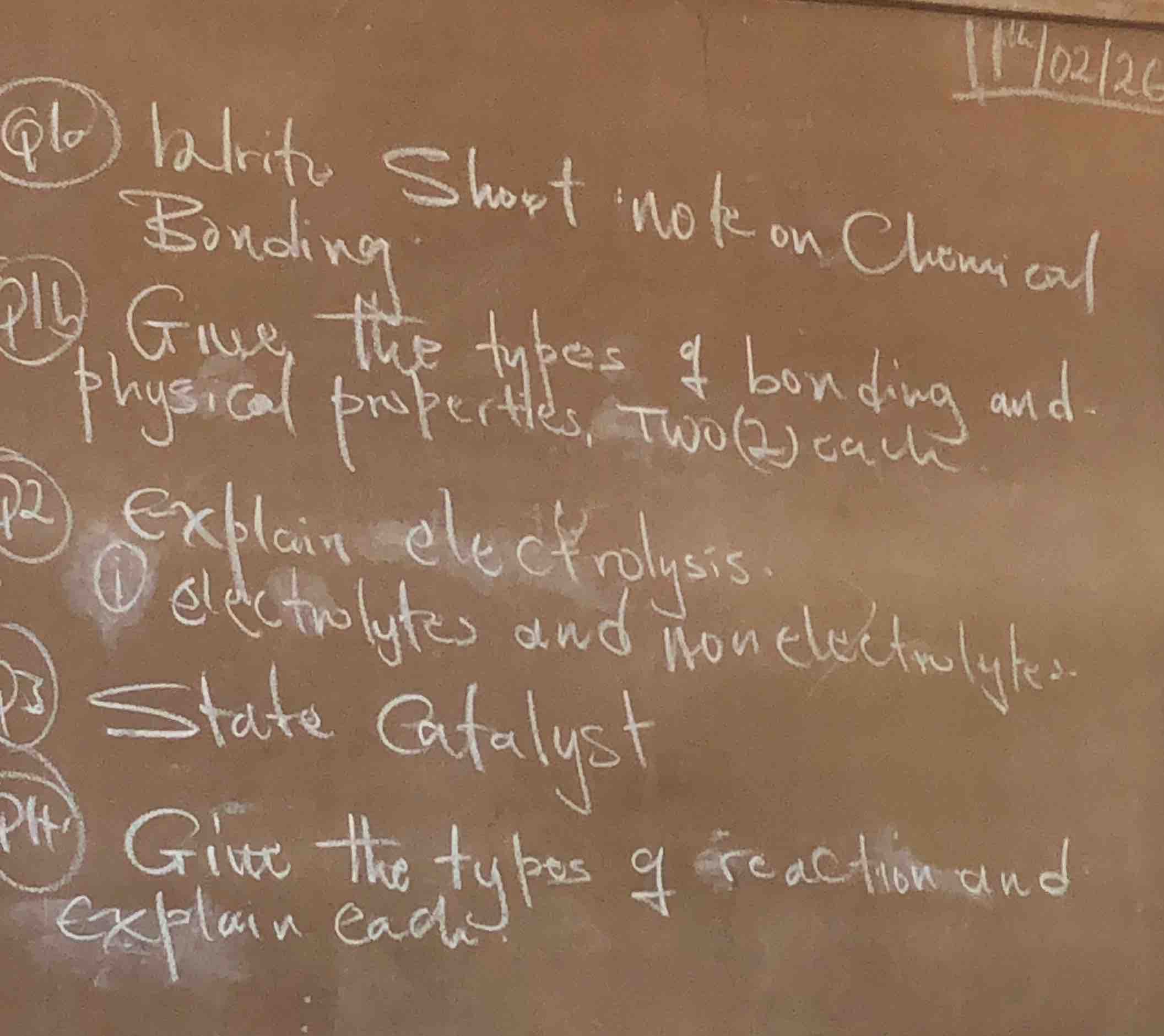
11/02/26
q6) write short note on chemical bonding
q16) give the types of bonding and physical properties, two(2) each
q2) explain electrolysis.
① electrolytes and non electrolytes.
q3) state catalyst
q14) give the types of reaction and explain each
Brief Explanations
- Q6 (Chemical Bonding Short Note): Chemical bonding is the attractive force that holds atoms, ions, or molecules together to form stable chemical compounds. It arises from the interaction of valence electrons between particles, enabling the formation of substances with distinct properties.
- Q16 (Bonding Types & Properties):
- Ionic Bonding: Formed by electron transfer between metals and nonmetals. Properties: High melting/boiling points; conducts electricity when molten/dissolved.
- Covalent Bonding: Formed by electron sharing between nonmetals. Properties: Low melting/boiling points (for molecular covalent); does not conduct electricity.
- Q2 (Electrolysis, Electrolytes, Non-Electrolytes):
- Electrolysis: A process where electrical energy drives a non-spontaneous chemical reaction, breaking down compounds into their components using electrodes in an electrolyte.
- Electrolytes: Substances (e.g., NaCl, HCl) that conduct electricity when dissolved in water or molten, as they dissociate into ions.
- Non-electrolytes: Substances (e.g., sugar, ethanol) that do not conduct electricity in any state, as they do not dissociate into ions.
- Q3 (Catalyst Definition): A catalyst is a substance that increases the rate of a chemical reaction without being consumed in the process, by lowering the reaction's activation energy.
- Q14 (Reaction Types & Explanations):
- Combination (Synthesis): Two or more substances react to form a single product (e.g., $2H_2 + O_2
ightarrow 2H_2O$).
- Decomposition: A single compound breaks down into two or more simpler substances (e.g., $2H_2O_2
ightarrow 2H_2O + O_2$).
- Displacement: A more reactive element replaces a less reactive element in a compound (e.g., $Zn + CuSO_4
ightarrow ZnSO_4 + Cu$).
- Double Displacement: Ions of two compounds swap places to form new compounds (e.g., $AgNO_3 + NaCl
ightarrow AgCl \downarrow + NaNO_3$).

Snap & solve any problem in the app
Get step-by-step solutions on Sovi AI
Photo-based solutions with guided steps
Explore more problems and detailed explanations
- Q6: Chemical bonding is the attractive force that holds atoms, ions, or molecules together to form stable chemical compounds, driven by interactions between valence electrons.
- Q16:
- Ionic Bonding: Formed via electron transfer; properties: high melting/boiling points, conducts electricity when molten/dissolved.
- Covalent Bonding: Formed via electron sharing; properties: low melting/boiling points (molecular), non-conductive.
- Q2:
- Electrolysis: A process using electrical energy to drive non-spontaneous chemical reactions and decompose compounds.
- Electrolytes: Ionizable substances that conduct electricity in solution/molten state (e.g., NaCl).
- Non-electrolytes: Non-ionizable substances that do not conduct electricity (e.g., sugar).
- Q3: A catalyst is a substance that speeds up a chemical reaction without being consumed, by lowering the reaction's activation energy.
- Q14:
- Combination: Two+ substances form one product (e.g., $2H_2 + O_2
ightarrow 2H_2O$).
- Decomposition: One compound breaks into simpler substances (e.g., $2H_2O_2
ightarrow 2H_2O + O_2$).
- Displacement: Reactive element replaces less reactive one in a compound (e.g., $Zn + CuSO_4
ightarrow ZnSO_4 + Cu$).
- Double Displacement: Ions of two compounds swap to form new compounds (e.g., $AgNO_3 + NaCl
ightarrow AgCl \downarrow + NaNO_3$).