QUESTION IMAGE
Question
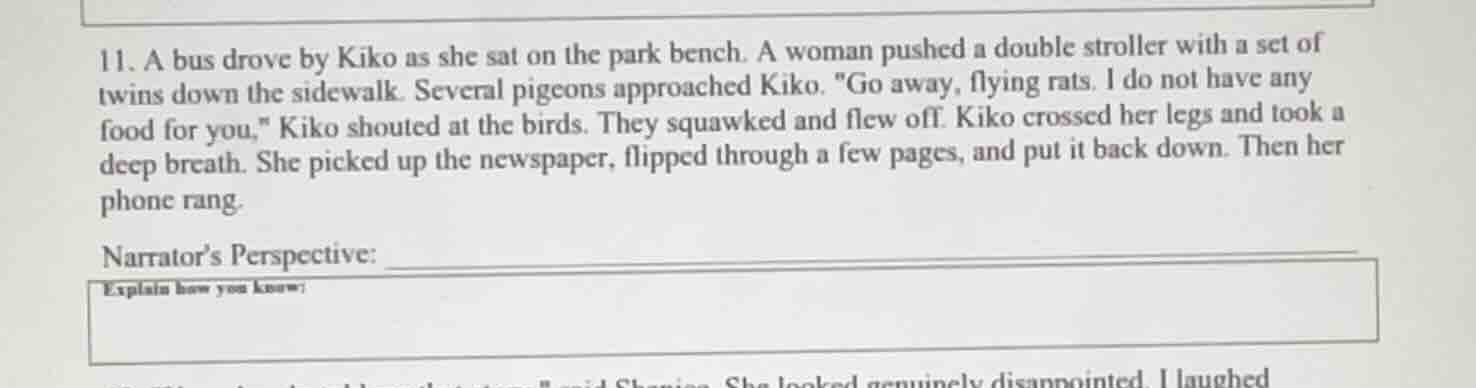
- a bus drove by kiko as she sat on the park bench. a woman pushed a double stroller with a set of twins down the sidewalk. several pigeons approached kiko. \go away, flying rats. i do not have any food for you,\ kiko shouted at the birds. they squawked and flew off. kiko crossed her legs and took a deep breath. she picked up the newspaper, flipped through a few pages, and put it back down. then her phone rang.
narrator’s perspective:
explain how you know:
Brief Explanations
To determine the narrator's perspective, we analyze the text:
- The narrator uses third - person pronouns like "Kiko", "she", "they" to refer to the characters. There is no use of first - person pronouns (like "I") to indicate that the narrator is a character in the story, and also no use of second - person pronouns (like "you") to directly address the reader as a participant.
- The narrator has an omniscient or at least a third - person objective view as they are able to describe the actions and surroundings of Kiko and other elements (like the bus, the woman with the stroller, the pigeons) from a detached, external point of view, reporting on what is happening without being a part of the story's action.
The narrator uses third - person pronouns (e.g., "Kiko", "she", "they") to describe the characters' actions and the events. The narrator is not a character in the story (no "I" used) and does not directly address the reader (no "you" used), instead reporting events from an external, observational point of view.

Snap & solve any problem in the app
Get step-by-step solutions on Sovi AI
Photo-based solutions with guided steps
Explore more problems and detailed explanations
Narrator’s Perspective: Third - person objective (or third - person)