QUESTION IMAGE
Question
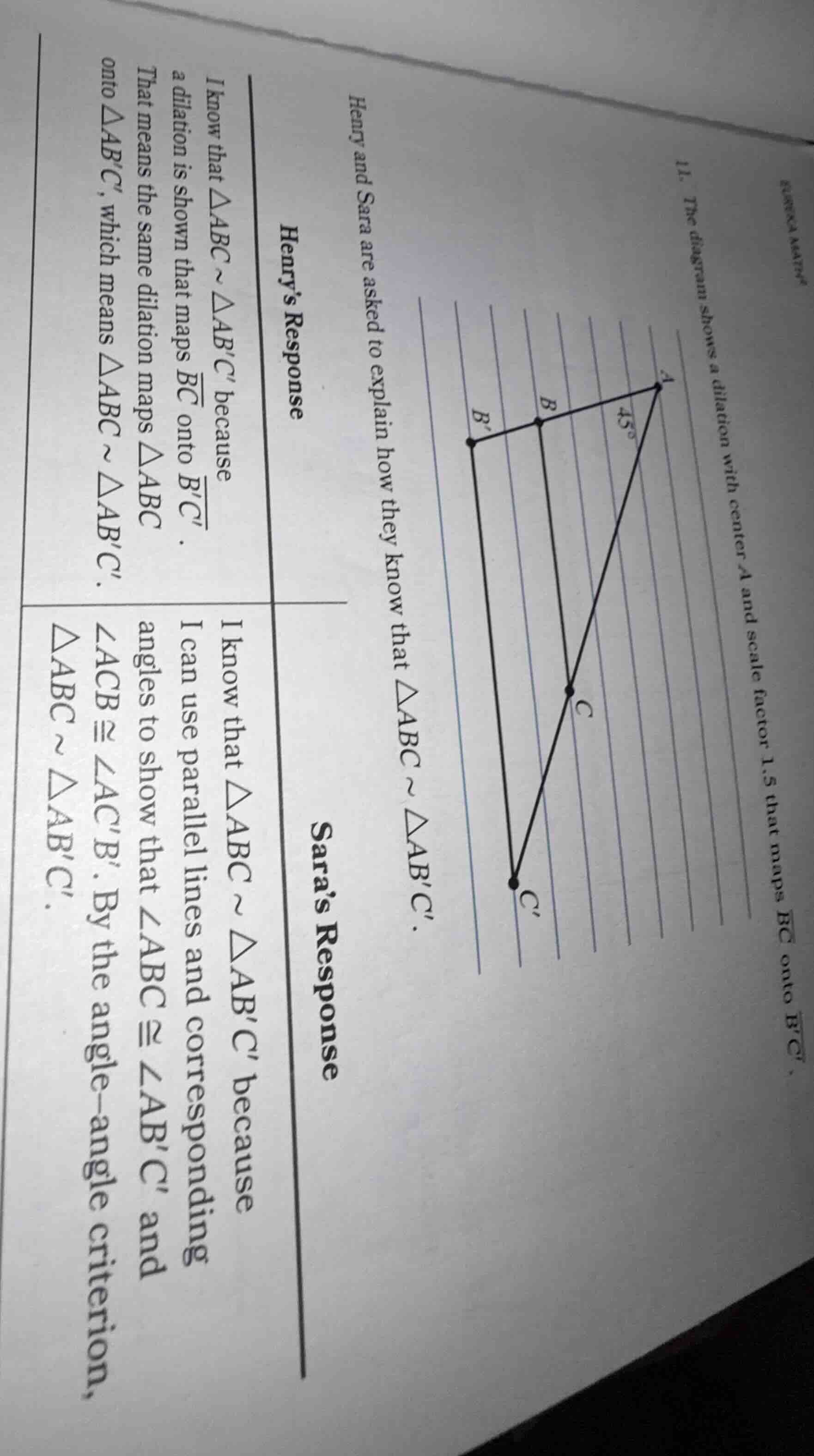
- the diagram shows a dilation with center a and scale factor 1.5 that maps \\(\overline{bc}\\) onto \\(\overline{bc}\\).
henry and sara are asked to explain how they know that \\(\triangle abc \sim \triangle abc\\).
henry’s response
i know that \\(\triangle abc \sim \triangle abc\\) because
a dilation is shown that maps \\(\overline{bc}\\) onto \\(\overline{bc}\\).
that means the same dilation maps \\(\triangle abc\\)
onto \\(\triangle abc\\), which means \\(\triangle abc \sim \triangle abc\\).
sara’s response
i know that \\(\triangle abc \sim \triangle abc\\) because
i can use parallel lines and corresponding
angles to show that \\(\angle abc \cong \angle abc\\) and
\\(\angle acb \cong \angle acb\\). by the angle–angle criterion,
\\(\triangle abc \sim \triangle abc\\).
Both Henry and Sara are correct. Henry uses the definition of dilation: a dilation maps a figure to a similar figure, so since the dilation maps $\triangle ABC$ to $\triangle AB'C'$, the triangles are similar. Sara uses the AA (Angle-Angle) similarity criterion: because $BC \parallel B'C'$ (a property of dilations, which preserve parallelism), corresponding angles $\angle ABC \cong \angle AB'C'$ and $\angle ACB \cong \angle AC'B'$. With two pairs of congruent corresponding angles, the triangles are similar by AA similarity.

Snap & solve any problem in the app
Get step-by-step solutions on Sovi AI
Photo-based solutions with guided steps
Explore more problems and detailed explanations
Both Henry and Sara have valid, correct explanations for why $\triangle ABC \sim \triangle AB'C'$. Henry relies on the defining property of dilations (they produce similar figures), while Sara uses the AA similarity criterion with parallel line corresponding angles.