QUESTION IMAGE
Question
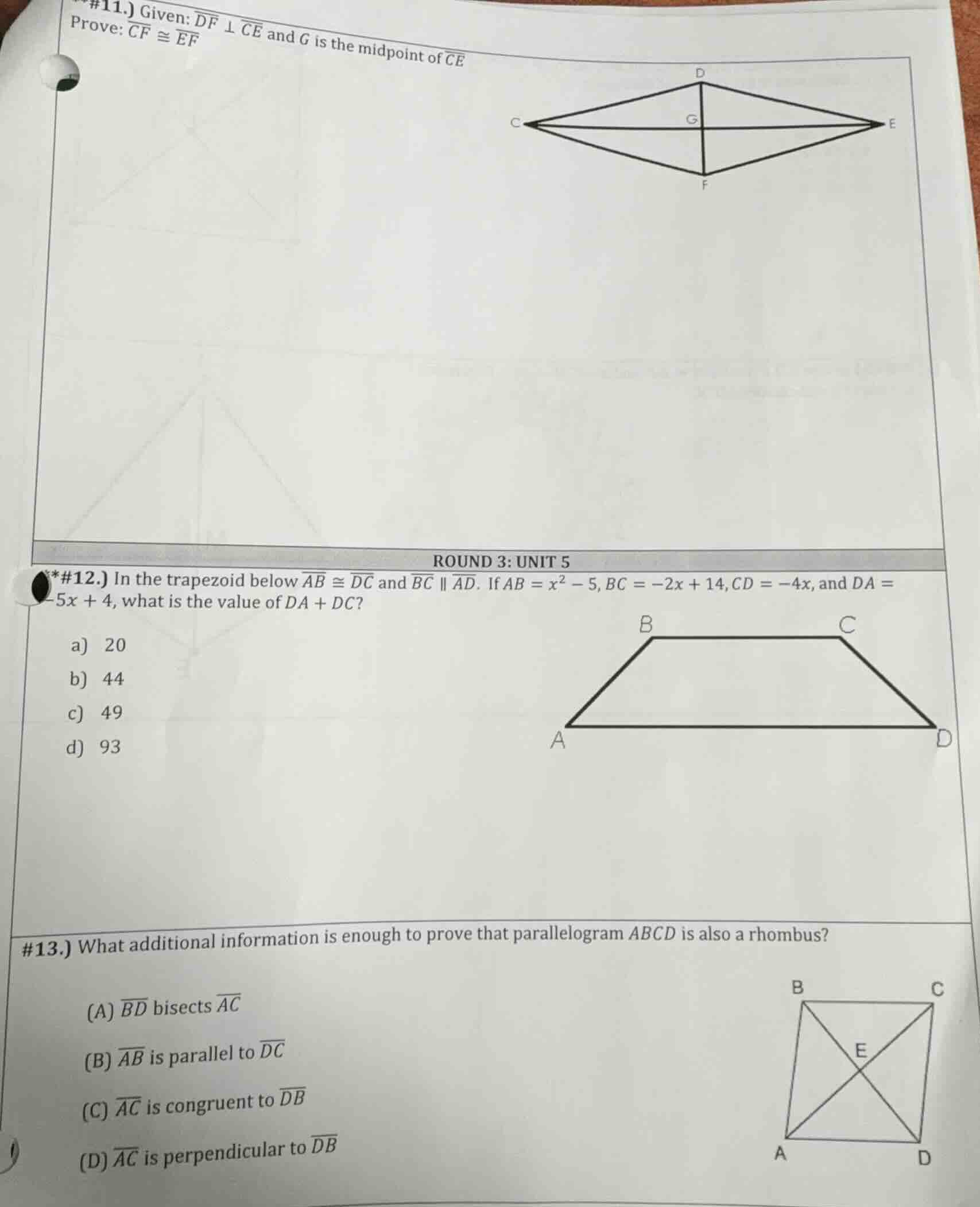
#11.) given: $overline{df} perp overline{ce}$ and $g$ is the midpoint of $overline{ce}$
prove: $overline{cf} cong overline{ef}$
round 3: unit 5
**#12.) in the trapezoid below $overline{ab} cong overline{dc}$ and $overline{bc} \parallel overline{ad}$. if $ab = x^2 - 5$, $bc = -2x + 14$, $cd = -4x$, and $da = -5x + 4$, what is the value of $da + dc$?
a) 20
b) 44
c) 49
d) 93
#13.) what additional information is enough to prove that parallelogram $abcd$ is also a rhombus?
(a) $overline{bd}$ bisects $overline{ac}$
(b) $overline{ab}$ is parallel to $overline{dc}$
(c) $overline{ac}$ is congruent to $overline{db}$
(d) $overline{ac}$ is perpendicular to $overline{db}$
Question 12 Solution:
Step1: Set \( AB = DC \)
Since \( \overline{AB} \cong \overline{DC} \), their lengths are equal. So \( x^2 - 5 = -4x \).
Step2: Solve the quadratic equation
Rearrange the equation: \( x^2 + 4x - 5 = 0 \). Factor it: \( (x + 5)(x - 1) = 0 \). So \( x = -5 \) or \( x = 1 \).
Step3: Check valid \( x \)
Lengths can't be negative. For \( x = -5 \), \( BC = -2(-5)+14 = 24 \), \( CD = -4(-5)=20 \), \( DA = -5(-5)+4 = 29 \) (all positive). For \( x = 1 \), \( CD = -4(1)= -4 \) (invalid, length can't be negative). So \( x = -5 \).
Step4: Calculate \( DA + DC \)
\( DA = -5x + 4 = -5(-5)+4 = 29 \), \( DC = -4x = -4(-5)=20 \). Then \( DA + DC = 29 + 20 = 49 \).
A rhombus is a parallelogram with perpendicular diagonals. Option A: Diagonals of a parallelogram always bisect each other, so this is true for all parallelograms, not just rhombuses. Option B: In a parallelogram, \( \overline{AB} \parallel \overline{DC} \) by definition, so this doesn't prove it's a rhombus. Option C: Congruent diagonals in a parallelogram mean it's a rectangle, not necessarily a rhombus. Option D: If diagonals are perpendicular, the parallelogram is a rhombus.

Snap & solve any problem in the app
Get step-by-step solutions on Sovi AI
Photo-based solutions with guided steps
Explore more problems and detailed explanations
c) 49