QUESTION IMAGE
Question
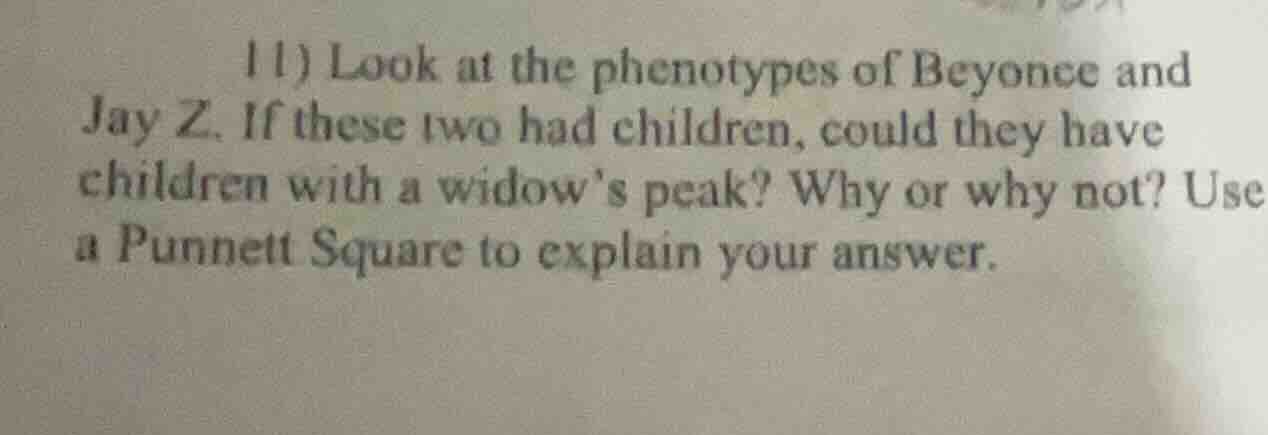
- look at the phenotypes of beyonce and jay z. if these two had children, could they have children with a widow’s peak? why or why not? use a punnett square to explain your answer.
To answer this, we first assume the genotype for widow’s peak (a dominant trait, let's say allele \( W \)) and no widow’s peak (recessive, \( w \)). Let's assume Beyoncé and Jay - Z’s genotypes (since the problem refers to “look at their phenotypes”, we'll make a common assumption for illustration: suppose both have the genotype \( ww \) for no widow’s peak, or one has \( Ww \) and the other \( ww \), etc. But let's take a typical case where widow’s peak is dominant (\( W \)) and no widow’s peak is recessive (\( w \)).
Step 1: Define Genotypes (Assumption)
Let's assume (for a common scenario) that both Beyoncé and Jay - Z have the genotype \( ww \) (no widow’s peak phenotype). The allele for widow’s peak (\( W \)) is dominant, and for no widow’s peak (\( w \)) is recessive.
Step 2: Set up Punnett Square
When we cross two individuals with genotype \( ww \), the gametes produced by each individual will only have the \( w \) allele.
| \( w \) | \( w \) | |
|---|---|---|
| \( w \) | \( ww \) | \( ww \) |
Step 3: Analyze the Punnett Square
All the offspring genotypes are \( ww \). Since the widow’s peak trait is dominant (\( W \) is needed to express the widow’s peak phenotype), and all offspring have the recessive \( ww \) genotype, they will have no widow’s peak.
However, if one of the parents has a genotype of \( Ww \) (widow’s peak phenotype, since \( W \) is dominant) and the other has \( ww \) (no widow’s peak), the Punnett square would be:
| \( w \) | \( w \) | |
|---|---|---|
| \( w \) | \( ww \) | \( ww \) |
In this case, 50% of the offspring would have the genotype \( Ww \), which would result in a widow’s peak phenotype.
The key is to know the actual genotypes of Beyoncé and Jay - Z from their phenotypes. But generally, if at least one parent has a dominant allele (\( W \)) for widow’s peak (either \( WW \) or \( Ww \) genotype), then there is a chance for the children to have a widow’s peak. If both parents are \( ww \) (no dominant allele for widow’s peak), then the children cannot have a widow’s peak.
For example, if we assume Beyoncé is \( Ww \) (widow’s peak) and Jay - Z is \( ww \) (no widow’s peak):
Step 1: Gamete Production
Beyoncé (\( Ww \)) produces gametes \( W \) and \( w \). Jay - Z (\( ww \)) produces gametes \( w \) and \( w \).
Step 2: Punnett Square
| \( w \) | \( w \) | |
|---|---|---|
| \( w \) | \( ww \) | \( ww \) |
Step 3: Phenotype Analysis
The genotypes \( Ww \) will show the widow’s peak phenotype (because \( W \) is dominant), and \( ww \) will not. So in this case, 50% of the children have a chance to have a widow’s peak.
If both parents are \( WW \) (widow’s peak), all children will be \( WW \) (widow’s peak). If one is \( WW \) and the other is \( Ww \), all children will have widow’s peak.
The answer depends on the actual genotypes of Beyoncé and Jay - Z, but using the Punnett square, we can determine the probability of their children having a widow’s peak based on their genotypes.
If we assume the common case where widow’s peak is dominant (\( W \)) and we know the parents' genotypes, we can conclude:
If at least one parent has a dominant allele (\( W \)) (i.e., genotype \( WW \) or \( Ww \)), then yes, they can have children with a widow’s peak. If both parents are \( ww \) (no dominant allele), then no.
For example, if we take the case where one parent is \( Ww \) and the other is \( ww \) (as above), the answer is yes, because 50% of the offspring will ha…

Snap & solve any problem in the app
Get step-by-step solutions on Sovi AI
Photo-based solutions with guided steps
Explore more problems and detailed explanations
To answer this, we first assume the genotype for widow’s peak (a dominant trait, let's say allele \( W \)) and no widow’s peak (recessive, \( w \)). Let's assume Beyoncé and Jay - Z’s genotypes (since the problem refers to “look at their phenotypes”, we'll make a common assumption for illustration: suppose both have the genotype \( ww \) for no widow’s peak, or one has \( Ww \) and the other \( ww \), etc. But let's take a typical case where widow’s peak is dominant (\( W \)) and no widow’s peak is recessive (\( w \)).
Step 1: Define Genotypes (Assumption)
Let's assume (for a common scenario) that both Beyoncé and Jay - Z have the genotype \( ww \) (no widow’s peak phenotype). The allele for widow’s peak (\( W \)) is dominant, and for no widow’s peak (\( w \)) is recessive.
Step 2: Set up Punnett Square
When we cross two individuals with genotype \( ww \), the gametes produced by each individual will only have the \( w \) allele.
| \( w \) | \( w \) | |
|---|---|---|
| \( w \) | \( ww \) | \( ww \) |
Step 3: Analyze the Punnett Square
All the offspring genotypes are \( ww \). Since the widow’s peak trait is dominant (\( W \) is needed to express the widow’s peak phenotype), and all offspring have the recessive \( ww \) genotype, they will have no widow’s peak.
However, if one of the parents has a genotype of \( Ww \) (widow’s peak phenotype, since \( W \) is dominant) and the other has \( ww \) (no widow’s peak), the Punnett square would be:
| \( w \) | \( w \) | |
|---|---|---|
| \( w \) | \( ww \) | \( ww \) |
In this case, 50% of the offspring would have the genotype \( Ww \), which would result in a widow’s peak phenotype.
The key is to know the actual genotypes of Beyoncé and Jay - Z from their phenotypes. But generally, if at least one parent has a dominant allele (\( W \)) for widow’s peak (either \( WW \) or \( Ww \) genotype), then there is a chance for the children to have a widow’s peak. If both parents are \( ww \) (no dominant allele for widow’s peak), then the children cannot have a widow’s peak.
For example, if we assume Beyoncé is \( Ww \) (widow’s peak) and Jay - Z is \( ww \) (no widow’s peak):
Step 1: Gamete Production
Beyoncé (\( Ww \)) produces gametes \( W \) and \( w \). Jay - Z (\( ww \)) produces gametes \( w \) and \( w \).
Step 2: Punnett Square
| \( w \) | \( w \) | |
|---|---|---|
| \( w \) | \( ww \) | \( ww \) |
Step 3: Phenotype Analysis
The genotypes \( Ww \) will show the widow’s peak phenotype (because \( W \) is dominant), and \( ww \) will not. So in this case, 50% of the children have a chance to have a widow’s peak.
If both parents are \( WW \) (widow’s peak), all children will be \( WW \) (widow’s peak). If one is \( WW \) and the other is \( Ww \), all children will have widow’s peak.
The answer depends on the actual genotypes of Beyoncé and Jay - Z, but using the Punnett square, we can determine the probability of their children having a widow’s peak based on their genotypes.
If we assume the common case where widow’s peak is dominant (\( W \)) and we know the parents' genotypes, we can conclude:
If at least one parent has a dominant allele (\( W \)) (i.e., genotype \( WW \) or \( Ww \)), then yes, they can have children with a widow’s peak. If both parents are \( ww \) (no dominant allele), then no.
For example, if we take the case where one parent is \( Ww \) and the other is \( ww \) (as above), the answer is yes, because 50% of the offspring will have the \( Ww \) genotype (expressing widow’s peak). If both are \( ww \), the answer is no, as shown in the first Punnett square.