QUESTION IMAGE
Question
11)
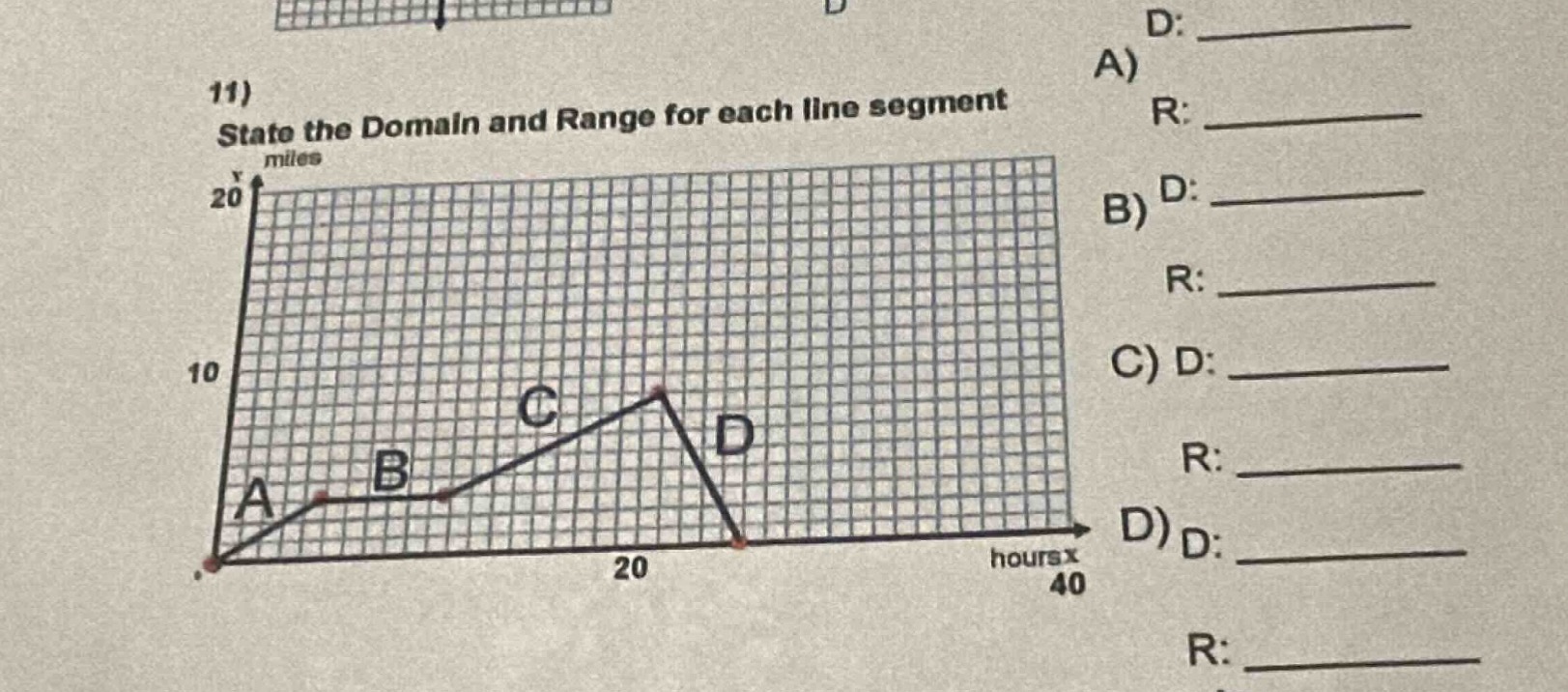
state the domain and range for each line segment
a)
d:
r:
b)
d:
r:
c)
d:
r:
d)
d:
r:
To determine the domain (x - values) and range (y - values) for each line segment, we analyze the endpoints of each segment from the graph:
Segment A
Step 1: Identify endpoints
The segment A starts at \((0,0)\) and ends at some point, say \((x_1,y_1)\). From the graph, we can see that the x - values for segment A range from \(0\) to, let's assume the x - coordinate of the end - point is \(x = a\) (by looking at the grid). The y - values range from \(0\) to the y - coordinate of the end - point. If we assume the end - point of A has coordinates \((a,b)\) where \(a\) is the x - value and \(b\) is the y - value. From the graph, we can see that for segment A, the domain \(D:[0,a]\) and range \(R:[0,b]\). But looking at the graph, if we assume the first segment (A) goes from \(x = 0\) to \(x = 5\) (approximate from the grid) and \(y\) from \(0\) to \(2\) (approximate). But more accurately, if we consider the standard way of reading domain and range from a graph:
For segment A:
Step 1: Find x - values (domain)
The left - most x - value is \(0\) and the right - most x - value (end of segment A) is, say, \(x = 5\) (by counting the grid squares). So domain \(D:0\leq x\leq5\) (or in interval notation \([0,5]\))
Step 2: Find y - values (range)
The lowest y - value is \(0\) and the highest y - value (end of segment A) is \(2\). So range \(R:0\leq y\leq2\) (or \([0,2]\))
Segment B
Step 1: Identify endpoints
Segment B is a horizontal line. Let the left - most x - value be \(x = 5\) (end of segment A) and the right - most x - value be \(x = 15\) (start of segment C). The y - value is constant, say \(y = 2\).
Step 1: Domain
The x - values for segment B range from \(5\) to \(15\), so \(D:5\leq x\leq15\) (or \([5,15]\))
Step 2: Range
The y - values are constant at \(y = 2\), so \(R:2\leq y\leq2\) (or \(\{2\}\) or \([2,2]\))
Segment C
Step 1: Identify endpoints
Segment C starts at \((15,2)\) (end of segment B) and ends at \((20,8)\) (approximate from the graph).
Step 1: Domain
The x - values range from \(15\) to \(20\), so \(D:15\leq x\leq20\) (or \([15,20]\))
Step 2: Range
The y - values range from \(2\) to \(8\), so \(R:2\leq y\leq8\) (or \([2,8]\))
Segment D
Step 1: Identify endpoints
Segment D starts at \((20,8)\) and ends at \((25,0)\) (approximate from the graph).
Step 1: Domain
The x - values range from \(20\) to \(25\), so \(D:20\leq x\leq25\) (or \([20,25]\))
Step 2: Range
The y - values range from \(0\) to \(8\), so \(R:0\leq y\leq8\) (or \([0,8]\))
Final Answers (assuming approximate values from the graph)
A)
Step 1: Domain of A
The x - values for segment A range from \(0\) to \(5\) (by looking at the grid). So domain \(D:0\leq x\leq5\)
Step 2: Range of A
The y - values for segment A range from \(0\) to \(2\). So range \(R:0\leq y\leq2\)
Step 1: Domain of B
The x - values for segment B range from \(5\) to \(15\). So domain \(D:5\leq x\leq15\)
Step 2: Range of B
The y - value for segment B is constant at \(2\). So range \(R:2\leq y\leq2\) (or \(\{2\}\))
Step 1: Domain of C
The x - values for segment C range from \(15\) to \(20\). So domain \(D:15\leq x\leq20\)
Step 2: Range of C
The y - values for segment C range from \(2\) to \(8\). So range \(R:2\leq y\leq8\)

Snap & solve any problem in the app
Get step-by-step solutions on Sovi AI
Photo-based solutions with guided steps
Explore more problems and detailed explanations
D: \(0\leq x\leq5\) (or \([0,5]\))
R: \(0\leq y\leq2\) (or \([0,2]\))
B)