QUESTION IMAGE
Question
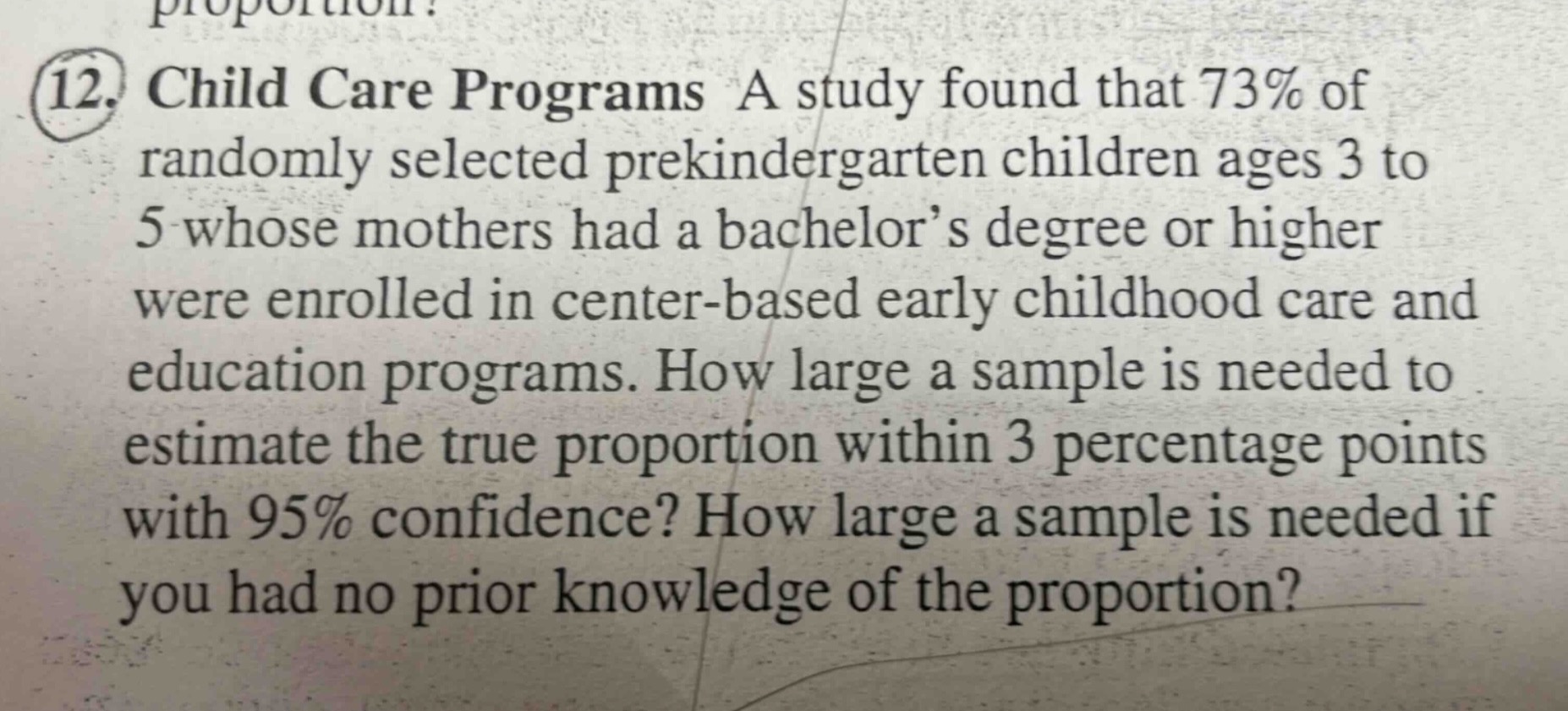
- child care programs a study found that 73% of randomly selected prekindergarten children ages 3 to 5 whose mothers had a bachelor’s degree or higher were enrolled in center - based early childhood care and education programs. how large a sample is needed to estimate the true proportion within 3 percentage points with 95% confidence? how large a sample is needed if you had no prior knowledge of the proportion?
Step1: Recall the formula for sample size when estimating a proportion
The formula for the sample size \( n \) to estimate a population proportion \( p \) is:
\[
n = \frac{z_{\alpha/2}^2 \cdot p \cdot (1 - p)}{E^2}
\]
where \( z_{\alpha/2} \) is the z-score corresponding to the desired confidence level, \( p \) is the estimated proportion, and \( E \) is the margin of error.
For a 95% confidence level, the critical value \( z_{\alpha/2} \) is approximately 1.96 (this is a standard value for 95% confidence). The margin of error \( E \) is 0.03 (3 percentage points).
Step2: Case 1: With prior knowledge of \( p = 0.73 \)
Substitute \( z_{\alpha/2} = 1.96 \), \( p = 0.73 \), \( 1 - p = 0.27 \), and \( E = 0.03 \) into the formula:
\[
n = \frac{(1.96)^2 \cdot 0.73 \cdot 0.27}{(0.03)^2}
\]
First, calculate the numerator:
\[
(1.96)^2 = 3.8416
\]
\[
3.8416 \cdot 0.73 \cdot 0.27 = 3.8416 \cdot 0.1971 = 0.7572
\]
Then, calculate the denominator:
\[
(0.03)^2 = 0.0009
\]
Now, divide the numerator by the denominator:
\[
n = \frac{0.7572}{0.0009} \approx 841.33
\]
Since the sample size must be an integer, we round up to the next whole number, so \( n = 842 \).
Step3: Case 2: No prior knowledge of \( p \)
When we have no prior knowledge of \( p \), we use \( p = 0.5 \) (this maximizes the product \( p(1 - p) \), leading to the largest sample size needed). Substitute \( z_{\alpha/2} = 1.96 \), \( p = 0.5 \), \( 1 - p = 0.5 \), and \( E = 0.03 \) into the formula:
\[
n = \frac{(1.96)^2 \cdot 0.5 \cdot 0.5}{(0.03)^2}
\]
Calculate the numerator:
\[
(1.96)^2 \cdot 0.5 \cdot 0.5 = 3.8416 \cdot 0.25 = 0.9604
\]
The denominator is still \( 0.0009 \).
\[
n = \frac{0.9604}{0.0009} \approx 1067.11
\]
Round up to the next whole number, so \( n = 1068 \).

Snap & solve any problem in the app
Get step-by-step solutions on Sovi AI
Photo-based solutions with guided steps
Explore more problems and detailed explanations
- With prior knowledge (\( p = 0.73 \)): The required sample size is \(\boldsymbol{842}\).
- Without prior knowledge (\( p = 0.5 \)): The required sample size is \(\boldsymbol{1068}\).