QUESTION IMAGE
Question
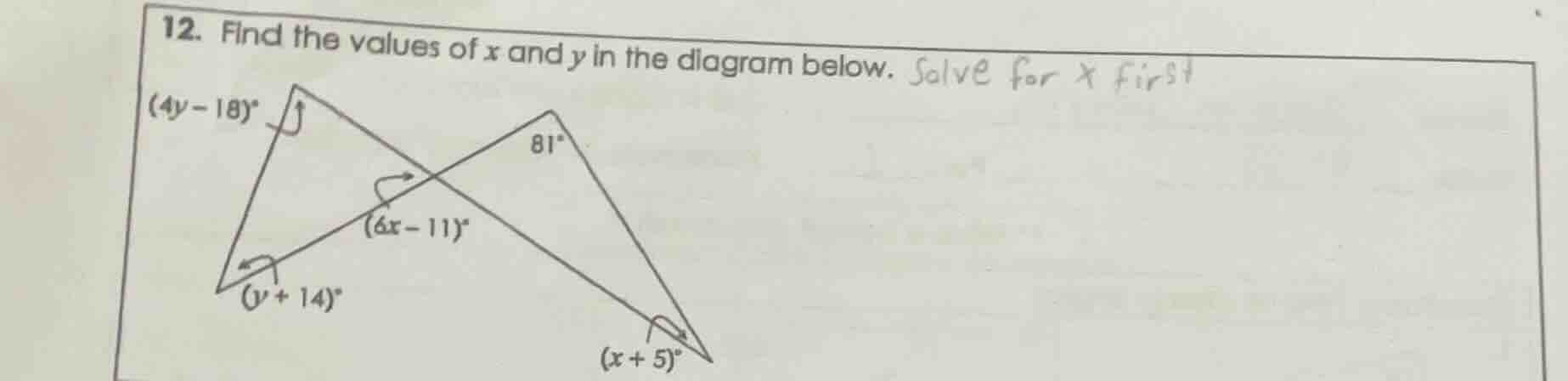
- find the values of x and y in the diagram below. solve for x first
Step1: Solve for \( x \) using vertical angles and triangle angle - sum? Wait, first, the vertical angles: the angle \( (6x - 11)^\circ \) and the angle opposite? Wait, no, let's look at the triangles. Wait, actually, the two triangles are congruent? Wait, no, let's use the fact that vertical angles are equal? Wait, no, maybe the triangles are similar or we can use the fact that in a triangle, the sum of angles is \( 180^\circ \). Wait, first, let's find \( x \). Let's look at the angles involving \( x \). The angle \( (6x - 11)^\circ \) and the angle in the other triangle: wait, maybe the two triangles are congruent, so the corresponding angles are equal. Wait, the angle \( (x + 5)^\circ \) and \( (y + 14)^\circ \)? No, wait, let's start with \( x \). Let's assume that the two triangles are congruent, so the angle \( (6x - 11)^\circ \) and the angle adjacent to \( 81^\circ \): wait, no, let's use the fact that in a triangle, the sum of angles is \( 180^\circ \). Wait, first, solve for \( x \). Let's consider the triangle with angle \( 81^\circ \), \( (x + 5)^\circ \), and the vertical angle of \( (6x - 11)^\circ \). Wait, vertical angles are equal, so the angle opposite to \( (6x - 11)^\circ \) is equal to it. Then, in the triangle with angles \( 81^\circ \), \( (x + 5)^\circ \), and \( (6x - 11)^\circ \), the sum of angles is \( 180^\circ \). So:
\( 81+(x + 5)+(6x - 11)=180 \)
Simplify the left - hand side:
\( 81+x + 5+6x-11 = 180 \)
Combine like terms:
\( (x+6x)+(81 + 5-11)=180 \)
\( 7x+75 = 180 \)
Subtract 75 from both sides:
\( 7x=180 - 75=105 \)
Divide both sides by 7:
\( x=\frac{105}{7}=15 \)
Step2: Now that we have \( x = 15 \), we can find the angle \( (x + 5)^\circ=(15 + 5)^\circ = 20^\circ \), and \( (6x - 11)^\circ=(6\times15-11)^\circ=(90 - 11)^\circ = 79^\circ \)
Now, let's look at the other triangle with angles \( (4y-18)^\circ \), \( (y + 14)^\circ \), and \( (6x - 11)^\circ=79^\circ \). The sum of angles in a triangle is \( 180^\circ \), so:
\( (4y-18)+(y + 14)+79 = 180 \)
Combine like terms:
\( 4y-18+y + 14+79 = 180 \)
\( 5y+( - 18+14 + 79)=180 \)
\( 5y+( - 4+79)=180 \)
\( 5y + 75=180 \)
Subtract 75 from both sides:
\( 5y=180 - 75 = 105 \)
Divide both sides by 5:
\( y=\frac{105}{5}=21 \)
Wait, let's check again. Wait, maybe the two triangles are congruent, so the angles \( (4y - 18)^\circ=81^\circ \)? Wait, that might be a better approach. Let's try that. If \( (4y-18)^\circ = 81^\circ \), then:
\( 4y-18 = 81 \)
\( 4y=81 + 18=99 \)
\( y=\frac{99}{4}=24.75 \), which doesn't match the previous result. So my first approach was wrong.
Let's start over. The two triangles are congruent (since they are formed by vertical angles, so the included angles are equal, and if the sides are equal, but maybe the triangles are congruent by ASA). So the angle \( (4y - 18)^\circ \) corresponds to \( 81^\circ \), the angle \( (y + 14)^\circ \) corresponds to \( (x + 5)^\circ \), and the angle \( (6x - 11)^\circ \) corresponds to the angle opposite (vertical angle). Wait, vertical angles are equal, so \( (6x - 11)^\circ \) is equal to the angle in the other triangle. Let's use the fact that in each triangle, the sum of angles is \( 180^\circ \).
For the right - hand triangle: angles are \( 81^\circ \), \( (x + 5)^\circ \), and \( \theta \) (where \( \theta=(6x - 11)^\circ \) because vertical angles are equal). So \( 81+(x + 5)+(6x - 11)=180 \)
Simplify:
\( 81+x + 5+6x-11 = 180 \)
\( 7x+75 = 180 \)
\( 7x=105 \)
\( x = 15 \) (this part was correct)
Now, for the left - hand triangle: angles are \( (4…

Snap & solve any problem in the app
Get step-by-step solutions on Sovi AI
Photo-based solutions with guided steps
Explore more problems and detailed explanations
\( x = 15 \), \( y = 21 \)