QUESTION IMAGE
Question
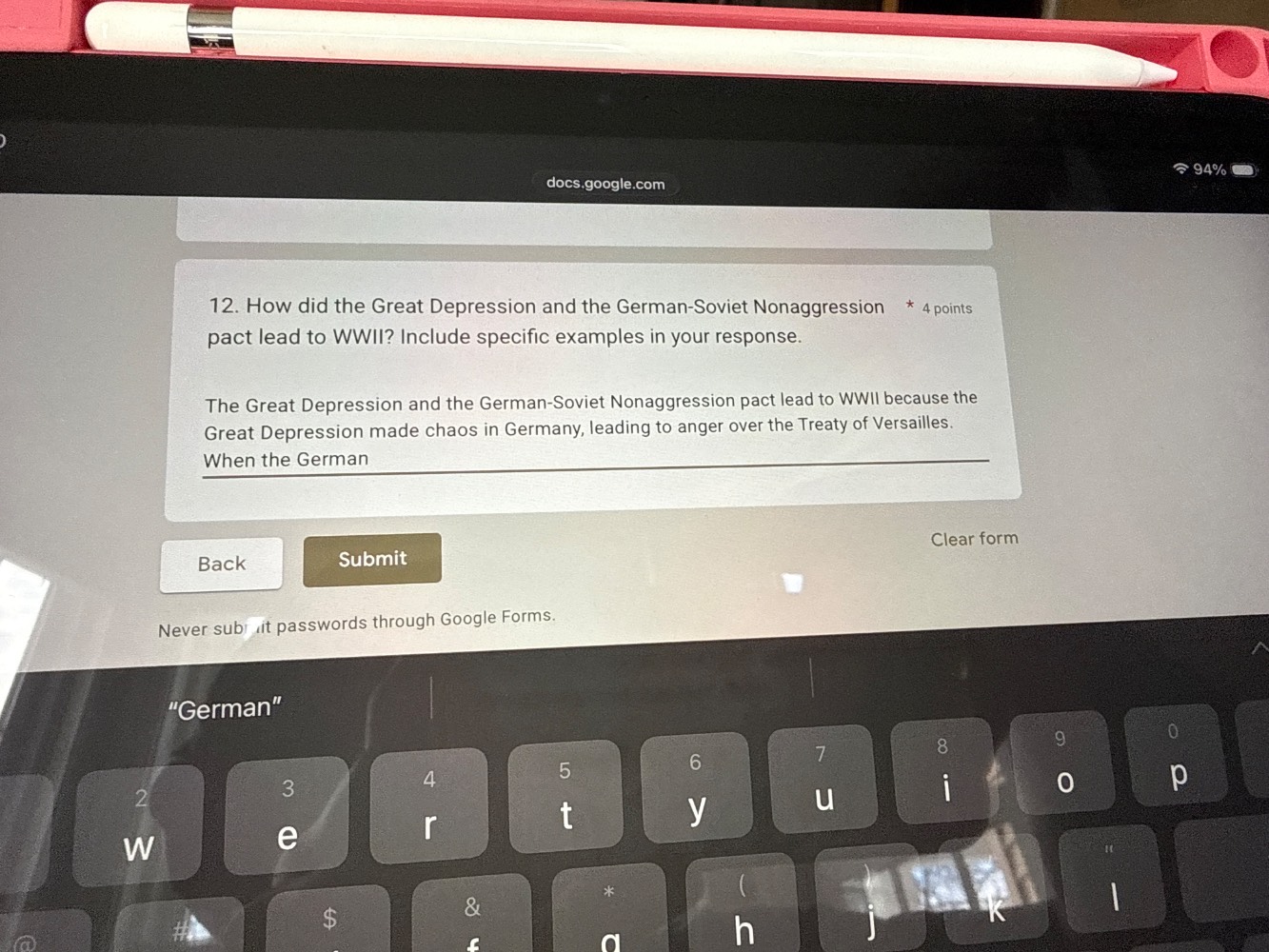
- how did the great depression and the german-soviet nonaggression pact lead to wwii? include specific examples in your response.
the great depression and the german-soviet nonaggression pact lead to wwii because the great depression made chaos in germany, leading to anger over the treaty of versailles.
when the german
Brief Explanations
- Great Depression's Role: The economic collapse destroyed Germany's post-WWI recovery, causing mass unemployment, poverty, and hyperinflation. This public anger and instability allowed extremist groups like the Nazi Party (led by Hitler) to rise to power by promising to fix the economy and reverse the humiliating Treaty of Versailles. Hitler used this discontent to justify aggressive territorial expansion, such as the 1936 reoccupation of the Rhineland and the 1938 annexation of Austria, which violated Versailles and escalated tensions.
- German-Soviet Nonaggression Pact's Role: Signed in 1939, this agreement between Germany and the Soviet Union guaranteed they would not attack each other, and secretly divided Eastern Europe into spheres of influence. This removed Germany's fear of a two-front war, which had doomed its efforts in WWI. With this security, Hitler felt confident to invade Poland on September 1, 1939, the direct trigger that led Britain and France to declare war on Germany, officially starting WWII.

Snap & solve any problem in the app
Get step-by-step solutions on Sovi AI
Photo-based solutions with guided steps
Explore more problems and detailed explanations
The Great Depression and the German-Soviet Nonaggression Pact both directly paved the way for WWII through interconnected political and military shifts:
- The Great Depression shattered Germany's fragile post-WWI economy, creating widespread poverty, unemployment, and public fury over the harsh reparations and restrictions of the Treaty of Versailles. This chaos allowed Adolf Hitler's Nazi Party to seize power by exploiting nationalist anger and promising economic recovery. Once in power, Hitler began violating the Treaty of Versailles—reoccupying the Rhineland (1936), annexing Austria (1938), and taking the Sudetenland (1938) through aggressive expansion that escalated European tensions.
- The 1939 German-Soviet Nonaggression Pact eliminated Germany's biggest military risk: a two-front war against France and the Soviet Union, which had crippled its WWI efforts. The pact also secretly split Eastern Europe into German and Soviet spheres of influence. Freed from the threat of Soviet intervention, Hitler launched a full-scale invasion of Poland on September 1, 1939. This act prompted Britain and France to declare war on Germany, marking the official start of World War II.