QUESTION IMAGE
Question
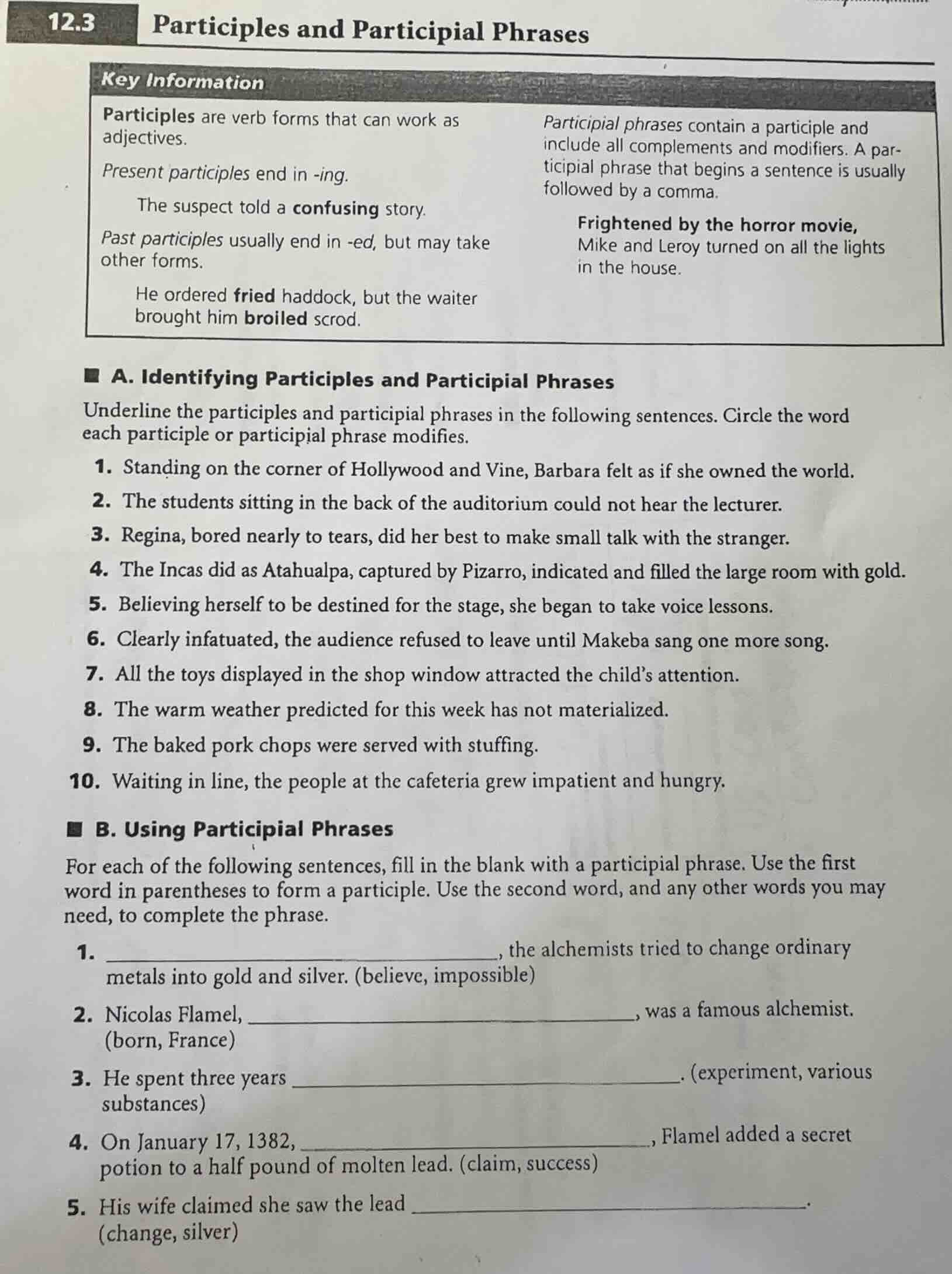
12.3 participles and participial phrases
key information
participles are verb forms that can work as adjectives.
present participles end in -ing.
the suspect told a confusing story.
past participles usually end in -ed, but may take other forms.
he ordered fried haddock, but the waiter brought him broiled scrod.
participial phrases contain a participle and include all complements and modifiers. a participial phrase that begins a sentence is usually followed by a comma.
frightened by the horror movie,
mike and leroy turned on all the lights in the house.
a. identifying participles and participial phrases
underline the participles and participial phrases in the following sentences. circle the word each participle or participial phrase modifies.
- standing on the corner of hollywood and vine, barbara felt as if she owned the world.
- the students sitting in the back of the auditorium could not hear the lecturer.
- regina, bored nearly to tears, did her best to make small talk with the stranger.
- the incas did as atahualpa, captured by pizarro, indicated and filled the large room with gold.
- believing herself to be destined for the stage, she began to take voice lessons.
- clearly infatuated, the audience refused to leave until makeba sang one more song.
- all the toys displayed in the shop window attracted the child’s attention.
- the warm weather predicted for this week has not materialized.
- the baked pork chops were served with stuffing.
- waiting in line, the people at the cafeteria grew impatient and hungry.
b. using participial phrases
for each of the following sentences, fill in the blank with a participial phrase. use the first word in parentheses to form a participle. use the second word, and any other words you may need, to complete the phrase.
- ____________, the alchemists tried to change ordinary metals into gold and silver. (believe, impossible)
- nicolas flamel, ____________, was a famous alchemist. (born, france)
- he spent three years ____________. (experiment, various substances)
- on january 17, 1382, ____________, flamel added a secret potion to a half pound of molten lead. (claim, success)
- his wife claimed she saw the lead ____________. (change, silver)
Part A: Identifying Participles and Participial Phrases
- Sentence: Standing on the corner of Hollywood and Vine, Barbara felt as if she owned the world.
- Participle/Participial Phrase: Standing on the corner of Hollywood and Vine (present participle phrase)
- Word Modified: Barbara
- Sentence: The students sitting in the back of the auditorium could not hear the lecturer.
- Participle/Participial Phrase: sitting in the back of the auditorium (present participle phrase)
- Word Modified: students
- Sentence: Regina, bored nearly to tears, did her best to make small talk with the stranger.
- Participle/Participial Phrase: bored nearly to tears (past participle phrase)
- Word Modified: Regina
- Sentence: The Incas did as Atahualpa, captured by Pizarro, indicated and filled the large room with gold.
- Participle/Participial Phrase: captured by Pizarro (past participle phrase)
- Word Modified: Atahualpa
- Sentence: Believing herself to be destined for the stage, she began to take voice lessons.
- Participle/Participial Phrase: Believing herself to be destined for the stage (present participle phrase)
- Word Modified: she
- Sentence: Clearly infatuated, the audience refused to leave until Makeba sang one more song.
- Participle/Participial Phrase: Clearly infatuated (past participle phrase)
- Word Modified: audience
- Sentence: All the toys displayed in the shop window attracted the child’s attention.
- Participle/Participial Phrase: displayed in the shop window (past participle phrase)
- Word Modified: toys
- Sentence: The warm weather predicted for this week has not materialized.
- Participle/Participial Phrase: predicted for this week (past participle phrase)
- Word Modified: weather
- Sentence: The baked pork chops were served with stuffing.
- Participle/Participial Phrase: baked (past participle)
- Word Modified: pork chops
- Sentence: Waiting in line, the people at the cafeteria grew impatient and hungry.
- Participle/Participial Phrase: Waiting in line (present participle phrase)
- Word Modified: people
Part B: Using Participial Phrases
- Sentence: ____, the alchemists tried to change ordinary metals into gold and silver. (believe, impossible)
- Participial Phrase: Believing the impossible (present participle phrase)
- Sentence: Nicolas Flamel, ____, was a famous alchemist. (born, France)
- Participial Phrase: born in France (past participle phrase)
- Sentence: He spent three years ____. (experiment, various substances)
- Participial Phrase: experimenting with various substances (present participle phrase)
- Sentence: On January 17, 1382, ____, Flamel added a secret potion to a half pound of molten lead. (claim, success)
- Participial Phrase: claiming success (present participle phrase)
- Sentence: His wife claimed she saw the lead ____. (change, silver)
- Participial Phrase: changing into silver (present participle phrase)
for Part B (if needed):
- Step 1: Identify the participle form (present/past) based on the first word in parentheses.
- For “believe,” use present participle (believing); for “born,” use past participle (born); for “experiment,” use present participle (experimenting); for “claim,” use present participle (claiming); for “change,” use present participle (changing).
- Step 2: Combine with the second word (and additional words) to form a phrase that modifies the subject/noun.
- Example: “Believing the impossible” modifies “alchemists”; “born in France” modifies “Nicolas Flamel.”
Final Answers (Part B):
- Believing the impossible
- born in France
- experimenting with various substances
- claiming success
- changing into silver

Snap & solve any problem in the app
Get step-by-step solutions on Sovi AI
Photo-based solutions with guided steps
Explore more problems and detailed explanations
for Part B (if needed):
- Step 1: Identify the participle form (present/past) based on the first word in parentheses.
- For “believe,” use present participle (believing); for “born,” use past participle (born); for “experiment,” use present participle (experimenting); for “claim,” use present participle (claiming); for “change,” use present participle (changing).
- Step 2: Combine with the second word (and additional words) to form a phrase that modifies the subject/noun.
- Example: “Believing the impossible” modifies “alchemists”; “born in France” modifies “Nicolas Flamel.”
Final Answers (Part B):
- Believing the impossible
- born in France
- experimenting with various substances
- claiming success
- changing into silver