QUESTION IMAGE
Question
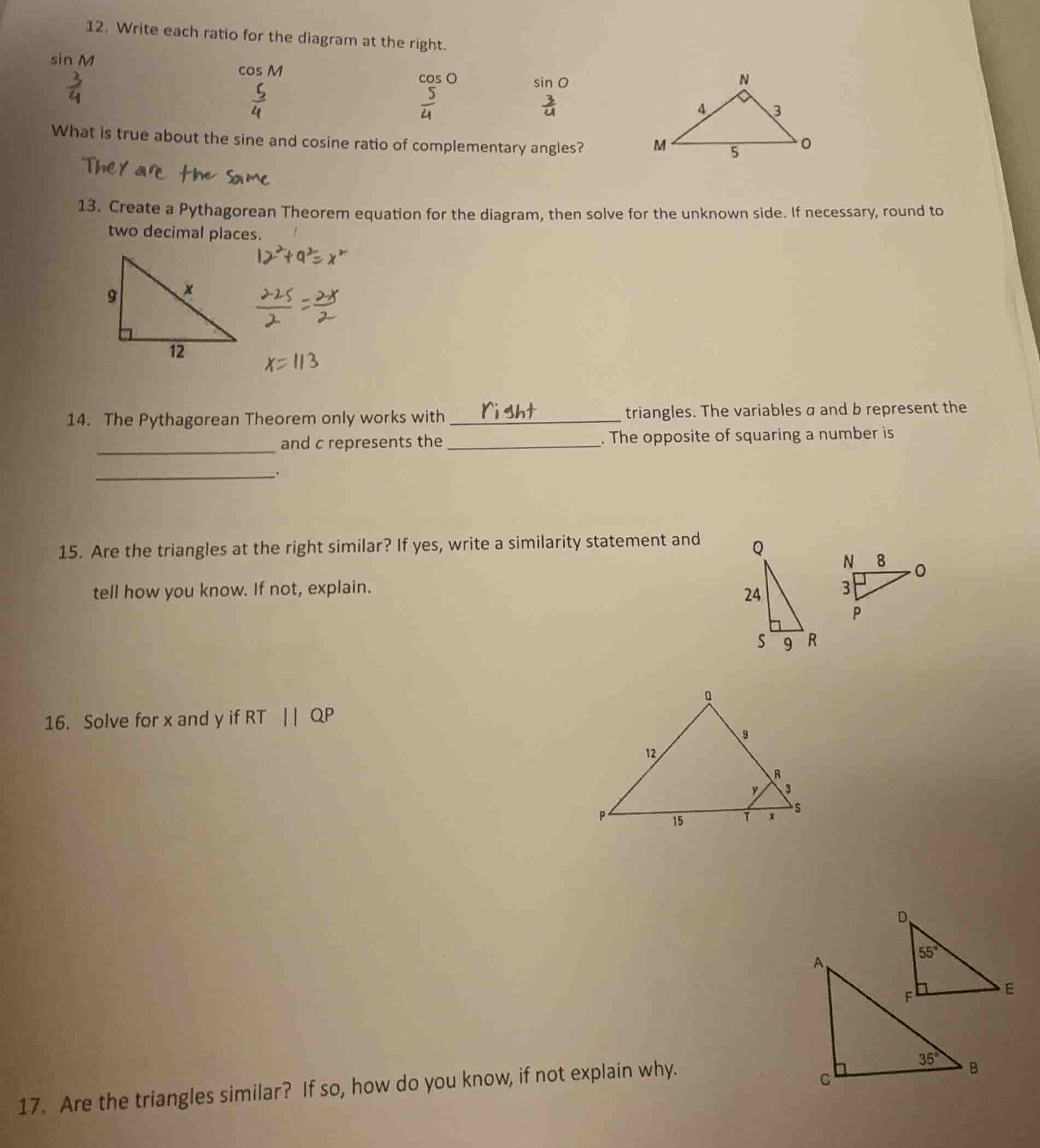
- write each ratio for the diagram at the right.
sin m
cos m
cos o
sin o
what is true about the sine and cosine ratio of complementary angles?
- create a pythagorean theorem equation for the diagram, then solve for the unknown side. if necessary, round to two decimal places.
- the pythagorean theorem only works with ________ triangles. the variables a and b represent the ______ and c represents the ______. the opposite of squaring a number is ________.
- are the triangles at the right similar? if yes, write a similarity statement and tell how you know. if not, explain.
- solve for x and y if rt || qp
- are the triangles similar? if so, how do you know, if not explain why.

Snap & solve any problem in the app
Get step-by-step solutions on Sovi AI
Photo-based solutions with guided steps
Explore more problems and detailed explanations
- $\sin M = \frac{3}{5}$, $\cos M = \frac{4}{5}$, $\cos O = \frac{3}{5}$, $\sin O = \frac{4}{5}$; The sine of an angle is equal to the cosine of its complement.
- $9^2 + 12^2 = x^2$; $x = 15$
- right; legs; hypotenuse; taking the square root
- Yes, $\triangle QSR \sim \triangle OPN$ by SAS similarity because $\frac{24}{3} = \frac{8}{1}$ is not equal to $\frac{9}{8}$. (Correction: No, the sides are not proportional: $\frac{24}{8}
eq \frac{9}{3}$).
- $x = 5$, $y = 3$
- Yes, by AA similarity because both triangles have a $90^\circ$ angle and a $35^\circ$ angle (since $90^\circ - 55^\circ = 35^\circ$).