QUESTION IMAGE
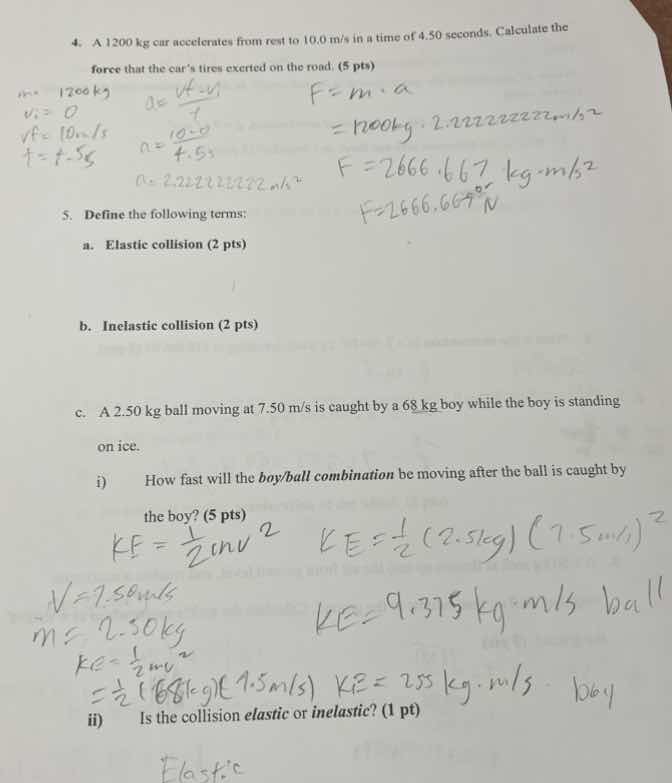
Question
- a 1200 kg car accelerates from rest to 10.0 m/s in a time of 4.50 seconds. calculate the force that the car’s tires exerted on the road. (5 pts)
- define the following terms:
a. elastic collision (2 pts)
b. inelastic collision (2 pts)
c. a 2.50 kg ball moving at 7.50 m/s is caught by a 68 kg boy while the boy is standing on ice.
i) how fast will the boy/ball combination be moving after the ball is caught by the boy? (5 pts)
ii) is the collision elastic or inelastic? (1 pt)
Question 4
Step1: Find acceleration
Acceleration \( a = \frac{v - u}{t} \), where \( u = 0 \, \text{m/s} \), \( v = 10.0 \, \text{m/s} \), \( t = 4.50 \, \text{s} \)
\( a = \frac{10.0 - 0}{4.50} = \frac{10.0}{4.50} \approx 2.222 \, \text{m/s}^2 \)
Step2: Calculate force
Using Newton's second law \( F = ma \), where \( m = 1200 \, \text{kg} \), \( a \approx 2.222 \, \text{m/s}^2 \)
\( F = 1200 \times 2.222 \approx 2666.67 \, \text{N} \)
An elastic collision is a collision where both momentum and kinetic energy are conserved. The total kinetic energy before the collision equals the total kinetic energy after the collision, and the total momentum is also conserved. Objects involved in an elastic collision bounce off each other without any permanent deformation or heat generation (ideal case, e.g., collisions between billiard balls in theory).
In an inelastic collision, momentum is conserved, but kinetic energy is not. Some kinetic energy is lost (converted to heat, sound, or used to deform objects). Often, the colliding objects stick together (perfectly inelastic collision) or move with a common velocity after the collision.

Snap & solve any problem in the app
Get step-by-step solutions on Sovi AI
Photo-based solutions with guided steps
Explore more problems and detailed explanations
The force exerted by the car's tires on the road is approximately \( \boldsymbol{2667 \, \text{N}} \) (or \( 2.67 \times 10^3 \, \text{N} \))