QUESTION IMAGE
Question
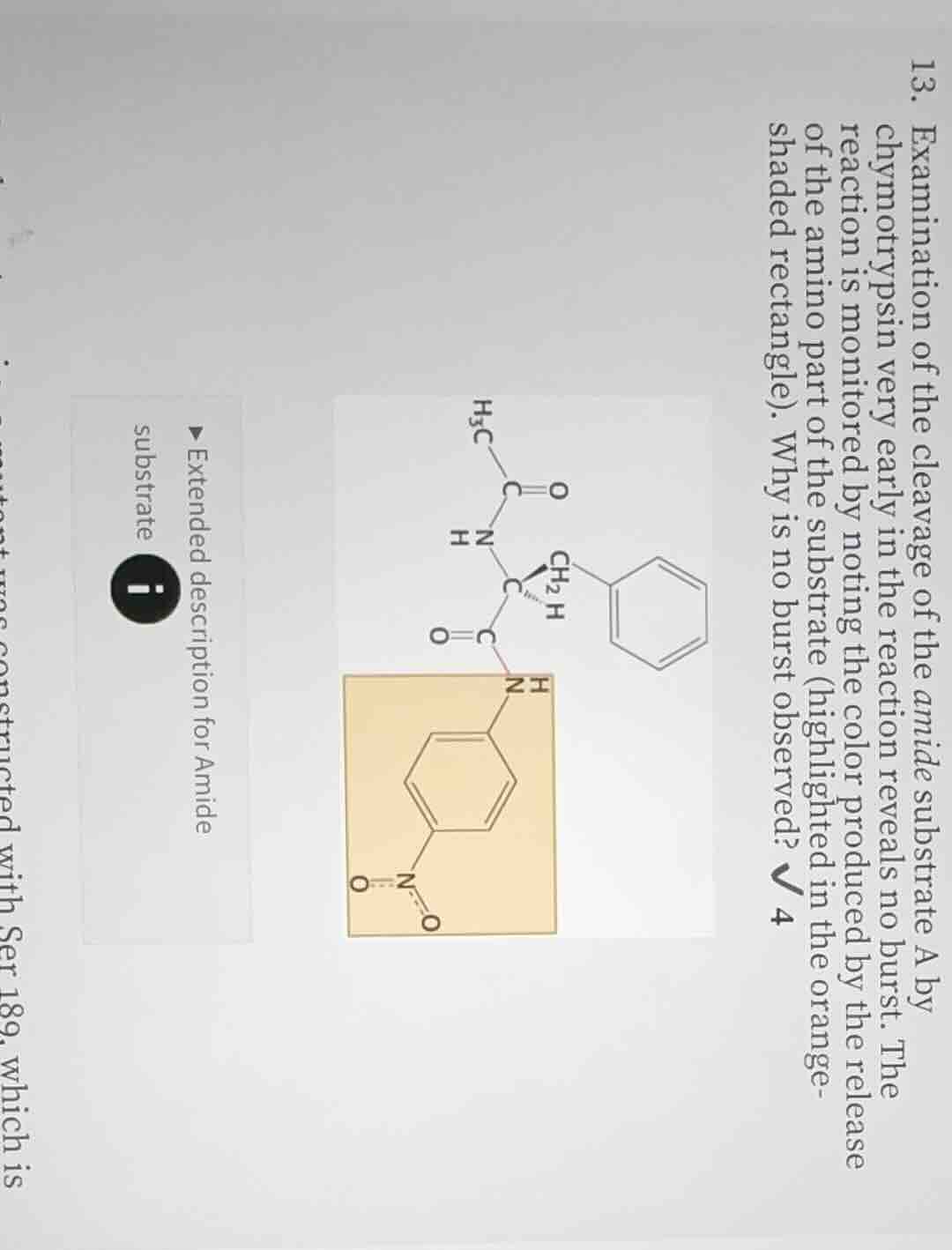
- examination of the cleavage of the amide substrate a by chymotrypsin very early in the reaction reveals no burst. the reaction is monitored by noting the color produced by the release of the amino part of the substrate (highlighted in the orange - shaded rectangle). why is no burst observed? extended description for amide substrate
Chymotrypsin's burst phase occurs when an acyl-enzyme intermediate forms, releasing the first product quickly. Here, the shaded 4-nitroaniline is the leaving group, but this substrate is an amide (not an ester). Amide bonds are far more stable than ester bonds, so the rate of acyl-enzyme formation (the step that would create the burst) is slower than the rate of acyl-enzyme hydrolysis. This means the two reaction steps happen at similar rates, eliminating the observable burst phase.

Snap & solve any problem in the app
Get step-by-step solutions on Sovi AI
Photo-based solutions with guided steps
Explore more problems and detailed explanations
No burst is observed because the substrate is an amide: amide bonds are highly stable, so the rate of acyl-enzyme intermediate formation (the step that generates the burst product) is not faster than the rate of acyl-enzyme hydrolysis. The two reaction steps proceed at comparable rates, so there is no initial rapid burst of colored 4-nitroaniline release.