QUESTION IMAGE
Question
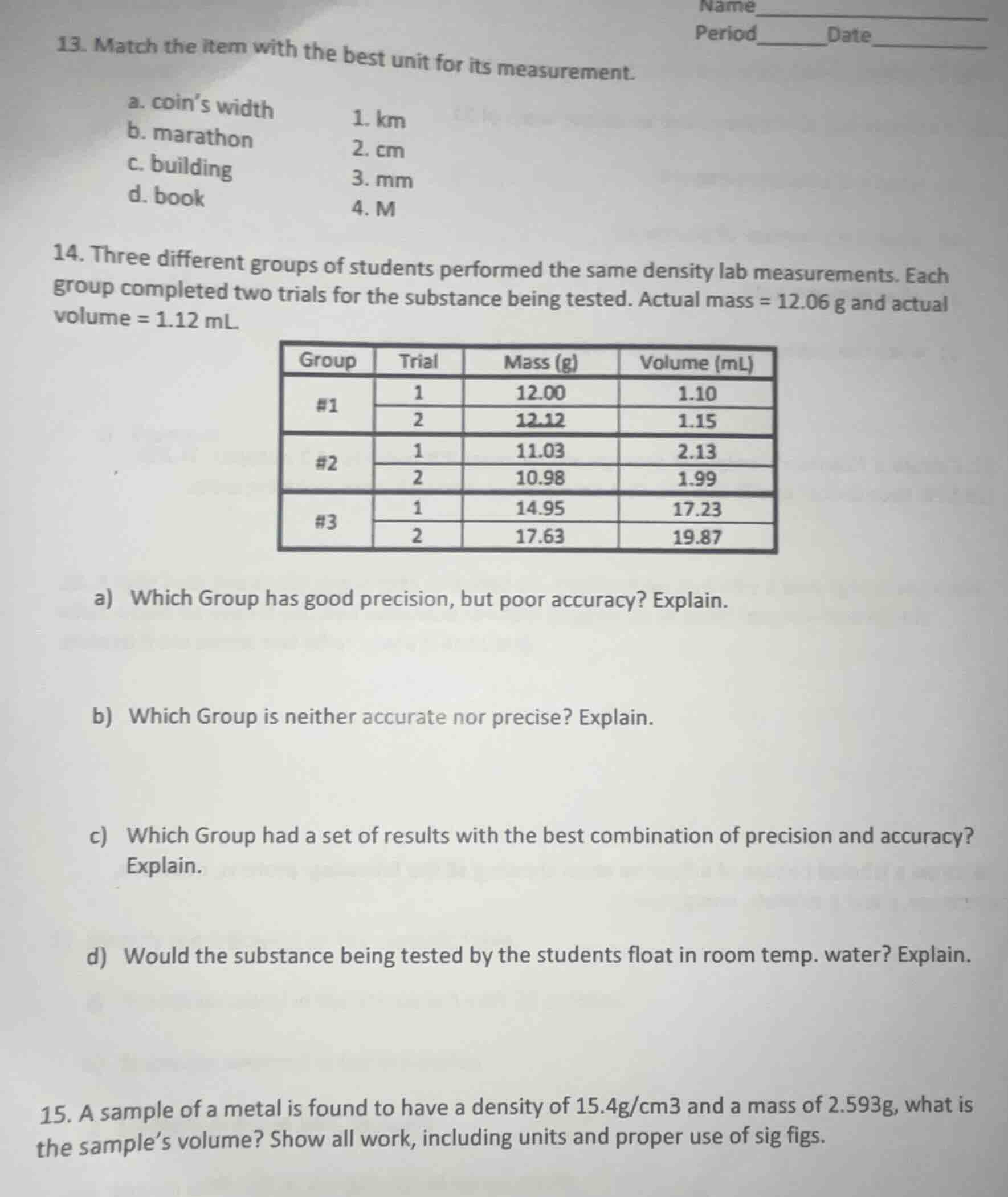
- match the item with the best unit for its measurement.
a. coin’s width
- km
b. marathon
- cm
c. building
- mm
d. book
- m
- three different groups of students performed the same density lab measurements. each group completed two trials for the substance being tested. actual mass = 12.06 g and actual volume = 1.12 ml.
| group | trial | mass (g) | volume (ml) |
|---|---|---|---|
| #1 | 2 | 12.12 | 1.15 |
| #2 | 1 | 11.03 | 2.13 |
| #2 | 2 | 10.98 | 1.99 |
| #3 | 1 | 14.95 | 17.23 |
| #3 | 2 | 17.63 | 19.87 |
a) which group has good precision, but poor accuracy? explain.
b) which group is neither accurate nor precise? explain.
c) which group had a set of results with the best combination of precision and accuracy? explain.
d) would the substance being tested by the students float in room temp. water? explain.
- a sample of a metal is found to have a density of 15.4g/cm3 and a mass of 2.593g, what is the sample’s volume? show all work, including units and proper use of sig figs.
Question 13
Match each item to the most appropriate unit based on typical size/scale:
- A coin's width is very small, so millimeters (mm) fit best.
- A marathon is a long-distance race, measured in kilometers (km).
- A building is tall, so meters (M, m) are the right unit.
- A book's width is moderate, so centimeters (cm) work best.
First, define key terms:
- Accuracy: How close measurements are to the actual value.
- Precision: How close repeated measurements are to each other.
Actual values: Mass = 12.06 g, Volume = 1.12 mL
Part a
Group 2's two trials have very close mass (11.03 g / 10.98 g) and volume (2.13 mL / 1.99 mL) values (good precision), but both are far from the actual mass and volume (poor accuracy).
Part b
Group 3's two trials have very different mass (14.95 g / 17.63 g) and volume (17.23 mL / 19.87 mL) values (poor precision), and both are far from the actual values (poor accuracy).
Part c
Group 1's two trials have mass (12.00 g / 12.12 g) and volume (1.10 mL / 1.15 mL) values that are close to each other (good precision) and close to the actual mass and volume (good accuracy).
Part d
First calculate the actual density of the substance using $
ho = \frac{m}{V}$. Room temperature water has a density of ~1.0 g/mL. Substances with density greater than 1.0 g/mL sink, while those less float.
Step1: Recall density formula
Density $
ho = \frac{m}{V}$, rearrange to solve for volume: $V = \frac{m}{
ho}$
Step2: Substitute given values
$m = 2.593\ \text{g}$, $
ho = 15.4\ \text{g/cm}^3$
$V = \frac{2.593\ \text{g}}{15.4\ \text{g/cm}^3}$
Step3: Calculate and apply sig figs
The density has 3 significant figures, which is the least number of sig figs in the given values. Round the result to 3 sig figs.
$V \approx 0.168\ \text{cm}^3$

Snap & solve any problem in the app
Get step-by-step solutions on Sovi AI
Photo-based solutions with guided steps
Explore more problems and detailed explanations
a. 3. mm
b. 1. km
c. 4. M
d. 2. cm
---