QUESTION IMAGE
Question
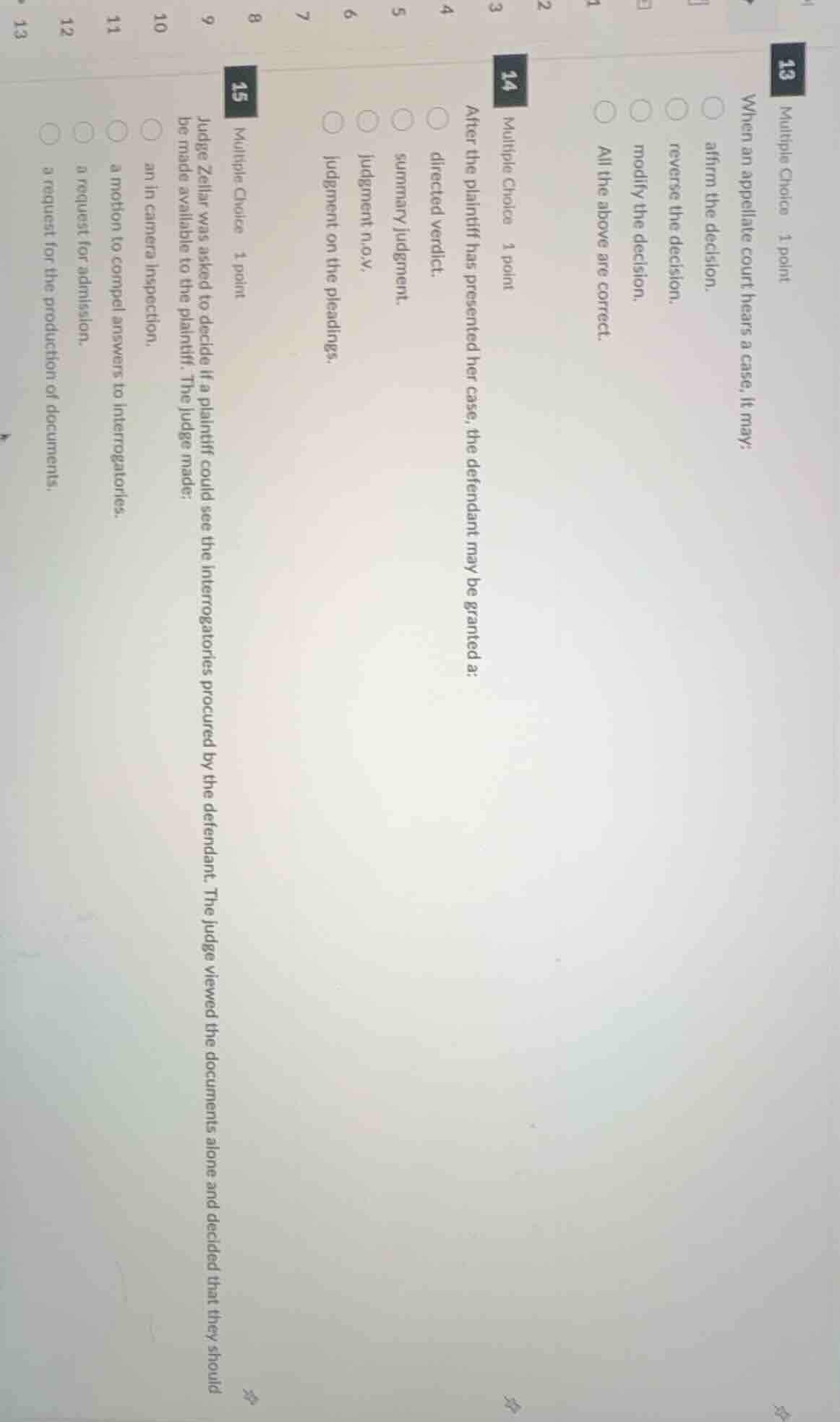
13 multiple choice 1 point when an appellate court hears a case, it may: affirm the decision. reverse the decision. modify the decision. all the above are correct. 14 multiple choice 1 point after the plaintiff has presented her case, the defendant may be granted a: directed verdict. summary judgment. judgment n.o.v. judgment on the pleadings. 15 multiple choice 1 point judge zellar was asked to decide if a plaintiff could see the interrogatories procured by the defendant. the judge viewed the documents alone and decided that they should be made available to the plaintiff: an in camera inspection. a motion to compel answers to interrogatories. a request for admission. a request for the production of documents.
- For question 13: Appellate courts have the authority to uphold (affirm), overturn (reverse), or adjust (modify) lower court decisions, so all options are valid.
- For question 14: A directed verdict is a ruling made after the plaintiff presents their case, if the plaintiff has not provided sufficient evidence to support their claim; this is the only option applicable at this stage of a trial.
- For question 15: An in camera inspection is a judge's private review of evidence to determine if it should be disclosed to the opposing party, which matches the scenario described.

Snap & solve any problem in the app
Get step-by-step solutions on Sovi AI
Photo-based solutions with guided steps
Explore more problems and detailed explanations
- D. All the above are correct.
- A. directed verdict.
- A. an in camera inspection.