QUESTION IMAGE
Question
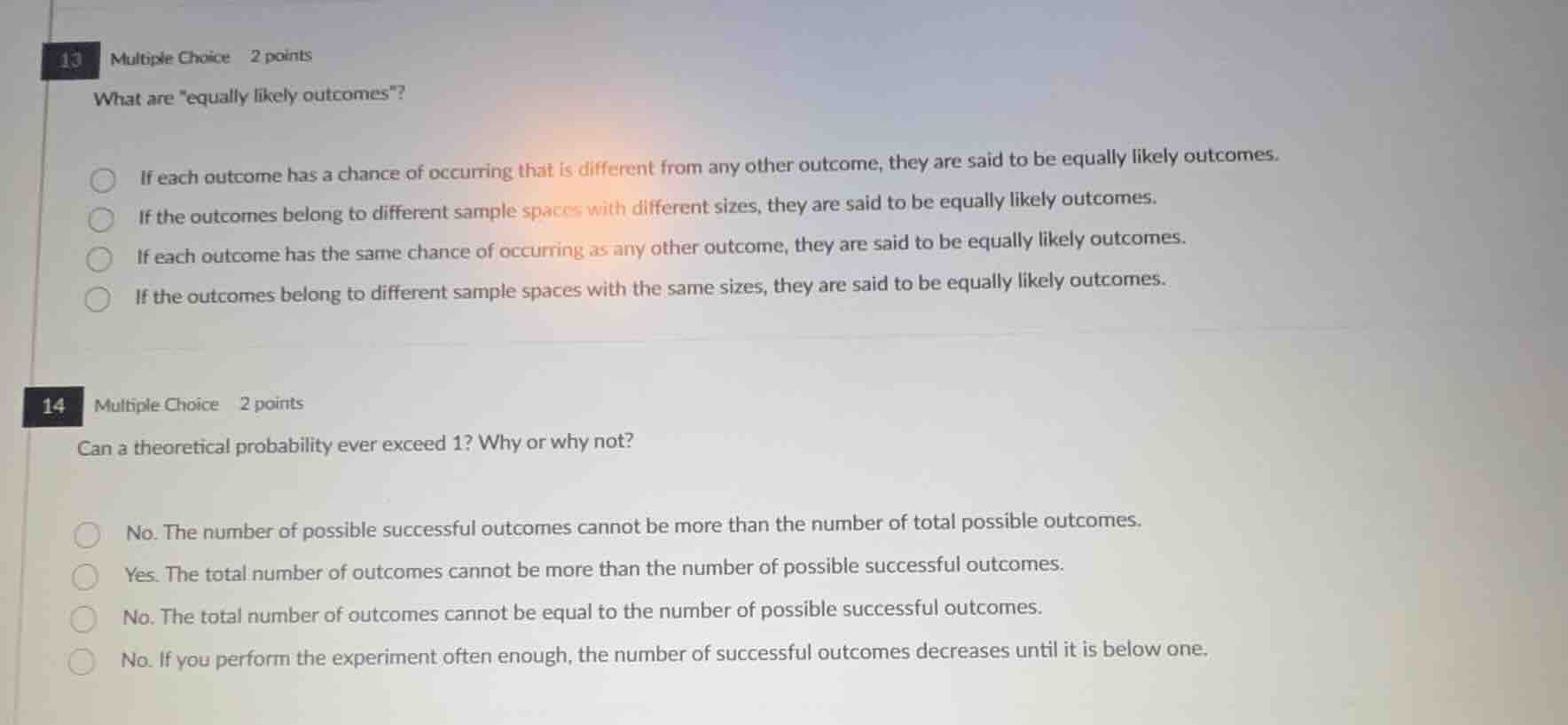
13 multiple choice 2 points
what are \equally likely outcomes\?
if each outcome has a chance of occurring that is different from any other outcome, they are said to be equally likely outcomes.
if the outcomes belong to different sample spaces with different sizes, they are said to be equally likely outcomes.
if each outcome has the same chance of occurring as any other outcome, they are said to be equally likely outcomes.
if the outcomes belong to different sample spaces with the same sizes, they are said to be equally likely outcomes.
14 multiple choice 2 points
can a theoretical probability ever exceed 1? why or why not?
no. the number of possible successful outcomes cannot be more than the number of total possible outcomes.
yes. the total number of outcomes cannot be more than the number of possible successful outcomes.
no. the total number of outcomes cannot be equal to the number of possible successful outcomes.
no. if you perform the experiment often enough, the number of successful outcomes decreases until it is below one.
Question 13
To determine the correct definition of "equally likely outcomes", we analyze each option:
- The first option says outcomes have different chances, which contradicts "equally likely".
- The second and fourth options involve different sample spaces, but equally likely outcomes are within a single sample space (the set of all possible outcomes of an experiment).
- The third option states each outcome has the same chance of occurring as any other, which matches the definition of equally likely outcomes.
Theoretical probability is calculated as $\frac{\text{number of successful outcomes}}{\text{total number of possible outcomes}}$.
- The second option is incorrect because the number of successful outcomes can't exceed the total number of outcomes (as successful outcomes are a subset of total outcomes).
- The third option is incorrect because the total number of outcomes can equal the number of successful outcomes (e.g., when all outcomes are successful, probability is 1).
- The fourth option is incorrect as the number of successful outcomes doesn't decrease with more experiments in the context of theoretical probability (theoretical probability is based on the nature of the experiment, not the number of trials).
- The first option is correct because the number of successful outcomes (favorable) can't be more than the total number of possible outcomes, so the fraction (probability) can't exceed 1 (since numerator ≤ denominator, so $\frac{\text{numerator}}{\text{denominator}} \leq 1$).

Snap & solve any problem in the app
Get step-by-step solutions on Sovi AI
Photo-based solutions with guided steps
Explore more problems and detailed explanations
C. If each outcome has the same chance of occurring as any other outcome, they are said to be equally likely outcomes.