QUESTION IMAGE
Question
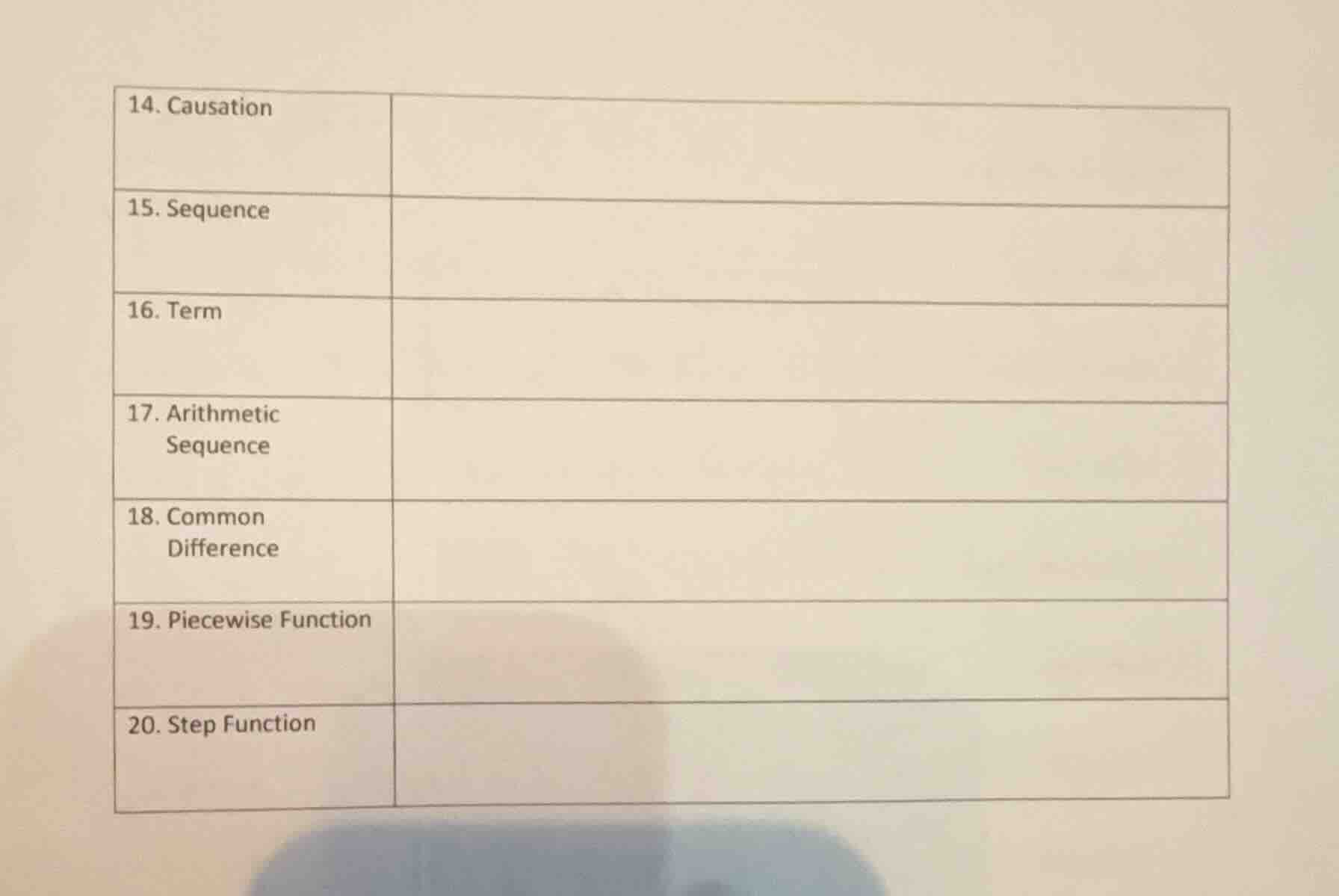
- causation
- sequence
- term
- arithmetic sequence
- common difference
- piecewise function
- step function
Brief Explanations
Definitions for each mathematical term are provided below, aligned with standard academic definitions.
- Causation: A relationship where one event directly causes another; a change in one variable produces a measurable change in another, distinct from correlation.
- Sequence: An ordered list of numbers/objects following a pattern.
- Term: An individual element in a sequence/mathematical expression.
- Arithmetic Sequence: A sequence with a constant difference between consecutive terms.
- Common Difference: The constant value between consecutive terms in an arithmetic sequence, denoted $d$.
- Piecewise Function: A function defined by multiple sub-functions, each applying to a specific interval of the domain.
- Step Function: A piecewise constant function with finite, constant values over intervals, forming "steps" on a graph.

Snap & solve any problem in the app
Get step-by-step solutions on Sovi AI
Photo-based solutions with guided steps
Explore more problems and detailed explanations
- Causation: A relationship where one event directly results in another event; a change in one variable directly induces a change in another (not just a correlated relationship).
- Sequence: An ordered list of numbers, objects, or terms that follow a specific pattern or rule.
- Term: A single element, number, or expression within a sequence, series, or mathematical equation.
- Arithmetic Sequence: A sequence of numbers where the difference between consecutive terms is a constant value.
- Common Difference: The fixed, constant value that is added to each term in an arithmetic sequence to get the next term, represented as $d$.
- Piecewise Function: A function that is defined by multiple distinct sub-functions, each of which applies to a separate, specific interval of the function's domain.
- Step Function: A type of piecewise function that has a constant value over each interval of its domain, creating a graph that looks like a series of horizontal "steps".