QUESTION IMAGE
Question
14.
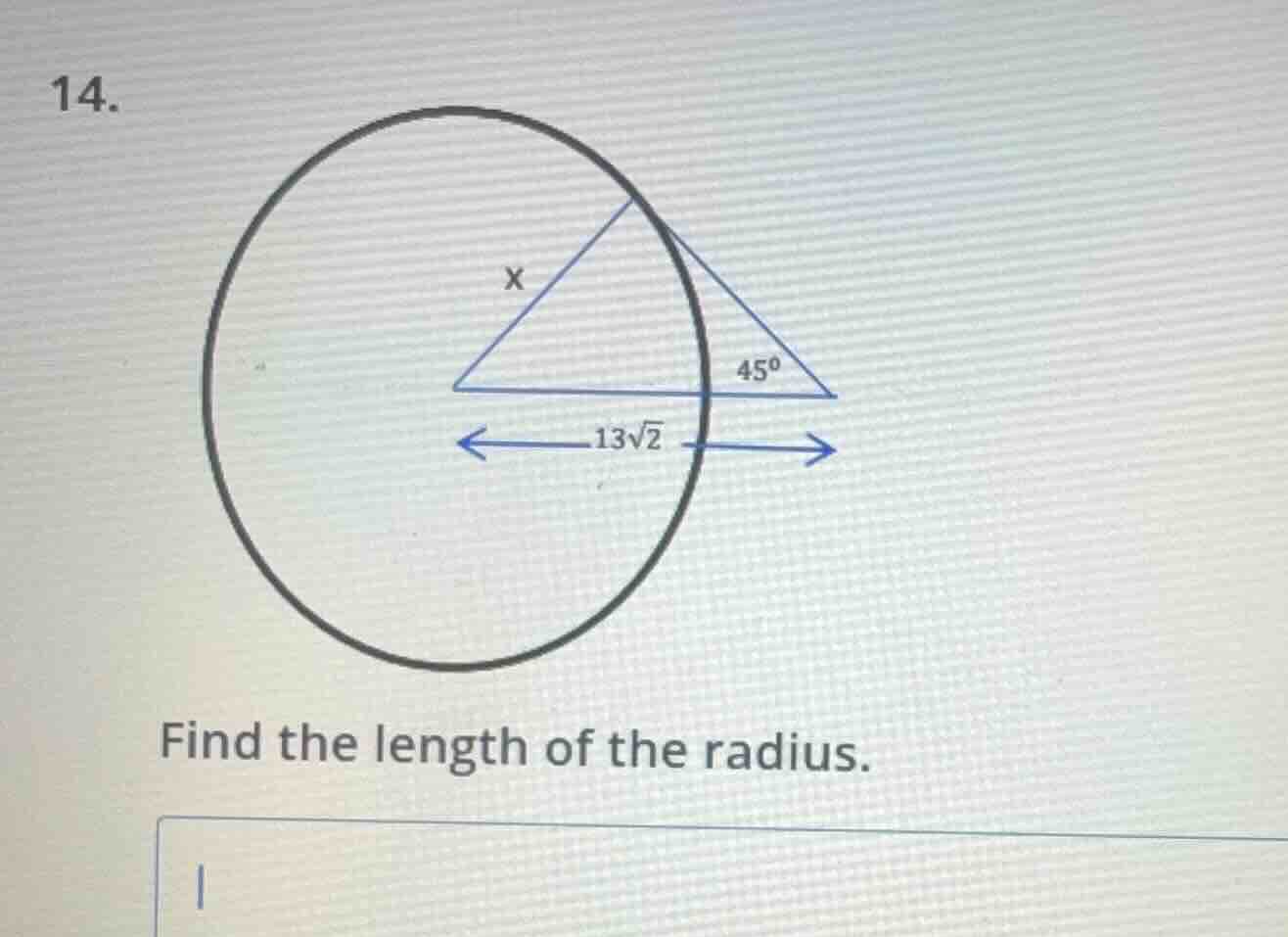
find the length of the radius.
Step1: Identify the triangle type
The triangle with angle \(45^\circ\) and two sides (radius \(x\) and the other side) is an isosceles right triangle? Wait, no, actually, the triangle formed with the radius and the given length: the line of length \(13\sqrt{2}\) is related to the radius \(x\) and the angle \(45^\circ\). Wait, using trigonometry, in the right triangle (since the radius is perpendicular to the tangent? Wait, no, maybe it's a triangle where we can use cosine. Wait, the horizontal line is \(13\sqrt{2}\), and the angle is \(45^\circ\), and the two sides from the vertex (one is radius \(x\), the other is also \(x\) because it's a radius? Wait, no, the triangle with angle \(45^\circ\) and the two sides: wait, maybe it's a triangle where we can use the cosine law or sine law. Wait, actually, if we consider the triangle with angle \(45^\circ\), and the adjacent side to the angle is \(x\) (radius), and the hypotenuse? Wait, no, the horizontal length is \(13\sqrt{2}\), which is the sum? Wait, no, maybe it's a right triangle with angle \(45^\circ\), so it's an isosceles right triangle. Wait, let's think again. The radius \(x\), and the angle \(45^\circ\), so using the cosine of \(45^\circ\): \(\cos(45^\circ)=\frac{x}{13\sqrt{2}}\)? Wait, no, maybe the horizontal line is the adjacent side. Wait, \(\cos(45^\circ)=\frac{\text{adjacent}}{\text{hypotenuse}}\), but here, if the angle is \(45^\circ\), and the adjacent side is \(x\), and the hypotenuse is \(13\sqrt{2}\)? No, that doesn't make sense. Wait, maybe it's a triangle where the two sides are \(x\) (radius) and the included angle is \(45^\circ\), and the third side is... Wait, no, let's use the formula for the length in a triangle with angle \(45^\circ\). Wait, actually, if we have a triangle with two sides equal to \(x\) (radii) and the included angle? No, the angle given is \(45^\circ\). Wait, maybe it's a right triangle with angle \(45^\circ\), so the legs are equal. Wait, the horizontal length is \(13\sqrt{2}\), and if we use the cosine of \(45^\circ\): \(\cos(45^\circ)=\frac{x}{13\sqrt{2}}\)? Wait, \(\cos(45^\circ)=\frac{\sqrt{2}}{2}\), so:
\(\frac{\sqrt{2}}{2}=\frac{x}{13\sqrt{2}}\)
Step2: Solve for \(x\)
Multiply both sides by \(13\sqrt{2}\):
\(x = 13\sqrt{2} \times \frac{\sqrt{2}}{2}\)
Simplify \(\sqrt{2} \times \sqrt{2}=2\), so:
\(x = 13 \times \frac{2}{2}=13\)
Wait, that makes sense. So \(x = 13\).

Snap & solve any problem in the app
Get step-by-step solutions on Sovi AI
Photo-based solutions with guided steps
Explore more problems and detailed explanations
\(13\)