QUESTION IMAGE
Question
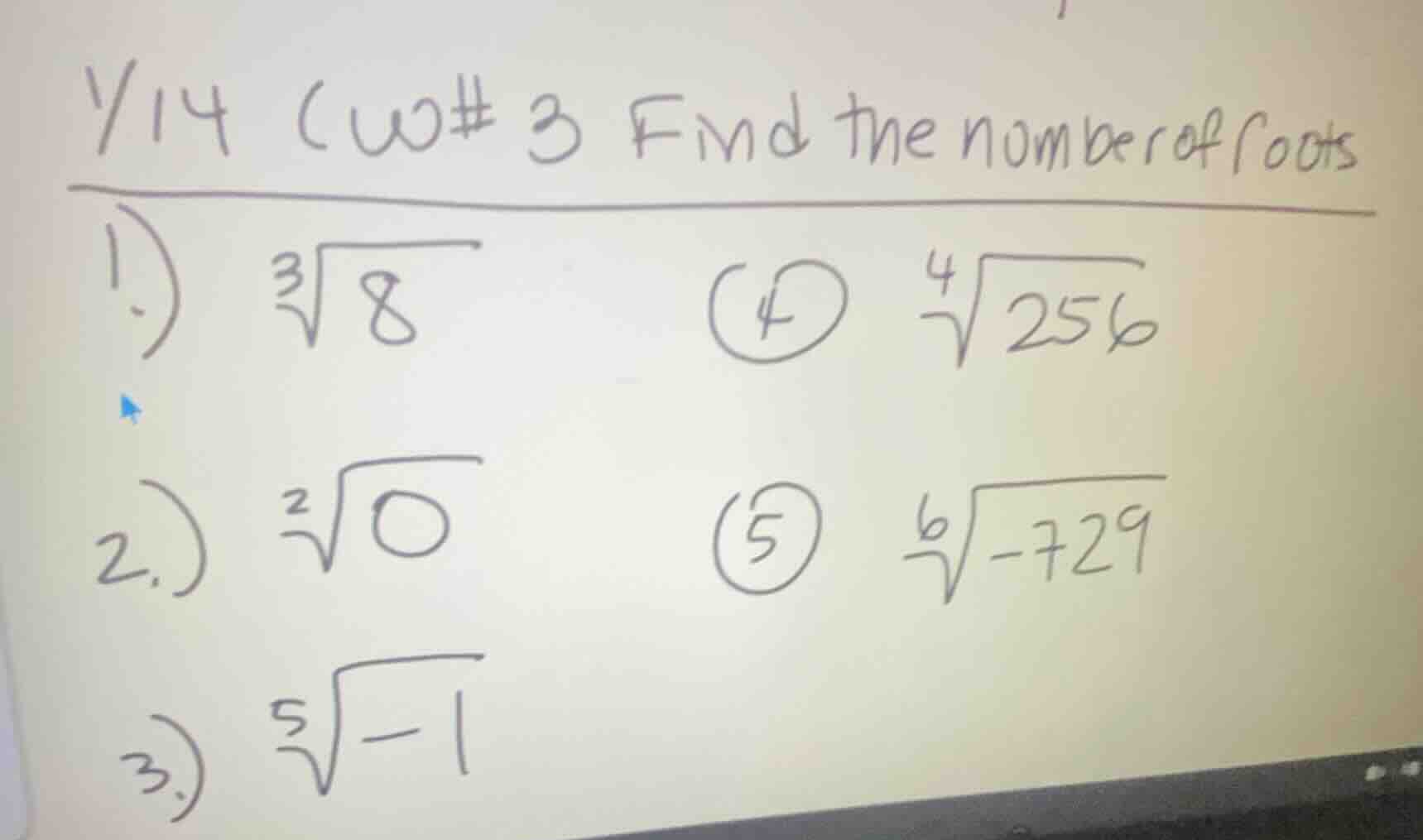
1/14 (w#3 find the number of roots
- $sqrt3{8}$ (4) $sqrt4{256}$
- $sqrt2{0}$ (5) $sqrt6{-729}$
- $sqrt5{-1}$
1. For $\boldsymbol{\sqrt[3]{8}}$
Step1: Recall the definition of nth roots
For a real number \( a \) and positive integer \( n \), the \( n \)-th root of \( a \), \( \sqrt[n]{a} \), has a certain number of real roots depending on the parity of \( n \) and the sign of \( a \). For odd \( n \), every real number has exactly one real \( n \)-th root. For even \( n \), non - negative real numbers have two real \( n \)-th roots (positive and negative) and negative real numbers have no real \( n \)-th roots. Also, \( \sqrt[n]{0}=0 \) for any \( n \).
Here, \( n = 3 \) (odd) and \( a=8 \).
Step2: Determine the number of roots
Since \( n = 3 \) is odd and \( 8\) is a real number, the cube root of \( 8 \) (i.e., \( \sqrt[3]{8} \)) has exactly 1 real root (because for odd \( n \), the function \( y = \sqrt[n]{x}\) is a one - to - one function over the real numbers). We know that \( \sqrt[3]{8}=2 \) (since \( 2^3 = 8 \)), and there is only one real number that when cubed gives 8.
Step1: Recall the property of square root of 0
The square root of a number \( x \) is a number \( y \) such that \( y^2=x \). For \( x = 0 \), we have \( y^2=0 \).
Step2: Solve for y
If \( y^2 = 0 \), then \( y = 0 \) (since \( 0\times0=0 \) and there is only one number that satisfies this equation for the square root of 0. Although for non - zero non - negative \( x \), \( \sqrt{x} \) has two roots (\( \sqrt{x} \) and \( -\sqrt{x} \)), for \( x = 0 \), both the positive and negative roots are 0. So, the square root of 0 has 1 real root.
Step1: Recall the rule for odd nth roots
For an odd positive integer \( n \), every real number has exactly one real \( n \)-th root. Here, \( n = 5 \) (which is odd) and \( a=-1 \).
Step2: Determine the number of roots
Since \( n = 5 \) is odd and \( - 1\) is a real number, the fifth root of \( - 1 \) (i.e., \( \sqrt[5]{-1}\)) has exactly 1 real root. We know that \( (-1)^5=-1 \), and there is only one real number that when raised to the 5th power gives \( - 1 \).

Snap & solve any problem in the app
Get step-by-step solutions on Sovi AI
Photo-based solutions with guided steps
Explore more problems and detailed explanations
1