QUESTION IMAGE
Question
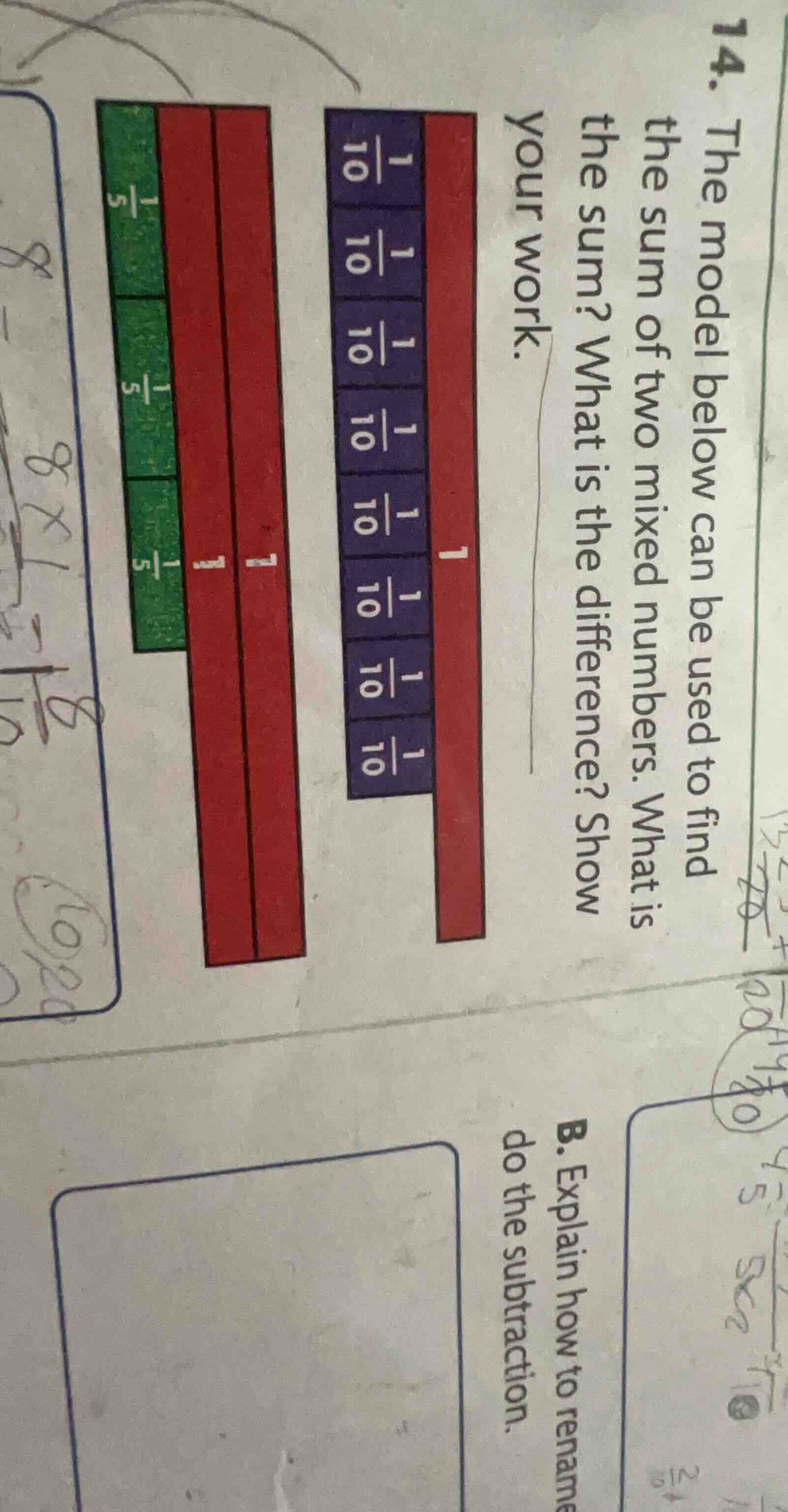
- the model below can be used to find the sum of two mixed numbers. what is the sum? what is the difference? show your work.
Step1: Identify the mixed numbers
From the model, the first mixed number (let's say \( A \)): The red part is \( 2 \) (whole numbers) and the purple part is \( \frac{8}{10} \) (since there are 8 blocks of \( \frac{1}{10} \)), so \( A = 2+\frac{8}{10}=2\frac{8}{10} \). The second mixed number (let's say \( B \)): The red part is \( 2 \) (whole numbers) and the green part is \( \frac{3}{5} \) (since there are 3 blocks of \( \frac{1}{5} \), and \( \frac{3}{5}=\frac{6}{10} \)), so \( B = 2+\frac{3}{5}=2\frac{3}{5}=2\frac{6}{10} \). Wait, maybe I misread. Wait, looking again: The first model (purple and red) – red is 1? Wait, no, maybe the first mixed number is \( 1\frac{8}{10} \) (since red is 1 whole and purple is 8/10) and the second is \( 2\frac{3}{5} \) (red is 2 wholes and green is 3/5). Wait, let's correct. Let's see:
First mixed number (left - purple and red): Red is 1 whole, purple is 8/10, so \( 1\frac{8}{10} \). Second mixed number (right - green and red): Red is 2 wholes, green is 3/5, so \( 2\frac{3}{5} \). Wait, maybe sum and difference. Let's convert to improper fractions or decimals.
Wait, \( 1\frac{8}{10}=1.8 \), \( 2\frac{3}{5}=2.6 \).
Step2: Calculate the sum
Sum: \( 1\frac{8}{10}+2\frac{3}{5} \). Convert \( \frac{3}{5} \) to tenths: \( \frac{3}{5}=\frac{6}{10} \). So \( 1\frac{8}{10}+2\frac{6}{10}=(1 + 2)+(\frac{8}{10}+\frac{6}{10})=3+\frac{14}{10}=3+\frac{7}{5}=3 + 1\frac{2}{5}=4\frac{2}{5} \) (or \( 4.4 \)).
Step3: Calculate the difference
Difference: \( 2\frac{3}{5}-1\frac{8}{10} \). Convert to tenths: \( 2\frac{6}{10}-1\frac{8}{10} \). We need to borrow: \( 2\frac{6}{10}=1\frac{16}{10} \). Then \( 1\frac{16}{10}-1\frac{8}{10}=(1 - 1)+(\frac{16}{10}-\frac{8}{10})=0+\frac{8}{10}=\frac{4}{5} \) (or 0.8). Wait, maybe the mixed numbers are \( 2\frac{8}{10} \) and \( 2\frac{3}{5} \)? No, the first model has 1 red and 8 purple, so 1 + 8/10. The second has 2 red and 3 green, so 2 + 3/5.
Wait, let's re-express:
First mixed number: \( 1\frac{8}{10} \) (1 whole + 8/10)
Second mixed number: \( 2\frac{3}{5} \) (2 wholes + 3/5)
Sum: \( 1\frac{8}{10}+2\frac{3}{5}=1\frac{4}{5}+2\frac{3}{5}=(1 + 2)+(\frac{4}{5}+\frac{3}{5})=3+\frac{7}{5}=3 + 1\frac{2}{5}=4\frac{2}{5} \)
Difference: \( 2\frac{3}{5}-1\frac{8}{10}=2\frac{6}{10}-1\frac{8}{10}=1\frac{16}{10}-1\frac{8}{10}=\frac{8}{10}=\frac{4}{5} \)
Wait, maybe the mixed numbers are \( 2\frac{8}{10} \) and \( 2\frac{3}{5} \)? No, the first red is 1? Wait, the image: first model (purple) has 8 blocks of 1/10 and red (maybe 1 whole? No, the red is a vertical bar. Wait, maybe the first mixed number is \( 2\frac{8}{10} \) (two red bars and 8/10 purple) and the second is \( 2\frac{3}{5} \) (two red bars and 3/5 green). Wait, if both have 2 wholes, then sum: \( 2\frac{8}{10}+2\frac{3}{5}=2\frac{4}{5}+2\frac{3}{5}=4+\frac{7}{5}=5\frac{2}{5} \), difference: \( 2\frac{8}{10}-2\frac{3}{5}=2\frac{4}{5}-2\frac{3}{5}=\frac{1}{5} \). But that seems too small. Maybe my initial identification is wrong.
Alternative approach: Let's take the two mixed numbers as \( 1\frac{8}{10} \) and \( 2\frac{3}{5} \).
Sum: \( 1\frac{8}{10} + 2\frac{3}{5} = 1 + \frac{8}{10} + 2 + \frac{3}{5} = (1 + 2) + (\frac{8}{10} + \frac{6}{10}) = 3 + \frac{14}{10} = 3 + 1\frac{4}{10} = 4\frac{2}{5} \)
Difference: \( 2\frac{3}{5} - 1\frac{8}{10} = 2\frac{6}{10} - 1\frac{8}{10} = 1\frac{16}{10} - 1\frac{8}{10} = \frac{8}{10} = \frac{4}{5} \)

Snap & solve any problem in the app
Get step-by-step solutions on Sovi AI
Photo-based solutions with guided steps
Explore more problems and detailed explanations
Sum: \( 4\frac{2}{5} \) (or \( 4.4 \)), Difference: \( \frac{4}{5} \) (or \( 0.8 \))
Wait, but maybe the mixed numbers are \( 1\frac{8}{10} \) and \( 2\frac{3}{5} \). Let's confirm the model:
- First model (purple and red): Red is 1 whole, purple is 8/10 → \( 1\frac{8}{10} \)
- Second model (green and red): Red is 2 wholes, green is 3/5 → \( 2\frac{3}{5} \)
Yes, that makes sense. So sum is \( 1\frac{8}{10} + 2\frac{3}{5} = 4\frac{2}{5} \), difference is \( 2\frac{3}{5} - 1\frac{8}{10} = \frac{4}{5} \).