QUESTION IMAGE
Question
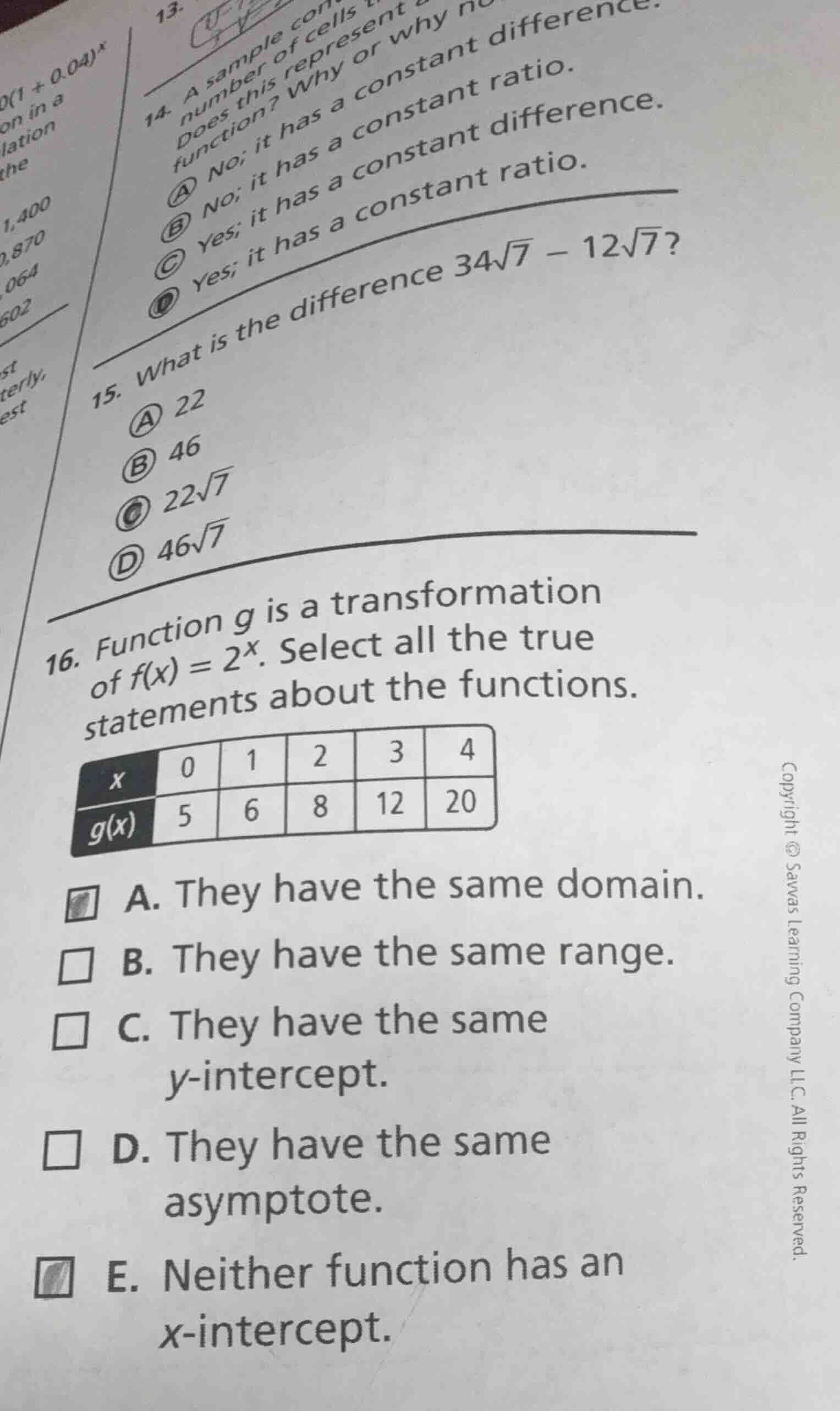
- a sample of cells number of cells does this represent a function? why or why no a no; it has a constant difference. b no; it has a constant ratio. c yes; it has a constant difference. d yes; it has a constant ratio. 15. what is the difference ( 34sqrt{7} - 12sqrt{7} )? a 22 b 46 c ( 22sqrt{7} ) d ( 46sqrt{7} ) 16. function ( g ) is a transformation of ( f(x) = 2^x ). select all the true statements about the functions. (\begin{array}{|c|c|c|c|c|} hline x & 0 & 1 & 2 & 3 & 4 \\ hline g(x) & 5 & 6 & 8 & 12 & 20 \\ hline end{array}) a. they have the same domain. b. they have the same range. c. they have the same y - intercept. d. they have the same asymptote. e. neither function has an x - intercept.
Response
Question 15
Step1: Identify like radicals
Both terms have $\sqrt{7}$, so we can combine them.
Step2: Subtract the coefficients
Subtract the coefficients of $\sqrt{7}$: $34 - 12 = 22$.
Step3: Combine the terms
So, $34\sqrt{7} - 12\sqrt{7} = (34 - 12)\sqrt{7} = 22\sqrt{7}$.
Brief Explanations
- Option A: The domain of $f(x) = 2^x$ is all real numbers. The domain of $g(x)$ (from the table) is the set of $x$-values given (0, 1, 2, 3, 4), but if we consider $g(x)$ as a function, its domain could be all real numbers (if it's defined for all $x$) or just the given values. However, typically, for such transformation questions, we assume the domain of $g(x)$ is also all real numbers (or at least the same as $f(x)$ in terms of being all real numbers if $g(x)$ is a function defined for all $x$). But actually, the table shows discrete values, but the original function $f(x)$ has domain $\mathbb{R}$. Wait, no—maybe the key is that both functions, if $g(x)$ is a transformation, would have domain all real numbers (or the same as $f(x)$). But let's check other options.
- Option B: The range of $f(x) = 2^x$ is $(0, \infty)$. The range of $g(x)$ from the table is $\{5, 6, 8, 12, 20\}$ and if it's a transformation, its range would be different (since $f(x)$ has range positive reals, $g(x)$ has range starting at 5, etc.), so B is false.
- Option C: The $y$-intercept of $f(x)$ is when $x = 0$, $f(0) = 2^0 = 1$. The $y$-intercept of $g(x)$ is when $x = 0$, $g(0) = 5$. So different, C is false.
- Option D: The function $f(x) = 2^x$ has a horizontal asymptote at $y = 0$. For $g(x)$, from the table, as $x$ decreases (if we extend), does it approach a horizontal line? The table values don't suggest an asymptote at $y = 0$ (since $g(0) = 5$), so D is false.
- Option E: For $f(x) = 2^x$, $2^x = 0$ has no solution (since exponential functions are always positive), so no $x$-intercept. For $g(x)$, from the table, $g(x)$ values are 5, 6, 8, 12, 20—all positive, so no $x$-intercept (if we assume the function doesn't cross the $x$-axis). So E is true. Also, re - evaluating A: If $g(x)$ is a transformation of $f(x)$, and $f(x)$ has domain all real numbers, and $g(x)$ (as a function, not just the table) would also have domain all real numbers (the table is just sample values), so A could be considered true. Wait, the table shows $x = 0,1,2,3,4$, but the function $f(x)$ has domain $\mathbb{R}$. If $g(x)$ is a function defined for all real $x$ (a transformation), then their domains are the same (all real numbers). So A is true, E is true.

Snap & solve any problem in the app
Get step-by-step solutions on Sovi AI
Photo-based solutions with guided steps
Explore more problems and detailed explanations
C. $22\sqrt{7}$