QUESTION IMAGE
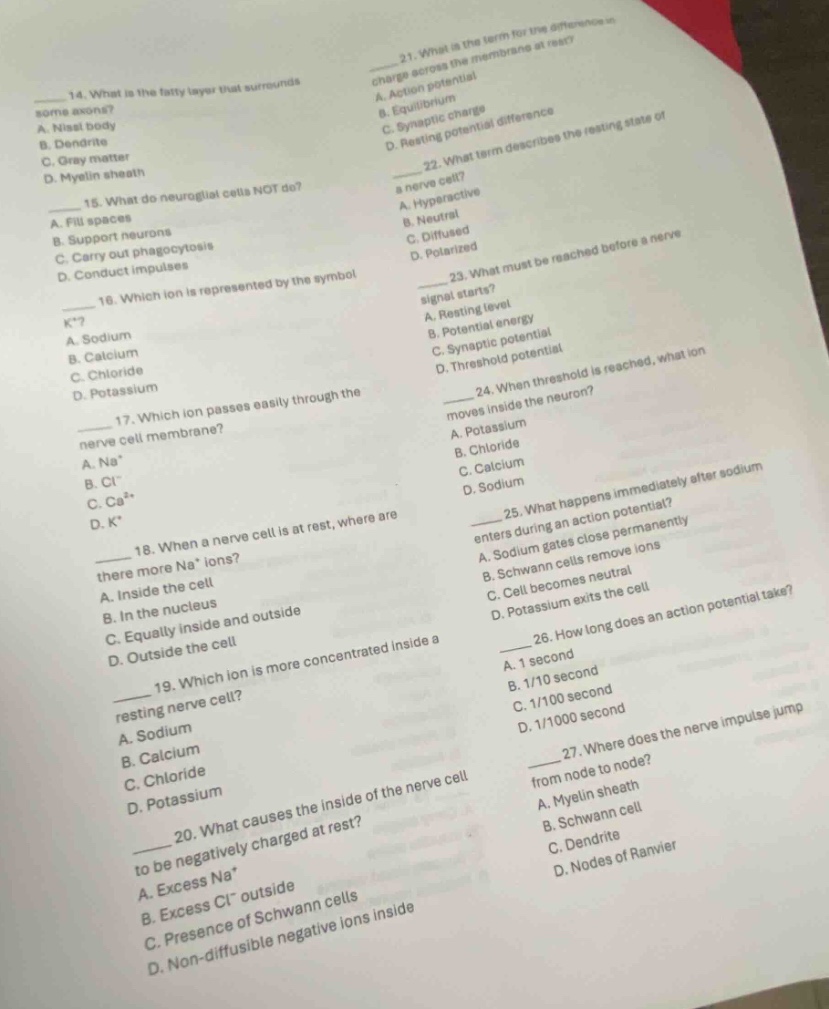
Question
- what is the fatty layer that surrounds some axons?
a. nissl body
b. dendrite
c. gray matter
d. myelin sheath
- what do neuroglial cells not do?
a. fill spaces
b. support neurons
c. carry out phagocytosis
d. conduct impulses
- which ion is represented by the symbol k⁺?
a. sodium
b. calcium
c. chloride
d. potassium
- which ion passes easily through the nerve cell membrane?
a. na⁺
b. cl⁻
c. ca²⁺
d. k⁺
- when a nerve cell is at rest, where are there more na⁺ ions?
a. inside the cell
b. in the nucleus
c. equally inside and outside
d. outside the cell
- which ion is more concentrated inside a resting nerve cell?
a. sodium
b. calcium
c. chloride
d. potassium
- what causes the inside of the nerve cell to be negatively charged at rest?
a. excess na⁺
b. excess cl⁻ outside
c. presence of schwann cells
d. non - diffusible negative ions inside
- what is the term for the difference in charge across the membrane at rest?
a. action potential
b. equilibrium
c. synaptic charge
d. resting potential difference
- what term describes the resting state of a nerve cell?
a. hyperactive
b. neutral
c. diffused
d. polarized
- what must be reached before a nerve signal starts?
a. resting level
b. potential energy
c. synaptic potential
d. threshold potential
- when threshold is reached, what ion moves inside the neuron?
a. potassium
b. chloride
c. calcium
d. sodium
- what happens immediately after sodium enters during an action potential?
a. sodium gates close permanently
b. schwann cells remove ions
c. cell becomes neutral
d. potassium exits the cell
- how long does an action potential take?
a. 1 second
b. 1/10 second
c. 1/100 second
d. 1/1000 second
- where does the nerve impulse jump from node to node?
a. myelin sheath
b. schwann cell
c. dendrite
d. nodes of ranvier
- Myelin sheath is the fatty insulating layer around axons.
- Neuroglial cells support neurons but do not conduct electrical impulses (neurons do this).
- The symbol K⁺ represents the potassium ion.
- Potassium ions (K⁺) have high permeability across resting nerve cell membranes.
- At rest, sodium ions are more concentrated outside the nerve cell due to ion pumps.
- Potassium ions are more concentrated inside a resting nerve cell.
- Trapped non-diffusible negative ions inside the cell create a negative resting charge.
- Resting potential difference is the charge difference across a resting neuron membrane.
- A resting nerve cell is polarized, with a negative internal charge relative to the outside.
- Threshold potential is the minimum stimulus needed to trigger a nerve signal.
- When threshold is reached, sodium ions rapidly move into the neuron to start an action potential.
- After sodium enters, potassium exits the cell to repolarize the membrane.
- An action potential lasts approximately 1 millisecond (1/1000 second).
- Nerve impulses jump between Nodes of Ranvier (gaps in myelin) in saltatory conduction.

Snap & solve any problem in the app
Get step-by-step solutions on Sovi AI
Photo-based solutions with guided steps
Explore more problems and detailed explanations
- D. Myelin sheath
- D. Conduct impulses
- D. Potassium
- D. K⁺
- D. Outside the cell
- D. Potassium
- D. Non-diffusible negative ions inside
- D. Resting potential difference
- D. Polarized
- D. Threshold potential
- D. Sodium
- D. Potassium exits the cell
- D. 1/1000 second
- D. Nodes of Ranvier