QUESTION IMAGE
Question
a 15-foot flagpole leans slightly, such that it makes an 80° angle with the ground. the shadow of the flagpole is 10 feet long when the sun has an unknown angle of elevation. how could the angle of elevation of the sun, x, be determined?
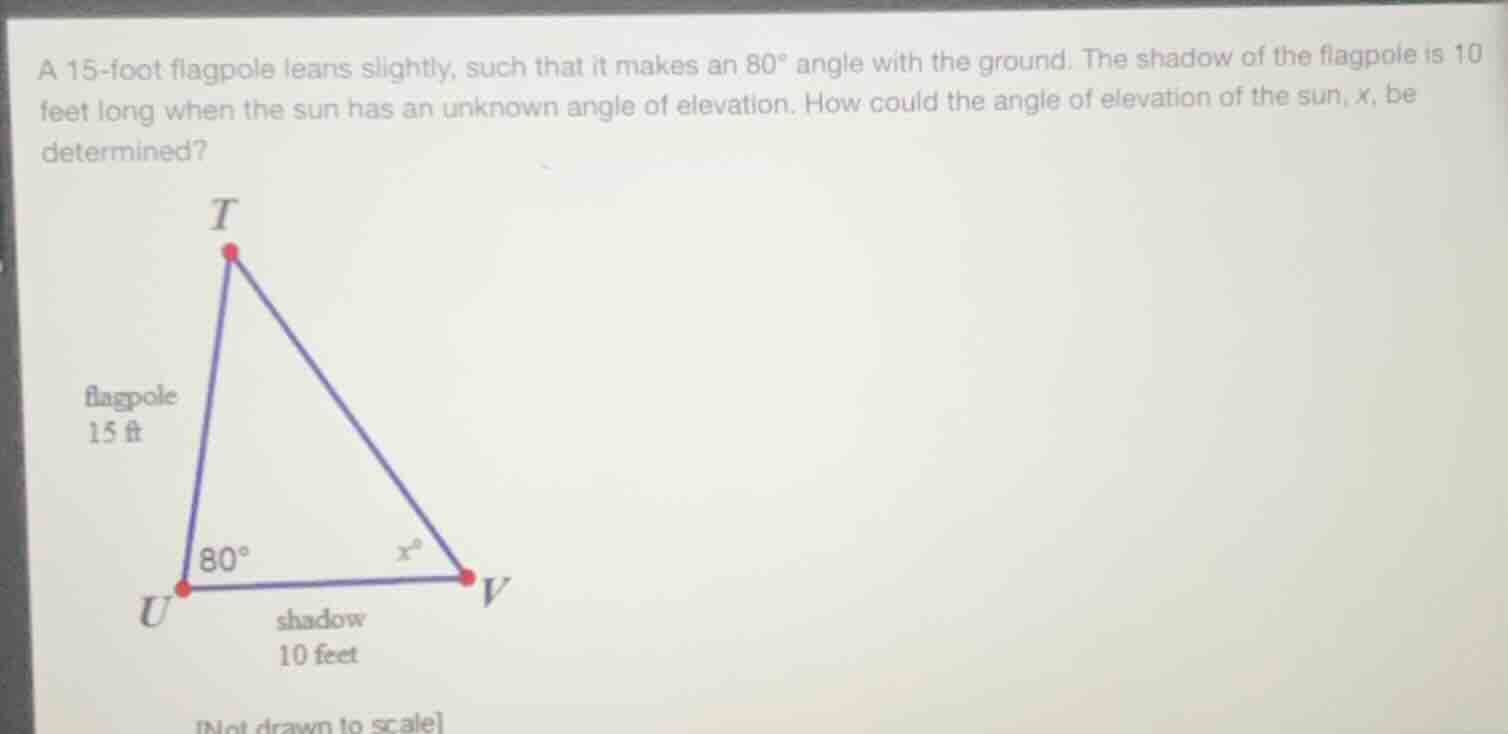
(image of triangle with vertices u, t, v: u to t is flagpole 15 ft, u to v is shadow 10 feet, angle at u is 80°, angle at v is x°)
(not drawn to scale)
Step1: Identify the triangle sides and angle
We have a triangle \( \triangle UVT \) with \( UT = 15 \) ft (flagpole), \( UV = 10 \) ft (shadow), and \( \angle U = 80^\circ \). We need to find \( \angle V=x \).
Step2: Apply the Law of Sines
The Law of Sines states that in any triangle, \( \frac{a}{\sin A}=\frac{b}{\sin B}=\frac{c}{\sin C} \). Here, let \( a = UT = 15 \), \( A=\angle V = x \), \( b = UV = 10 \), \( B=\angle T \). First, find \( \angle T \) using the fact that the sum of angles in a triangle is \( 180^\circ \), so \( \angle T=180^\circ - 80^\circ - x=100^\circ - x \). But more directly, apply Law of Sines as \( \frac{UT}{\sin x}=\frac{UV}{\sin \angle T} \), but actually, correct sides: \( UT = 15 \), opposite \( \angle V=x \); \( UV = 10 \), opposite \( \angle T \); \( \angle U = 80^\circ \). Wait, correct: \( \frac{UT}{\sin x}=\frac{UV}{\sin \angle T} \), but also \( \angle T=180 - 80 - x=100 - x \). Alternatively, \( \frac{15}{\sin x}=\frac{10}{\sin(180^\circ - 80^\circ - x)}=\frac{10}{\sin(100^\circ - x)} \), but simpler: use \( \frac{15}{\sin x}=\frac{10}{\sin(180 - 80 - x)} \), but actually, the Law of Sines is \( \frac{UT}{\sin \angle V}=\frac{UV}{\sin \angle T} \), and \( \angle T = 180 - 80 - x = 100 - x \). But another way: \( \frac{15}{\sin x}=\frac{10}{\sin(180 - 80 - x)}=\frac{10}{\sin(100 - x)} \), but since \( \sin(100 - x)=\sin(80 + x) \)? No, better: Let's denote sides: \( UT = 15 \) (side opposite \( \angle V = x \)), \( UV = 10 \) (side opposite \( \angle T \)), \( \angle U = 80^\circ \). So by Law of Sines: \( \frac{15}{\sin x}=\frac{10}{\sin \angle T} \), and \( \angle T = 180 - 80 - x = 100 - x \). So \( \frac{15}{\sin x}=\frac{10}{\sin(100 - x)} \). But also, \( \sin(100 - x)=\sin(80 + x) \)? No, \( \sin(100 - x)=\sin(180 - (80 + x))=\sin(80 + x) \)? No, \( 100 - x = 180 - (80 + x) \), so \( \sin(100 - x)=\sin(80 + x) \). But maybe better to use \( \frac{15}{\sin x}=\frac{10}{\sin(180 - 80 - x)}=\frac{10}{\sin(100 - x)} \), but we can also write \( \frac{15}{\sin x}=\frac{10}{\sin(180 - 80 - x)}=\frac{10}{\sin(100 - x)} \), and since \( \sin(100 - x)=\sin(80 + x) \) is not helpful. Wait, actually, the correct application: in \( \triangle UVT \), sides: \( UT = 15 \), \( UV = 10 \), \( \angle U = 80^\circ \). So by Law of Sines: \( \frac{UT}{\sin \angle V}=\frac{UV}{\sin \angle T} \), where \( \angle V = x \), \( \angle T = 180 - 80 - x = 100 - x \). So \( \frac{15}{\sin x}=\frac{10}{\sin(100 - x)} \). Cross-multiplying: \( 15\sin(100 - x)=10\sin x \). But \( \sin(100 - x)=\sin 100 \cos x - \cos 100 \sin x \). So \( 15(\sin 100 \cos x - \cos 100 \sin x)=10\sin x \). \( 15\sin 100 \cos x - 15\cos 100 \sin x = 10\sin x \). \( 15\sin 100 \cos x = \sin x(10 + 15\cos 100) \). \( \tan x=\frac{15\sin 100}{10 + 15\cos 100} \). Alternatively, use Law of Sines directly: \( \frac{15}{\sin x}=\frac{10}{\sin(180 - 80 - x)}=\frac{10}{\sin(100 - x)} \), but maybe the problem is to state the method, so the angle of elevation \( x \) can be determined using the Law of Sines: \( \frac{15}{\sin x}=\frac{10}{\sin(180^\circ - 80^\circ - x)} \), or simplifying, first find the third angle and then apply Law of Sines, or use \( \frac{15}{\sin x}=\frac{10}{\sin(100^\circ - x)} \), and solve for \( x \).

Snap & solve any problem in the app
Get step-by-step solutions on Sovi AI
Photo-based solutions with guided steps
Explore more problems and detailed explanations
The angle of elevation \( x \) can be determined using the Law of Sines in triangle \( \triangle UVT \). The Law of Sines states \( \frac{UT}{\sin x}=\frac{UV}{\sin(180^\circ - 80^\circ - x)} \), where \( UT = 15 \) ft, \( UV = 10 \) ft, and \( \angle U = 80^\circ \). Substituting the values, we get \( \frac{15}{\sin x}=\frac{10}{\sin(100^\circ - x)} \), and solving this equation (e.g., by cross - multiplying and using trigonometric identities or a calculator) will give the value of \( x \).