QUESTION IMAGE
Question
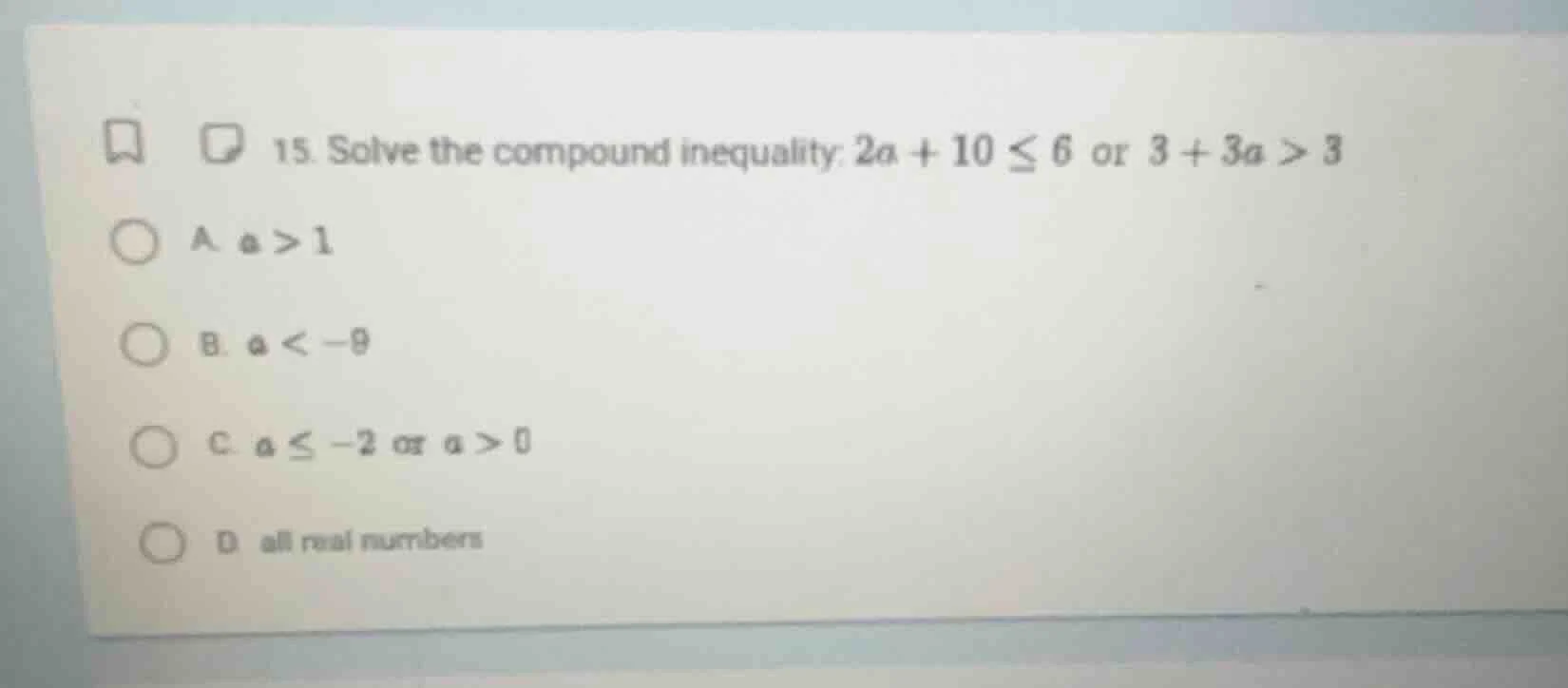
- solve the compound inequality: $2a + 10 \leq 6$ or $3 + 3a > 3$
a $a > 1$
b $a < -9$
c $a \leq -2$ or $a > 0$
d all real numbers
Step1: Solve \(2a + 10 \leq 6\)
Subtract 10 from both sides: \(2a + 10 - 10 \leq 6 - 10\)
Simplify: \(2a \leq -4\)
Divide by 2: \(\frac{2a}{2} \leq \frac{-4}{2}\)
Result: \(a \leq -2\)
Step2: Solve \(3 + 3a > 3\)
Subtract 3 from both sides: \(3 + 3a - 3 > 3 - 3\)
Simplify: \(3a > 0\)
Divide by 3: \(\frac{3a}{3} > \frac{0}{3}\)
Result: \(a > 0\)
Step3: Combine solutions (OR)
The compound inequality is "or", so we combine \(a \leq -2\) and \(a > 0\). This means all real numbers because any real number is either \(\leq -2\), \(> 0\), or between them (but "or" includes all cases where either is true, and together they cover all real numbers? Wait, no—wait, \(a \leq -2\) or \(a > 0\) does not cover between -2 and 0. Wait, no, I made a mistake. Wait, no—wait, let's re - check.
Wait, step 1: \(2a+10\leq6\) gives \(a\leq - 2\)
Step 2: \(3 + 3a>3\) gives \(a > 0\)
But the "or" means the solution is all \(a\) such that \(a\leq - 2\) or \(a > 0\)? Wait, no, that can't be. Wait, no, wait the options: option D is all real numbers. Wait, maybe I made a mistake in solving.
Wait, re - solve \(3 + 3a>3\):
\(3+3a>3\)
Subtract 3: \(3a>0\)
Divide by 3: \(a > 0\)
And \(2a + 10\leq6\):
\(2a\leq6 - 10=-4\)
\(a\leq - 2\)
Now, the compound inequality is "or", so the solution is the union of \(a\leq - 2\) and \(a > 0\). But that's not all real numbers. Wait, but the options have D as all real numbers. Wait, maybe I messed up the solving.
Wait, wait, let's check the options again. The options are:
A. \(a>1\)
B. \(a < - 9\)
C. \(a\leq - 2\) or \(a > 0\)
D. all real numbers
Wait, when we solve \(2a + 10\leq6\), we get \(a\leq - 2\)
When we solve \(3+3a>3\), we get \(a>0\)
But the "or" in the compound inequality means that a number is a solution if it satisfies either inequality. Now, let's check if there is any real number that doesn't satisfy either. Take a number between - 2 and 0, say \(a=-1\). Does it satisfy \(2a + 10\leq6\)? \(2(-1)+10 = 8\), which is not \(\leq6\). Does it satisfy \(3 + 3a>3\)? \(3+3(-1)=0\), which is not \(>3\). Wait, so \(a = - 1\) does not satisfy either. So my previous conclusion was wrong. But the options have D as all real numbers. There must be a mistake in my solving.
Wait, wait, re - solve \(3 + 3a>3\):
\(3+3a>3\)
Subtract 3: \(3a>0\)
Divide by 3: \(a>0\)
And \(2a + 10\leq6\):
\(2a\leq - 4\)
\(a\leq - 2\)
But the options: option C is \(a\leq - 2\) or \(a > 0\), option D is all real numbers. Wait, maybe the original problem was written incorrectly? Or maybe I misread the problem.
Wait, the problem is \(2a + 10\leq6\) or \(3 + 3a>3\)
Wait, let's check the options again. Option C is \(a\leq - 2\) or \(a > 0\), option D is all real numbers.
Wait, maybe I made a mistake in the first inequality. Let's re - solve \(2a+10\leq6\):
\(2a\leq6 - 10=-4\)
\(a\leq - 2\) (correct)
Second inequality: \(3 + 3a>3\)
\(3a>0\)
\(a > 0\) (correct)
So the solution is \(a\leq - 2\) or \(a > 0\), which is option C? But that's not all real numbers. Wait, the options given:
A. \(a>1\)
B. \(a < - 9\)
C. \(a\leq - 2\) or \(a > 0\)
D. all real numbers
Wait, maybe there is a typo in the problem. Or maybe I misread the coefficients. Wait, the first inequality: \(2a + 10\leq6\)
If it was \(2a+1\leq6\), then \(2a\leq5\), \(a\leq2.5\), but no. Wait, the original problem is \(2a + 10\leq6\) or \(3 + 3a>3\)
Wait, let's check with \(a=-1\): does it satisfy either?
For \(2a + 10\): \(2*(-1)+10 = 8\), \(8\leq6\)? No.
For \(3 + 3a\): \(3+3*(-1)=0\), \(0>3\)? No. So \(a = - 1\) is not a solution. So the solution is…

Snap & solve any problem in the app
Get step-by-step solutions on Sovi AI
Photo-based solutions with guided steps
Explore more problems and detailed explanations
C. \(a \leq -2\) or \(a > 0\)