QUESTION IMAGE
Question
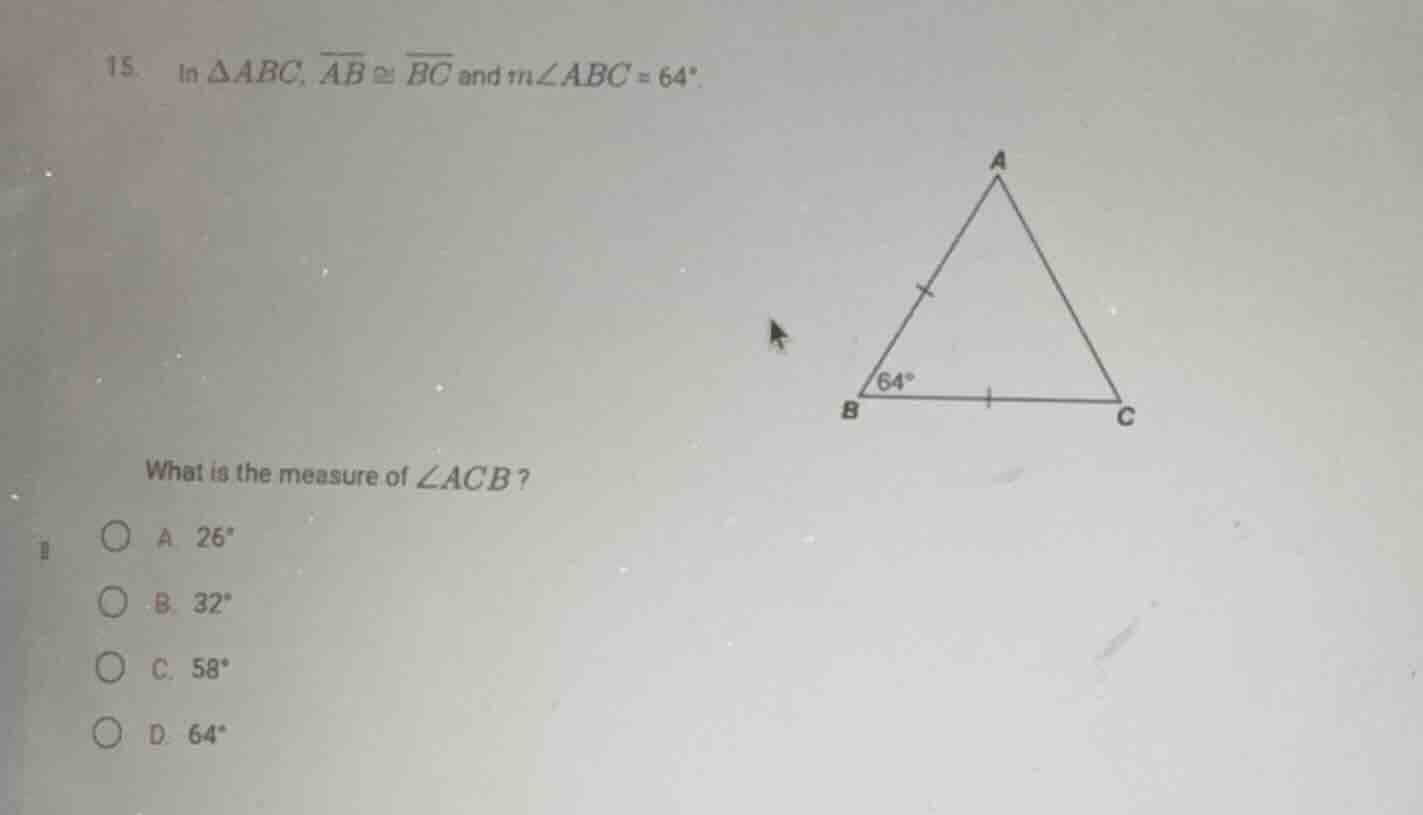
- in $\triangle abc$, $\overline{ab} \cong \overline{bc}$ and $m\angle abc = 64^\circ$.
what is the measure of $\angle acb$?
\bigcirc a. $26^\circ$
\bigcirc b. $32^\circ$
\bigcirc c. $58^\circ$
\bigcirc d. $64^\circ$
Step1: Identify triangle type
Since \( \overline{AB} \cong \overline{BC} \), \( \triangle ABC \) is isosceles with \( \angle BAC \cong \angle ACB \).
Step2: Sum of angles in triangle
The sum of angles in a triangle is \( 180^\circ \). Let \( m\angle ACB = x \), then \( m\angle BAC = x \). We know \( m\angle ABC = 64^\circ \), so:
\[
x + x + 64^\circ = 180^\circ
\]
Step3: Solve for x
Simplify the equation:
\[
2x + 64^\circ = 180^\circ
\]
Subtract \( 64^\circ \) from both sides:
\[
2x = 180^\circ - 64^\circ = 116^\circ
\]
Divide by 2:
\[
x = \frac{116^\circ}{2} = 58^\circ
\]
Wait, no, wait. Wait, in an isosceles triangle with \( AB = BC \), the base angles are \( \angle A \) and \( \angle C \)? Wait, no, \( AB = BC \), so the equal sides are \( AB \) and \( BC \), so the base is \( AC \), and the equal angles are \( \angle A \) and \( \angle C \)? Wait, no, let's correct. In triangle \( ABC \), sides \( AB \) and \( BC \) are equal, so the angles opposite them are equal. The angle opposite \( AB \) is \( \angle ACB \), and the angle opposite \( BC \) is \( \angle BAC \). So \( \angle BAC = \angle ACB \). Then sum of angles: \( \angle ABC + \angle BAC + \angle ACB = 180^\circ \). So \( 64^\circ + 2\angle ACB = 180^\circ \). Then \( 2\angle ACB = 180 - 64 = 116 \), so \( \angle ACB = 58^\circ \)? Wait, but let me check again. Wait, maybe I mixed up the sides. Wait, \( AB = BC \), so vertex at \( B \), so the two equal sides are \( AB \) and \( BC \), so the base is \( AC \), and the base angles are \( \angle A \) and \( \angle C \). So yes, \( \angle A = \angle C \). Then \( 64 + 2x = 180 \), so \( 2x = 116 \), \( x = 58 \). But wait, the options have 58 as option C. Wait, but let me check the diagram. The diagram shows \( AB \) and \( BC \) with ticks, so \( AB = BC \), so angle at \( A \) and angle at \( C \) are equal. So yes, calculation is correct. Wait, but maybe I made a mistake. Wait, 180 - 64 is 116, divided by 2 is 58. So the answer should be C. 58°.
Wait, but let me re-express:
In \( \triangle ABC \), \( AB = BC \) (given by congruent segments), so it's isosceles with \( \angle BAC = \angle BCA \) (angles opposite equal sides). Let \( \angle BCA = x \), so \( \angle BAC = x \). Sum of angles in triangle: \( \angle ABC + \angle BAC + \angle BCA = 180^\circ \). Substitute: \( 64^\circ + x + x = 180^\circ \). So \( 64 + 2x = 180 \). Subtract 64: \( 2x = 116 \). Divide by 2: \( x = 58 \). So \( \angle ACB = 58^\circ \), which is option C.

Snap & solve any problem in the app
Get step-by-step solutions on Sovi AI
Photo-based solutions with guided steps
Explore more problems and detailed explanations
C. \( 58^\circ \)