QUESTION IMAGE
Question
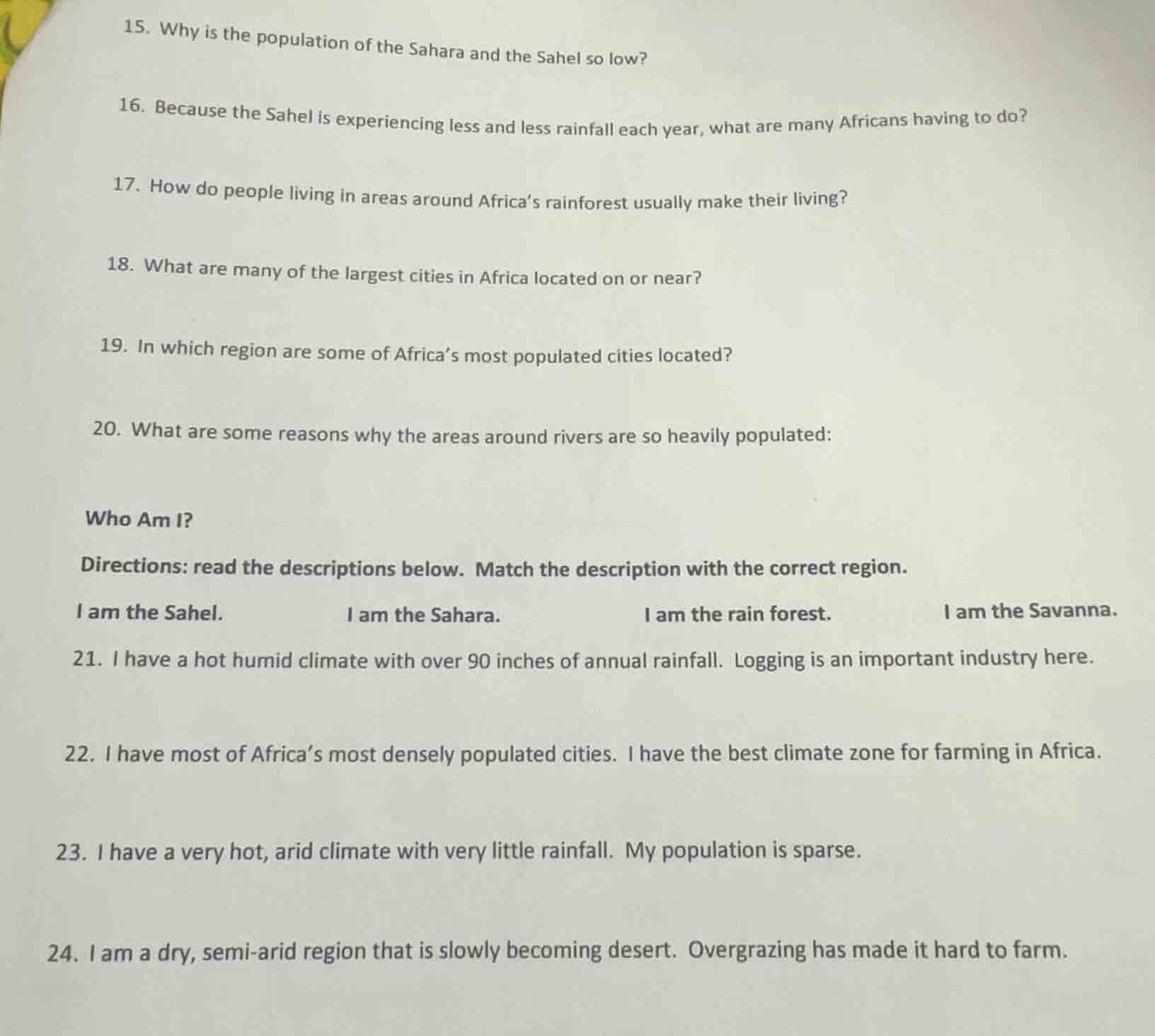
- why is the population of the sahara and the sahel so low?
- because the sahel is experiencing less and less rainfall each year, what are many africans having to do?
- how do people living in areas around africa’s rainforest usually make their living?
- what are many of the largest cities in africa located on or near?
- in which region are some of africa’s most populated cities located?
- what are some reasons why the areas around rivers are so heavily populated:
who am i?
directions: read the descriptions below. match the description with the correct region.
i am the sahel. i am the sahara. i am the rain forest. i am the savanna.
- i have a hot humid climate with over 90 inches of annual rainfall. logging is an important industry here.
- i have most of africa’s most densely populated cities. i have the best climate zone for farming in africa.
- i have a very hot, arid climate with very little rainfall. my population is sparse.
- i am a dry, semi - arid region that is slowly becoming desert. overgrazing has made it hard to farm.
Brief Explanations
- The Sahara is hyper-arid with extreme heat, scarce water, and poor soil, making farming and permanent settlement nearly impossible. The Sahel has semi-arid conditions, frequent droughts, and soil degradation that limits food production and habitation.
- Declining rainfall causes desertification, destroying farmland and pasture, so people must move to wetter or urban areas to find resources and work.
- The rainforest's rich ecosystem supports small-scale farming (like slash-and-burn), harvesting forest resources (timber, fruits, medicinal plants), and some hunting/gathering.
- Water access is critical for drinking, agriculture, and trade, so major cities cluster near these features.
- This region has fertile soil, moderate rainfall, and favorable temperatures for agriculture, supporting large populations and urban growth.
- Rivers provide reliable freshwater for drinking, irrigation for farming, transportation for trade, and fertile alluvial soil that boosts crop yields, all of which support dense settlement.
- The description matches the rainforest's high rainfall, humid conditions, and logging industry.
- The savanna has fertile land, moderate rainfall ideal for farming, and supports dense urban centers.
- This matches the Sahara's hot, dry climate and very low population density.
- The Sahel is a semi-arid transition zone facing desertification from overgrazing and drought.

Snap & solve any problem in the app
Get step-by-step solutions on Sovi AI
Photo-based solutions with guided steps
Explore more problems and detailed explanations
- The Sahara is extremely arid with scarce water, extreme temperatures, and infertile soil that cannot support large populations. The Sahel faces frequent droughts, desertification, and poor soil quality that limits food production and habitation.
- Many Africans are being forced to migrate to wetter regions or urban areas to find access to water, farmland, and employment.
- They usually make their living through small-scale subsistence farming (including slash-and-burn agriculture), logging, harvesting forest resources (like fruits, nuts, and medicinal plants), and some hunting and gathering.
- Many of the largest cities in Africa are located on or near rivers, lakes, or the coast.
- Some of Africa's most populated cities are located in the Savanna region.
- - Reliable access to freshwater for drinking, cooking, and livestock
- Fertile alluvial soil from river deposits, ideal for farming
- Easy transportation for trade and movement of goods/people
- Support for diverse economic activities like fishing and agriculture
- I am the rain forest.
- I am the Savanna.
- I am the Sahara.
- I am the Sahel.