QUESTION IMAGE
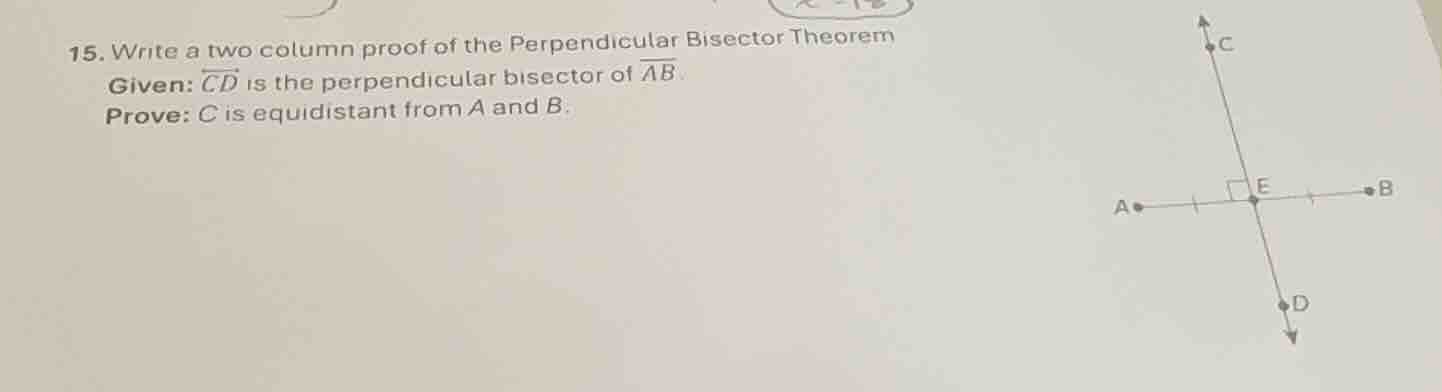
Question
- write a two column proof of the perpendicular bisector theorem
given: $overline{cd}$ is the perpendicular bisector of $overline{ab}$.
prove: c is equidistant from a and b.
Step1: State given info
$\overline{CD}$ is perpendicular bisector of $\overline{AB}$, so $\overline{AE} = \overline{EB}$, $\angle CEA = \angle CEB = 90^\circ$
Step2: Identify shared side
$\overline{CE} = \overline{CE}$ (Reflexive Property)
Step3: Apply SAS congruence
$\triangle CEA \cong \triangle CEB$ (SAS: $\overline{AE}=\overline{EB}$, $\angle CEA=\angle CEB$, $\overline{CE}=\overline{CE}$)
Step4: Corresponding parts are equal
$\overline{CA} = \overline{CB}$ (CPCTC: Corresponding Parts of Congruent Triangles are Congruent)

Snap & solve any problem in the app
Get step-by-step solutions on Sovi AI
Photo-based solutions with guided steps
Explore more problems and detailed explanations
Two-column proof:
| Statements | Reasons |
|---|---|
| 2. $\overline{AE} = \overline{EB}$, $\angle CEA = \angle CEB = 90^\circ$ | 2. Definition of perpendicular bisector |
| 3. $\overline{CE} = \overline{CE}$ | 3. Reflexive Property of Congruence |
| 4. $\triangle CEA \cong \triangle CEB$ | 4. SAS Congruence Postulate |
| 5. $\overline{CA} = \overline{CB}$ | 5. CPCTC |
| 6. $C$ is equidistant from $A$ and $B$ | 6. Definition of equidistant |