QUESTION IMAGE
Question
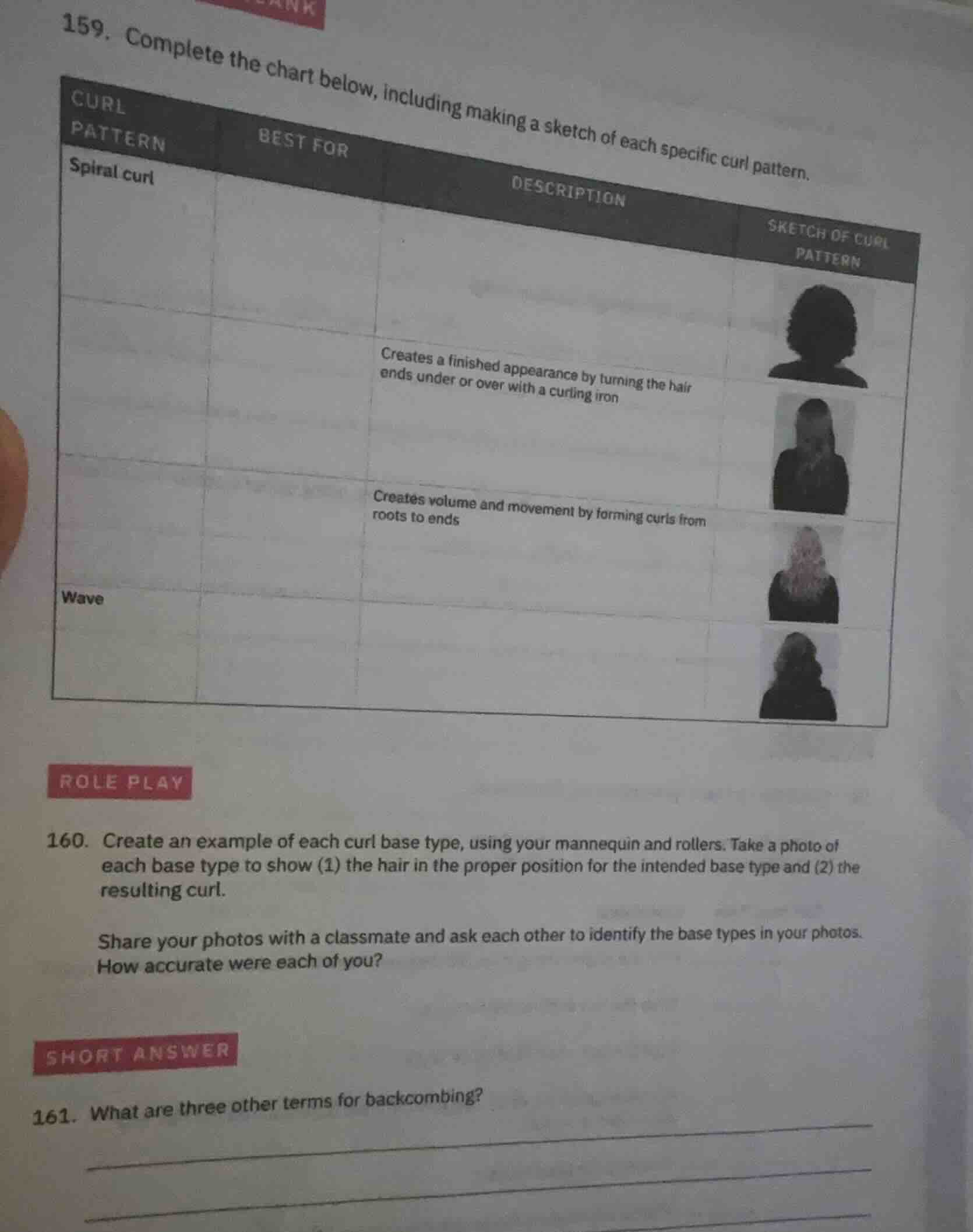
- complete the chart below, including making a sketch of each specific curl pattern.
curl pattern | best for | description | sketch of curl pattern
spiral curl | | |
| creates a finished appearance by turning the hair ends under or over with a curling iron | |
| creates volume and movement by forming curls from roots to ends |
wave | | |
role play
- create an example of each curl base type, using your mannequin and rollers. take a photo of each base type to show (1) the hair in the proper position for the intended base type and (2) the resulting curl.
share your photos with a classmate and ask each other to identify the base types in your photos. how accurate were each of you?
short answer
- what are three other terms for backcombing?
For question 161:
Backcombing is a hair - styling technique. Three other common terms for it are teasing, ratting, and matting. These terms are used interchangeably in the context of hair styling to refer to the process of combing hair against the direction of hair growth to create volume or texture.

Snap & solve any problem in the app
Get step-by-step solutions on Sovi AI
Photo-based solutions with guided steps
Explore more problems and detailed explanations
Three other terms for backcombing are teasing, ratting, and matting.
For question 159 (completing the chart for curl patterns):
Let's analyze each curl pattern:
Spiral curl:
- Best for: Long hair (as spiral curls look more elegant and defined on long hair, creating a flowing, curly effect).
- Description: Spiral curls are long, corkscrew - shaped curls. They are created by wrapping hair around a curling iron in a spiral manner, usually resulting in a more elongated and defined curl pattern compared to other curl types.
- Sketch: A sketch of a spiral curl would show long, continuous, corkscrew - like curls, often with a smooth and even curve from the root to the tip of the hair strand.
The curl pattern with the description "Creates a finished appearance by turning the hair ends under or over with a curling iron" (likely a "Wrap curl" or "End curl"):
- Best for: Medium - length hair (to give a polished look to the ends, suitable for a more formal or finished hairstyle on medium - length hair).
- Curl Pattern Name: Let's call it "Wrap curl" (or "End - turned curl").
- Sketch: A sketch would show hair with the ends turned under or over, creating a more subtle curl at the ends, with the rest of the hair relatively straight or with a slight bend, focusing on the end - turning effect.
The curl pattern with the description "Creates volume and movement by forming curls from roots to ends" (likely a "Full - head curl" or "Root - to - tip curl"):
- Best for: Hair that needs more volume, such as fine or thin hair (as it adds body from the roots, giving the appearance of thicker hair).
- Curl Pattern Name: Let's call it "Root - to - tip curl" (or "Full curl").
- Sketch: A sketch would show curls that start from the roots and go all the way to the ends, with a more voluminous and bouncy appearance, with multiple curls throughout the head.
Wave:
- Best for: Short to medium - length hair (waves can give a soft, beachy look to short or medium - length hair, adding texture without the intensity of full curls).
- Description: Waves are gentle, undulating bends in the hair. They are less defined than curls and create a more relaxed, wavy texture, often achieved with a curling iron with a larger barrel or by using a waving iron, or through braiding techniques for a more natural wave.
- Sketch: A sketch of a wave would show gentle, S - shaped or undulating curves in the hair, with a more relaxed and flowing appearance compared to curls.
For question 160 (creating curl base types):
- On - base curls:
- Proper position: The hair is wrapped around the roller or curling iron with the base of the hair (the part closest to the scalp) placed on the roller. This creates maximum volume at the root.
- Resulting curl: The resulting curl will have a lot of volume at the root, and the curl will be more lifted and bouncy near the scalp, with the curl pattern following the direction of the roller placement.
- Photo: When taking a photo, the first photo should show the hair section placed on the roller (with the base on the roller), and the second photo should show the resulting curl with a voluminous root area and a defined curl pattern.
- Off - base curls:
- Proper position: The hair is wrapped around the roller or curling iron with the base of the hair slightly away from the roller. This creates a more natural - looking curl with less volume at the root.
- Resulting curl: The resulting curl will have a more relaxed appearance at the root, with the curl pattern still defined but not as lifted as on - base curls.
- Photo: The first photo shows the hair section with the base away from the roller, and the second photo shows the resulting curl with a more natural - looking root area.
- Half - base curls:
- Proper position: The hair is wrapped around the roller or curling iron with the base of the hair partially on the roller. This creates a moderate amount of volume at the root, between the volume of on - base and off - base curls.
- Resulting curl: The resulting curl will have a moderate volume at the root, with a curl pattern that is a balance between the lifted look of on - base and the natural look of off - base curls.
- Photo: The first photo shows the hair section with the base partially on the roller, and the second photo shows the resulting curl with a moderate volume at the root.
When sharing photos with a classmate, you can identify the base types by looking at the root area of the curls. On - base curls will have the most volume at the root, off - base the least, and half - base a moderate amount. The accuracy of identification will depend on how well the base types were created and how distinct the differences in root volume and curl placement are.