QUESTION IMAGE
Question
16)
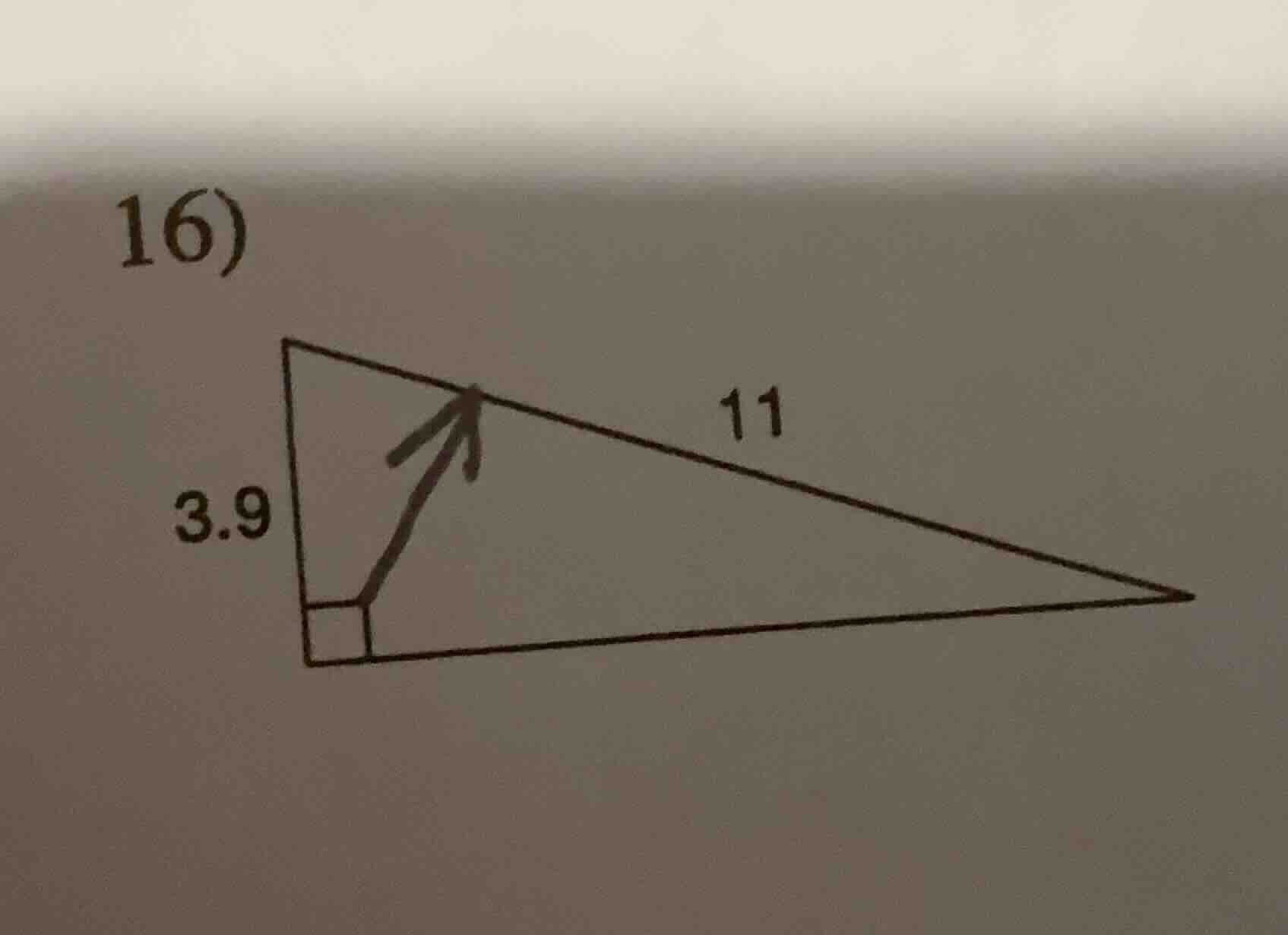
3.9
11
To solve for the length of the segment (let's assume it's the altitude to the hypotenuse in a right triangle), we can use the geometric mean theorem (or altitude-on-hypotenuse theorem) in a right triangle. However, first, let's confirm the triangle is right - angled (it has a right - angle symbol, so it is a right triangle with legs \(a = 3.9\) and hypotenuse \(c=11\), and we want to find the length of the altitude \(h\) to the hypotenuse.
Step 1: Recall the formula for the area of a right triangle
The area of a right triangle can be calculated in two ways:
- Method 1: Using the legs as the base and height. If the legs are \(a\) and \(b\) (in a right triangle, one leg can be considered as the base and the other as the height), the area \(A=\frac{1}{2}\times a\times b\). Here, we know one leg \(a = 3.9\), and let the other leg be \(b\). First, we can find the length of the other leg using the Pythagorean theorem \(a^{2}+b^{2}=c^{2}\), where \(c\) is the hypotenuse.
\(b=\sqrt{c^{2}-a^{2}}=\sqrt{11^{2}-3.9^{2}}=\sqrt{121 - 15.21}=\sqrt{105.79}\approx10.285\)
- Method 2: Using the hypotenuse and the altitude to the hypotenuse. The area \(A=\frac{1}{2}\times c\times h\), where \(h\) is the altitude to the hypotenuse.
Step 2: Equate the two expressions for the area
Since the area of the triangle is the same regardless of the method we use to calculate it:
\(\frac{1}{2}\times a\times b=\frac{1}{2}\times c\times h\)
We can also use the formula for the altitude to the hypotenuse in a right triangle: \(h=\frac{a\times b}{c}\)
We know \(a = 3.9\), \(b=\sqrt{11^{2}-3.9^{2}}\approx10.285\) and \(c = 11\)
\(h=\frac{3.9\times\sqrt{11^{2}-3.9^{2}}}{11}\)
First, calculate \(11^{2}-3.9^{2}=121 - 15.21 = 105.79\)
\(\sqrt{105.79}\approx10.285\)
Then \(3.9\times10.285 = 40.1115\)
\(h=\frac{40.1115}{11}\approx3.6465\)
Alternatively, if we assume that the segment is the length of the projection of the leg \(a = 3.9\) onto the hypotenuse, we can use the geometric mean formula. The length of the projection \(x\) of a leg \(a\) onto the hypotenuse \(c\) is given by \(x=\frac{a^{2}}{c}\)
\(x=\frac{3.9^{2}}{11}=\frac{15.21}{11}\approx1.3827\)
If we assume the problem is to find the length of the altitude to the hypotenuse:
The answer is approximately \(3.65\) (rounded to two decimal places)
If we assume the problem is to find the length of the projection of the leg with length \(3.9\) onto the hypotenuse:
The answer is approximately \(1.38\) (rounded to two decimal places)
Since the arrow is pointing to a segment inside the right triangle (probably the altitude or the projection), if we take the altitude:

Snap & solve any problem in the app
Get step-by-step solutions on Sovi AI
Photo-based solutions with guided steps
Explore more problems and detailed explanations
The length of the altitude to the hypotenuse is approximately \(\boldsymbol{3.65}\) (or if it's the projection, approximately \(\boldsymbol{1.38}\)). If we follow the area - based method for the altitude:
We can also use the formula \(h=\frac{a\times b}{c}\), and since \(a = 3.9\), \(b=\sqrt{11^{2}-3.9^{2}}\), \(c = 11\)
\(h=\frac{3.9\times\sqrt{121 - 15.21}}{11}=\frac{3.9\times\sqrt{105.79}}{11}\approx\frac{3.9\times10.285}{11}\approx\frac{40.1115}{11}\approx3.65\)
So the final answer (for the altitude) is \(\approx\boldsymbol{3.65}\)